 When, in April 1978, the Saur Revolution (also known as the April Revolution or April Coup) ended the rule of Mohammed Daoud Khan as President of Afghanistan, few expected that it would soon develop into a long-term armed conflict lasting until 1989.
In September 1979, tensions between the President Nur Mohammad Taraki and Hafizullah Amin – one of the leaders of the Saur Revolution and widely regarded as second-in-command – culminated in Taraki’s assassination. Amin assumed full control of the country, but this failed to stabilise the situation. On the contrary, his rule became a direct catalyst for Soviet military intervention.
After several months of preparation, the decision to intervene was made on 24 December 1979, and Soviet forces began their advance into Afghanistan. Simultaneously, a large-scale airborne operation was launched.
On 25 December 1979, at 15:00 Moscow time (18:00 local time), Il-76, An-12 and An-22 transport aircraft carrying airborne troops from the 103rd Guards Airborne Division and the 345th Independent Guards Airborne Regiment took off from airfields within the Turkestan Military District and headed for Afghanistan.
Soviet forces landed at the airfields in Kabul and Bagram. During the evening and night of 25 December, the Soviet Military Transport Aviation completed a total of 343 sorties, delivering 7,700 military personnel, 894 vehicles and 1,062 tonnes of cargo to Afghanistan.
Regrettably for the Soviet Air Force, 25 December also saw the first fatalities of the operation. At 19:35 local time, the Il-76M “86063” crashed into a mountain while approaching the Kabul Airport. The accident occurred during a heavy snowstorm and initially went unnoticed. It was only after all the aircraft departing from Mary Air Base had landed safely in Kabul that it was realised that one of the Ilyushin aircraft was missing.
The rescue mission dispatched the following morning encountered severe difficulties in reaching the crash site due to adverse weather conditions. The precise location of the wreckage was identified only on 30 December, from a Mi-8 helicopter, which reported that the aircraft had broken into two sections. The rescue team reached the nose section only on 1 January, but could not access the main wreckage, as it was located in a snow-covered, inaccessible area
The Il-76M “86063” had a crew of seven airmen and was carrying 37 airborne troops, two trucks and additional equipment. All the crew members and passengers on board were killed in the accident. Several bodies, including that of the aircraft commander, were recovered in 1980. The tail section of the aircraft was not reached until 2005.
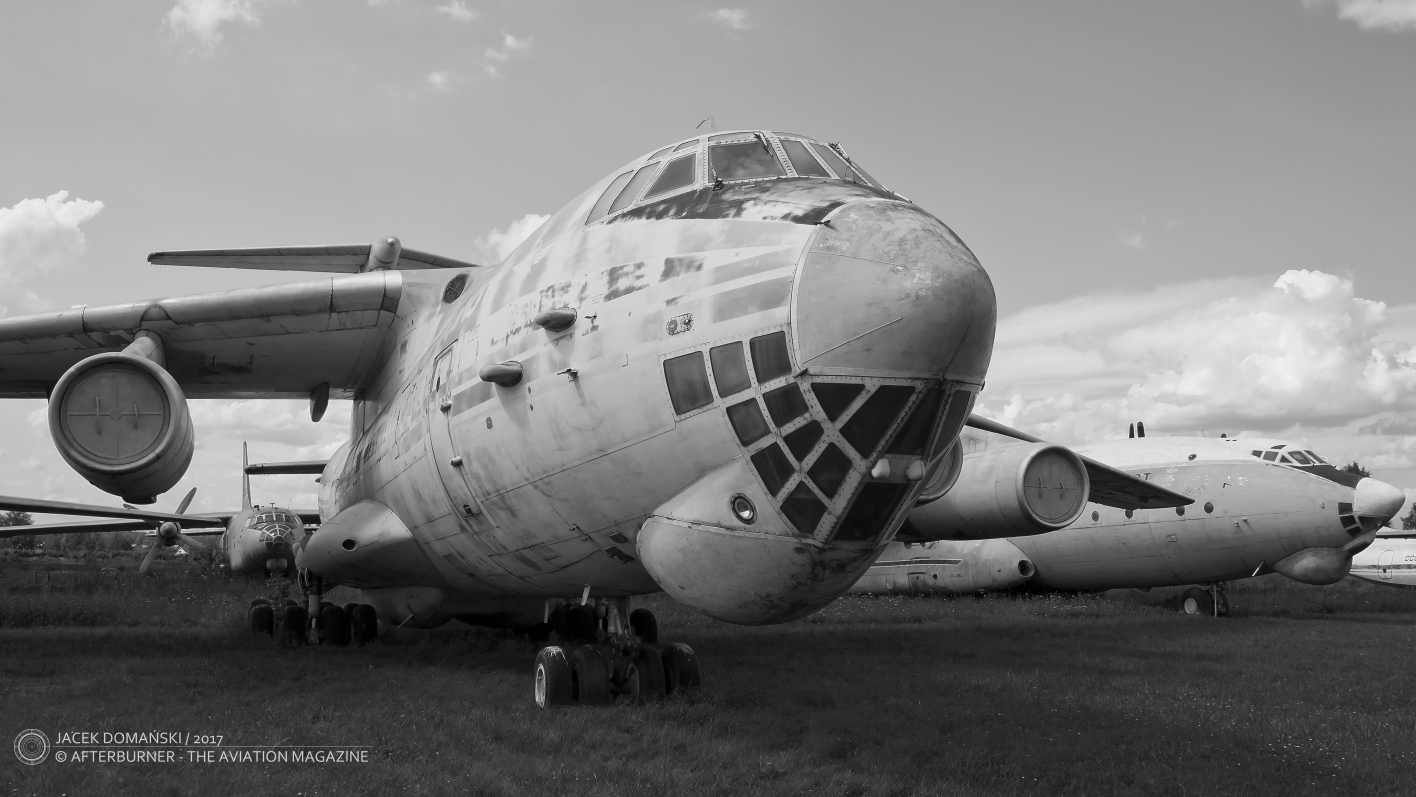
Cover photo: Ilyushin Il-76M exhibited at the Central Air Force Museum in Monino, 2017 (illustrative photo).