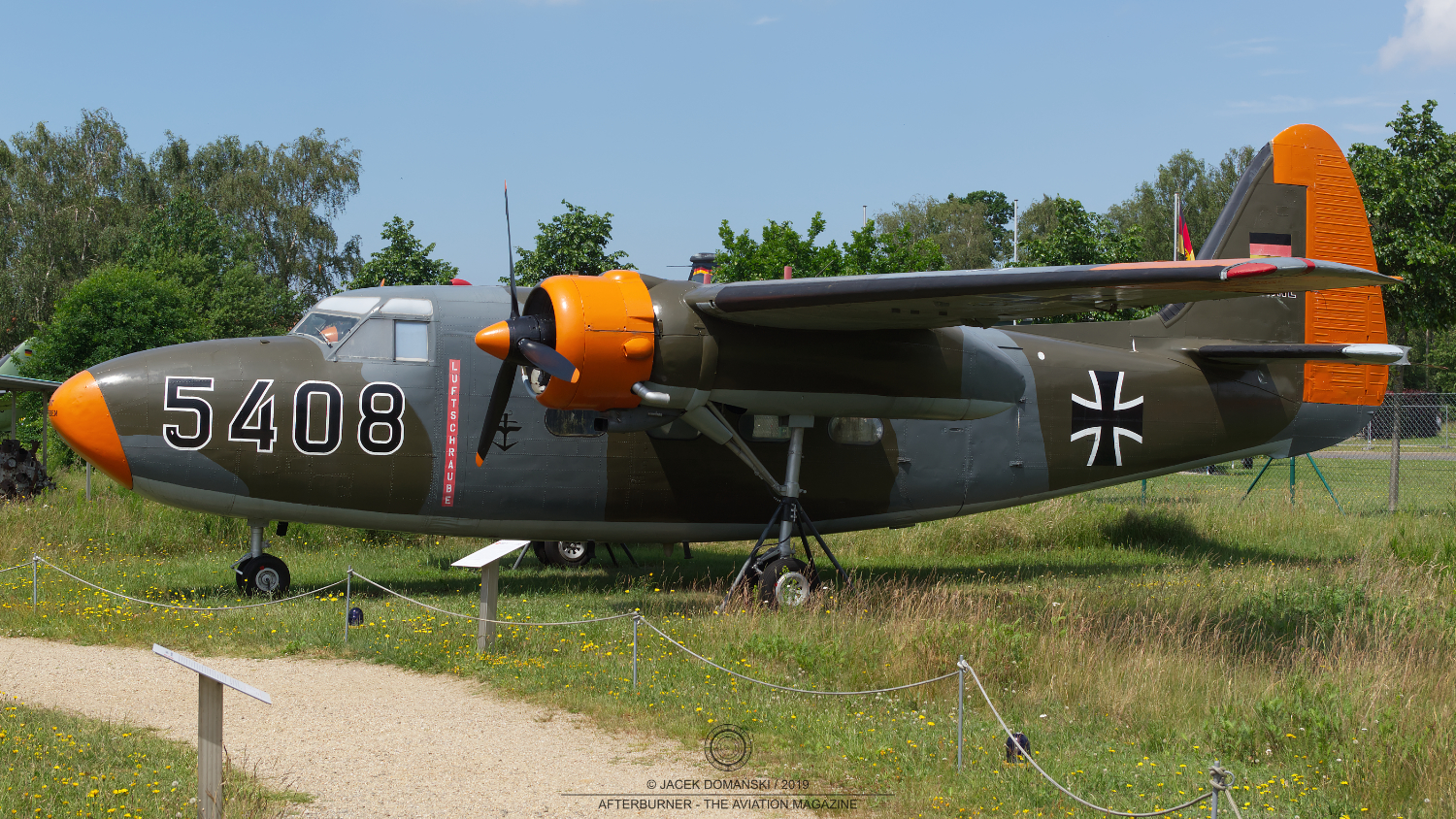
 Hunting (Percival) P.66 Pembroke C.54 (c/n 105, formerly “SE+515” and “5408” of the German Naval Aviation / Marineflieger), exhibited at the Aeronauticum aviation museum, Nordholz, June 2019.
The history of the Pembroke transport aircraft began in the mid-1940s, when Percival Aircraft Ltd. (part of the Hunting Group) developed a twin-engine, all-metal high-wing monoplane known as the Merganser.
The aircraft was built in only two prototype examples. One of these successfully performed its maiden flight on 9 May 1947. Subsequently used as a test aircraft, the Merganser never entered series production.
In 1948, the company introduced to the market a light transport aircraft derived from the Merganser and known as the Percival Prince. It was a high-wing monoplane of all-metal, stressed-skin construction and equipped with a retractable tricycle undercarriage. The Prince was powered by two 520–550 hp Alvis Leonides nine-cylinder radial engines.
The aircraft was officially designated the P.50 Prince and approved for military use. Shortly thereafter, two specialised variants were developed: the P.50 Sea Prince for the Royal Navy and the P.54 Survey Prince. The survey aircraft were fitted with a lengthened, transparent nose and camera hatches.
In addition, the aircraft was produced for the civilian market. A small number were used as executive transports, operated by international corporations and by the UK Ministry of Civil Aviation.
On 21 November 1952, the new, modernised Pembroke transport aircraft made its maiden flight. Developed from the Prince, it was designated the P.66 Pembroke. While retaining the general configuration of its predecessor, the Pembroke featured a longer wing and was powered by two Alvis Leonides 127 radial engines, each rated at 540 hp. The Pembroke was approximately 500 kg heavier than the Prince, offered increased payload capacity and had a significantly greater range.
In 1953, the aircraft entered service with the Royal Air Force as the Pembroke C.1, intended for transport duties. Soon afterwards, a reconnaissance variant, designated the Pembroke C(PR).1, was developed.
The reconnaissance Pembrokes were widely employed on sensitive intelligence-gathering missions over East Germany as part of Operation Hallmark. From 1956 onwards, the aircraft served with the 2nd Tactical Air Force Communications Squadron (later renumbered as No. 60 Squadron RAF) in West Germany. Officially, the Pembrokes flew transport missions to West Berlin along the Berlin Air Corridors; in reality, they conducted covert photographic reconnaissance and collected intelligence on Warsaw Pact military activities in East Germany. These missions continued until 1988, when the last Pembroke C(PR).1 was withdrawn from service.
In addition to British service, the Percival Pembroke was also operated by the armed forces of Belgium, Denmark, Finland, Germany, Sweden, Sudan and Zambia. Export variants of the aircraft were designated C.51 to C.55.
In 1954, Percival Aircraft Ltd. changed its name to Hunting Percival Aircraft. Three years later, the company was renamed once more, becoming Hunting Aircraft.
The Bundeswehr acquired its first Pembroke in June 1957. The aircraft, marked AS+551, was assigned to Technische Schule der Luftwaffe (the Luftwaffe Technical School) at Faßberg. In total, the German Armed Forces received thirty-three Pembrokes, of which twenty-three were allocated to the Luftwaffe, six to Marineflieger and four to Heer (Army).
The Hunting P.66 Pembroke featured in our Photo of the Week series was originally manufactured with the construction number 1000 and delivered as CA+021 to a training unit in Memmingen. Following an accident, the aircraft was rebuilt using parts from two other German Pembrokes (c/n 100 and 103). It was then assigned the new construction number 105 and transferred to Naval Aviation service as SE+515. In 1968, the aircraft received a new identification number, 5408.
Since 1994, the aircraft has formed part of the collection of Aeronauticum – Deutsches Luftschiff- und Marinefliegermuseum Nordholz, where it remains on display today.