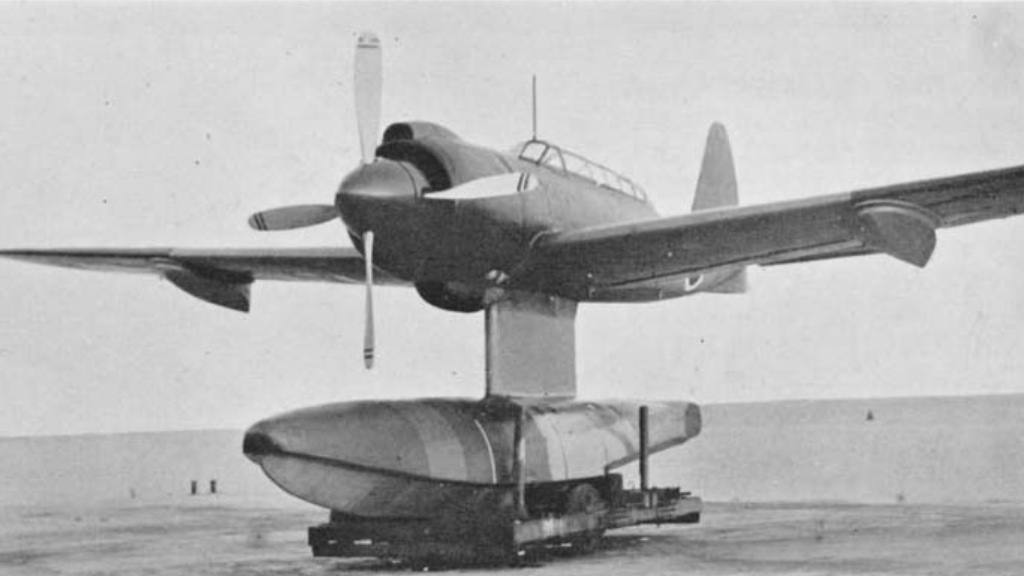
 On 5 December 1941, the prototype of the two-seat Japanese floatplane Kawanishi E15K Shiun (Allied reporting name: Norm) made its first flight.
In 1939, the Imperial Japanese Navy assigned the Kawanishi Aircraft Company the challenging task of developing a reconnaissance floatplane capable of operating in areas where air superiority belonged to the enemy.
Although complicated, the idea of creating a fast reconnaissance aircraft able to achieve a speed greater than that of potential enemy fighters was quite common in the 1930s and was evaluated, with varying degrees of success, by several air forces. Nevertheless, there was a catch in the task set for the Kawanishi team – the aircraft that was to be faster than land-based fighters had to be a seaplane, as it was intended for use by Imperial Navy cruisers.
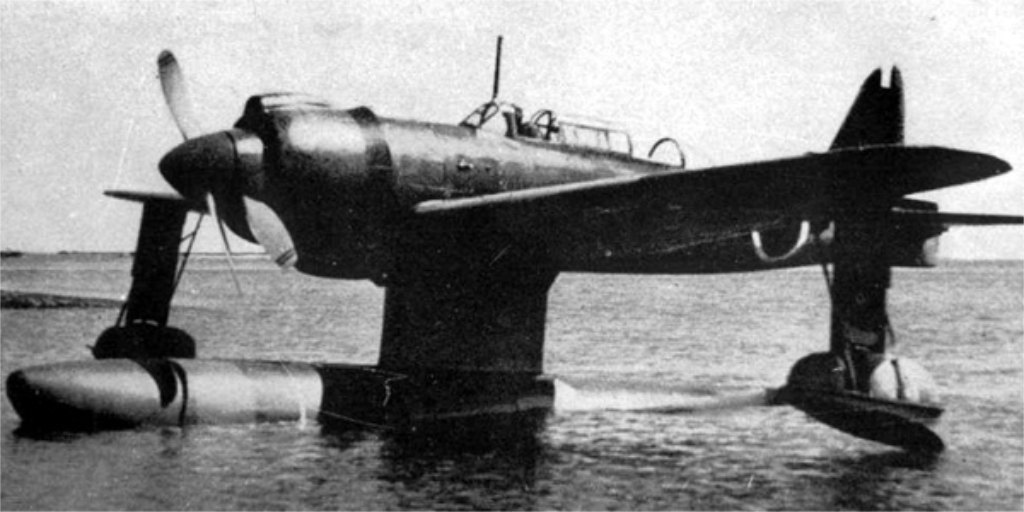
Responding to the Navy’s needs, the Kawanishi company created a single-engine, low-wing monoplane equipped with a single central float under the fuselage and two stabilising floats under the wings. An unusual solution was adopted for the propulsion system: the aircraft was fitted with a 1,460 hp Mitsubishi MK4D Kasei 14 fourteen-cylinder radial engine and two contra-rotating two-bladed propellers – the first implementation of this kind in Japan.
In addition, and to increase maximum speed, the aforementioned stabilising floats could be retracted during flight. Moreover, in case of emergency, the central float could be jettisoned to reduce drag and gain even more speed.
On 5 December 1941, the new aircraft, officially designated Kawanishi E15K1, performed its maiden flight. However, it soon became apparent that the advanced solutions used in the aeroplane were still rough-edged. In fact, they required years of refinement before they could deliver the expected results. One of the biggest issues was caused by malfunctions of the retractable stabilising floats. Eventually, it was decided to keep them fixed, and the resulting increase in drag was compensated for by fitting the E15K with an even more powerful engine, the 1,850 hp MK4S Kasei 24.
A total of six prototypes of the E15K were built and underwent intensive evaluation until 1943. In April of the following year, the first six series-produced aeroplanes entered service with the Imperial Japanese Navy. The floatplane was officially designated as the Navy Type 2 High-speed Reconnaissance Seaplane Shiun Model 11 and assigned to the 12th Reconnaissance Squadron.
However, delays in development meant that the E15K was already obsolete by the time it entered service. Equipped with the Kasei 24 engine, the aircraft could reach a maximum speed of 469 kph, which could be increased by a further 90 kph after jettisoning the central float.
In terms of the original design requirements, this performance was a notable achievement. What had seemed exceptional in 1939 was merely acceptable in 1941 and completely outdated by 1944. By that time, the maximum speeds of US fighter aircraft had significantly exceeded 600 kph.
It soon became clear that the E15K could be easily intercepted, even when the main float was jettisoned. Moreover, this emergency feature was far from reliable. Consequently, serial production of the aircraft was abandoned in the early 1944, after only eleven E15K aircraft had been produced.
An interesting fact is that Shiun, the Japanese official name of the aircraft, translates into English as “violet cloud”. This can refer either to a type of rock found in the Kitakami Mountains or to one of Buddha’s appearances.
Cover photo: Kawanishi E15K, Wikipedia, CC0 1.0