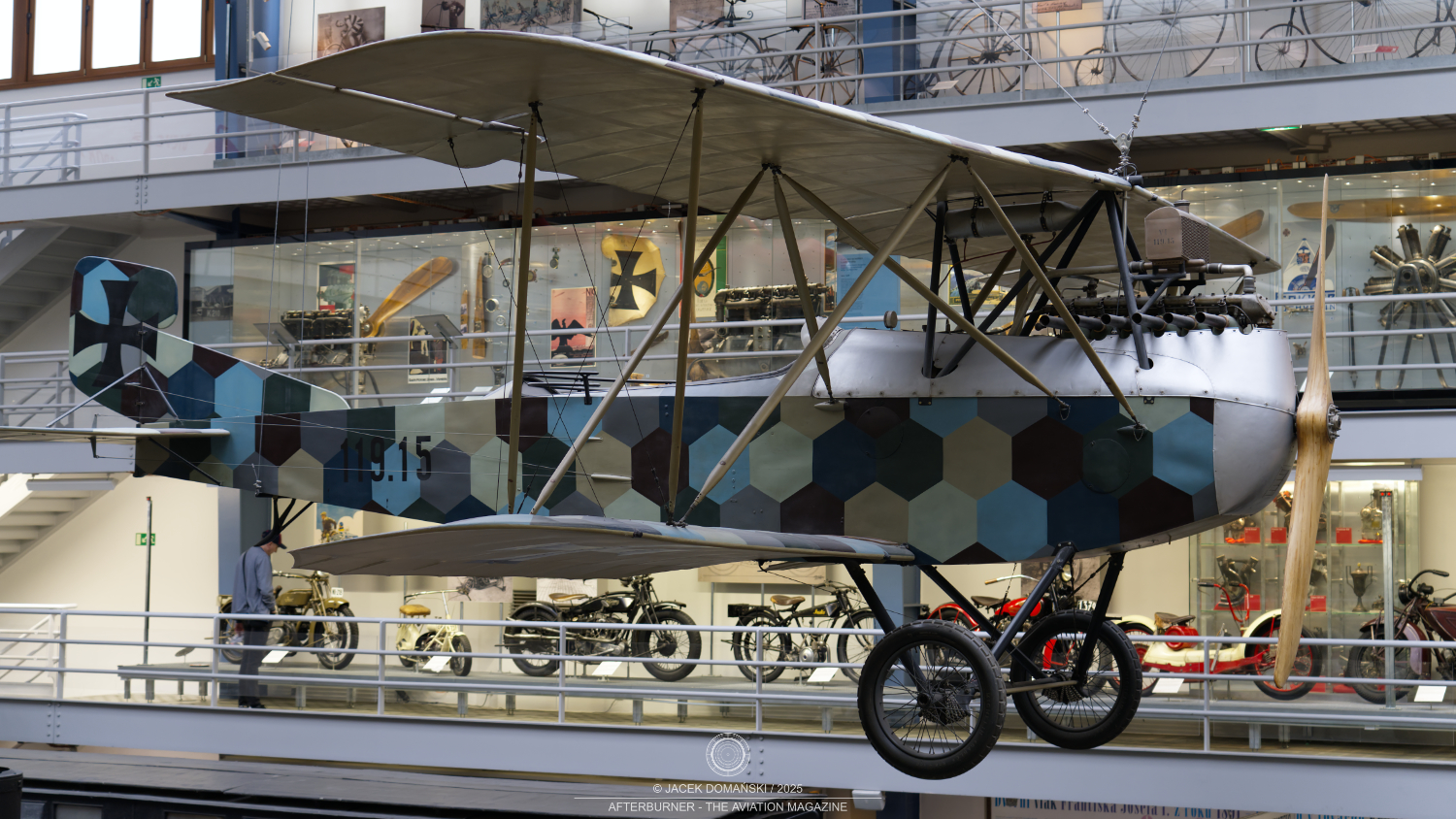
Knoller C.II (c/n 119.15, formerly in service with Kaiserliche und Königliche Luftfahrtruppen / the Austro-Hungarian Aviation Troops), on display at the National Technical Museum in Prague, April 2025.
The outbreak of the Great War led to the rapid development of military aviation. Within a short period, the relatively new invention of the heavier-than-air aircraft evolved from an awkward, fragile assembly of canvas and plywood into an effective, multi-role combat machine.
All countries involved in the Great War placed great emphasis on developing and manufacturing of new combat aircraft. Austro-Hungary was no exception to this rule; however, the country was not among the leading pioneers of the aviation industry and, to a large extent, had to depend on its German ally.
When the war began, Kaiserliche und Königliche Luftfahrtruppen had only thirty-nine aircraft in their inventory. This number was soon significantly increased through purchases in Germany and by launching licensed production within the country.
In the following years, Austro-Hungarian manufacturers entered the market. Although only a few domestically designed aircraft were approved for serial production, an impressive total of 125 aeroplanes was developed in the country.
The Austro-Hungarian authorities launched a programme to support the development of new aircraft. Commonly referred to as the “Knoller Programme”, the initiative was supervised by Richard Knoller, a professor at the Technical University of Vienna, widely regarded as an aviation expert and known for his theoretical studies on aeroplanes.
However, theory and practice do not always align. The Knoller Programme resulted in the development of three combat aircraft being designed by Knoller himself and designated the Knoller B.I, C.I, and C.II. All of them turned out to be a failure.
In January 1915, the Thöne & Fiala aviation workshop was tasked with building the prototype of the Knoller B.I biplane. This challenge proved to be too demanding for the small and inexperienced company. The B.I project was plagued by delays and was not completed until November of that year.
Moreover, the B.I was a disaster. The aeroplane suffered from numerous structural and aerodynamic shortcomings, and a further six months were spent trying to fix them without much success. Despite this, the Knoller B.I was approved for serial production, and forty-three examples were ordered. However, when the aircraft was delivered to Kaiserliche und Königliche Luftfahrtruppen in July 1916, it was deemed unsuitable for service by combat units.
Nevertheless, at the end of 1915 Richard Knoller had developed his second combat aircraft, the reconnaissance biplane known as the Knoller C.I. This time, work on the prototype was assigned to Phönix Flugzeug-Werke AG. However, development encountered serious technical difficulties once again and the aircraft was not completed until April 1916.
Like its predecessor, the C.I was nothing else than a complete failure. Still, it was approved for serial production, and seventy-two examples were ordered.
The C.I was so poorly received by frontline units that only about a dozen aircraft were completed and delivered. The remaining completed airframes were stored permanently in their wooden crates, without engines ever being installed, and faded into oblivion.
As the saying goes, “third time lucky”, and so Professor Knoller proceeded to develop his third combat aircraft. Like its predecessors, this was also a reconnaissance biplane, featuring a wooden structure covered with fabric and plywood, staggered wings, and an open cockpit with two seats arranged in tandem configuration. Designated the Knoller C.II, the aircraft was powered by a 185 hp Austro-Daimler six-cylinder in-line piston engine.
Needless to say, the C.II followed in the footsteps of its two predecessors. The aircraft was characterised by poor flying qualities, substandard build quality, and serious overall deficiencies. In spite of these shortcomings, as with the earlier designs, the Knoller C.II was approved for serial production, and 120 examples were ordered. It is probably not insignificant that the person responsible for assessing and approving Austro-Hungarian aircraft for service with Kaiserliche und Königliche Luftfahrtruppen was… Richard Knoller himself.
The first C.II was delivered to a combat unit in September 1916. Shortly afterwards, one of the aircraft broke up in mid-air, killing its crew.
As in previous cases, the C.II was rated very poorly by operational crews. Within a short time, the aeroplane became commonly known as “the aircraft that should never be allowed to take off”. Nevertheless, production of the Knoller C.II continued and, most likely, all the ordered aircraft were built. Most of them ended their brief “combat service” in wooden crates, never being unpacked after delivery.
Only in early 1917 did the Austro-Hungarian parliament address the issue of the Knoller aircraft. Shortly thereafter, the programme was cancelled. By that time, approximately 180 aircraft designed by Knoller had been produced and purchased by the Austro-Hungarian military. This represented not only a considerable waste of resources, but the Knoller Programme also had a negative impact on the country’s military aviation and combat capability, as it significantly delayed the introduction of modern aircraft into service.
The Knoller C.II on display at the National Technical Museum in Prague is the sole surviving example of this type of aircraft.
Sources:
Reinhard Desoye: Die k. u. k. Luftfahrtruppe. Die Entstehung, der Aufbau und die Organisation der österreichisch-ungarischen Heeresluftwaffe 1912–1918, Wien 1999
Grosz /Haddow/ Schiemer: Austro-Hungarian Army Aircraft of World War One, Boulder 2002