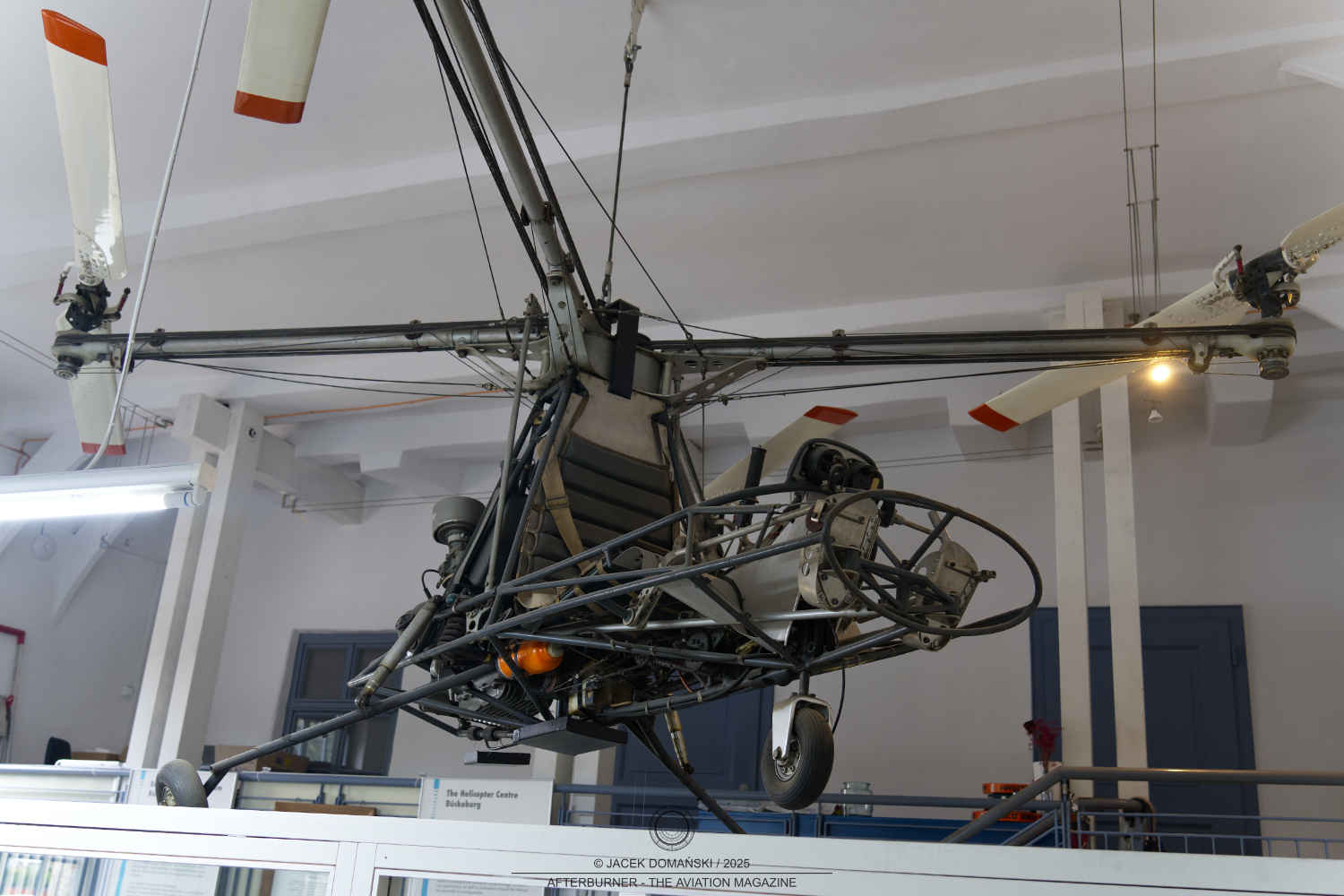
 The Aerotechnik WGM.21 prototype, exhibited at Hubschraubermuseum Bückeburg (Bückeburg Helicopter Museum), June 2025.
In the 1960s, the German company Aerotechnik Entwicklung und Apparatebau GmbH (Aerotechnik Development and Equipment Manufacturing Ltd.), based in Frankfurt am Main, began the development of a simple rotorcraft designed to be easy to fly and store.
The aircraft, designed by Wolfgang Müller, was first disclosed to the public in 1968 (or in 1969, according to some sources). Powered by a single 54 hp BMW automotive engine, it featured a single-seat, open-structure fuselage made of steel tubing and a fixed tricycle undercarriage.
The rotorcraft had an unusual configuration of four rotors, each fitted with a two-bladed propeller. This made the WGM.21 one of the world’s earliest quadrotor aircraft. Notably, the rotor support arms were arranged in an X-shaped layout, allowing them to be easily folded for transport and storage.
The quadrotor configuration was chosen to make the aircraft as easy to operate as possible. It did not require any tail rotor nor tail control surfaces, and the cockpit controls were reduced to a single control yoke and two pedals. In May 1968, the WGM.21 was approved for flight testing and successfully completed its maiden flight the following year.
According to Air Progress magazine, published in December 1971, the WGM.21 had a maximum speed of 125 km/h, a cruising speed of 115 km/h and a service ceiling of 2,100 metres. The empty weight of the rotorcraft was only 90 kg.
Initially, the WGM.21 was intended solely as a test-bed aircraft to demonstrate the efficiency of the quadrotor configuration. Around the same time, Aerotechnik presented a model of a more advanced, two-seat rotorcraft with an enclosed cockpit, designated the WGM.22. However, available sources provide conflicting information regarding the year in which the WGM.22 was introduced, with dates ranging from 1968 to the mid-1970s.
As Aerotechnik was primarily an experimental aviation workshop, the company lacked the capacity to begin serial production of the quadrotor. Efforts to find a business partner proved unsuccessful, as no potential customer, including the military, expressed interest in the project.
The development of the WGM.21 and WGM.22 was ultimately terminated in mid-1975. The sole prototype of the German quadrotor was transferred to the Bückeburg Helicopter Museum, where it remains on display today.
Although the WGM.21 represented a highly innovative and forward-looking rotorcraft design, the early quadrotor ultimately became just another example of an intriguing aircraft concept that never progressed beyond the prototype stage.