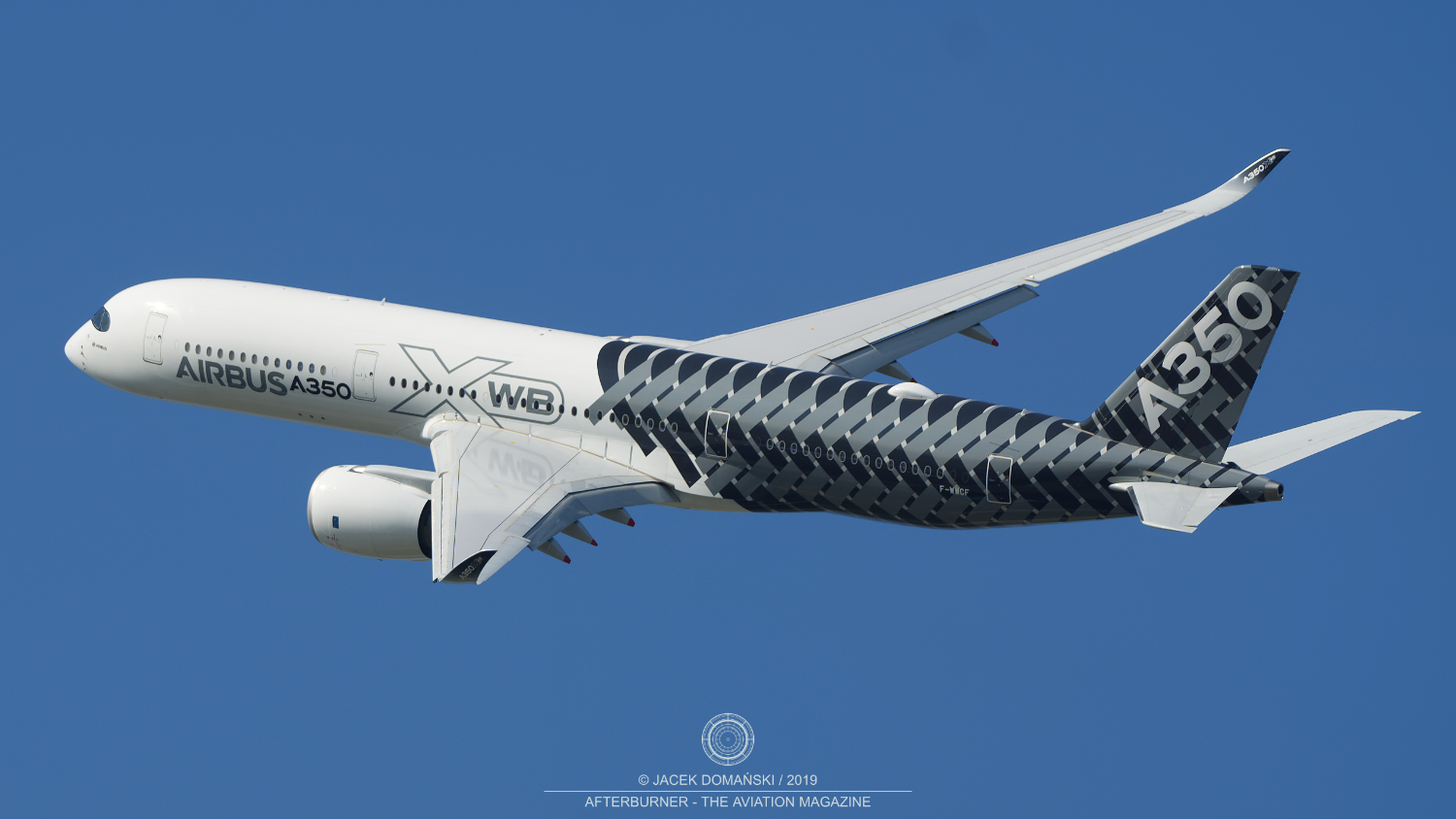
 Airbus A350-941 XWB (c/n 002, F-WWCF), flying display at the XIV International Aviation and Space Salon MAKS-2019, Zhukovsky, August 2019.
The Airbus A350 airliner was developed in the late 2000s as the company’s answer to the Boeing 787 Dreamliner.
Initially, the European aviation manufacturer had no intention of responding to the introduction of the Dreamliner to the market. However, the success of Boeing’s new design began to pose a threat to the A330 series. Therefore, Airbus was compelled to start developing a direct competitor.
The first idea was to modernise the A330 by reducing its weight, improving aerodynamics, and using modern engines. This new concept, known as the A330 Lite, was due to be showcased in 2004 during the Farnborough International Airshow. However, the project was abandoned yet before the show.
Instead, at the end of that year, the company announced that it had launched a completely new development, designated the A350. The new aeroplane was initially scheduled to enter the market in 2010 and was intended to be a 250–300-seat airliner based on the A330, but with improved fuel efficiency and greater range. Airbus expected the A350 to capture about fifty per cent of the market, with more than 3,000 aircraft estimated to be ordered by airline operators.
Nevertheless, those plans were quickly revised. Leading airlines saw no advantage in ordering what was essentially an upgraded A330, and the scope of modernisation seemed economically inefficient. Ultimately, the A350 design was criticised by the two largest aircraft lessors on the market, finally leading Airbus to reconsider the concept once again.
Eventually, during the 2006 Farnborough International Airshow, the company announced a new clean-sheet development of its competitor to the 787 – the A350 XWB (Xtra Wide Body).
The new airliner was designed to accommodate up to 475 passengers, with a maximum of ten seats per row. The A350 also featured a redesigned composite fuselage, a new Rolls-Royce Trent XWB powerplant developed specifically for the type, and a completely new flight management system.
The first batch of twenty A350 XWB aircraft was ordered by Singapore Airlines. Interestingly, that order was placed during the aforementioned 2006 Farnborough International Airshow.
Production of the A350 required a huge investment in new manufacturing facilities. According to Flight International magazine (2009), Airbus built ten new production plants and expanded a further three of its existing factories. Manufacturing of the first A350 fuselage began in December 2009. The first prototype was completed three years later.
On 14 June 2013, the A350 successfully performed its maiden flight. In September of the following year, the aircraft received type certification.
In December 2014, the first A350 was delivered to its launch customer, Qatar Airways. The first commercial flight took place on 15 January the following year, between Doha and Frankfurt.
Within a short time, the airliner gained popularity on the market. To date, more than 700 examples of the A350 have been delivered to customers worldwide, while more than 800 aircraft remain on order.
At present, the largest operator of the A350 family is Singapore Airlines, with sixty-five aeroplanes in service. However, Turkish Airlines is the carrier that has so far placed the largest order, totalling 110 aircraft of this type.
Currently, the A350 family consists of three main variants: the A350-800, the A350-900, and the A350-1000. It also includes the ACJ350 corporate jet, the A350-900/1000ULR (ultra-long-range) variants, and the A350F freighter.
The A350-900 featured in our Photo of the Week series was manufactured in early 2014 as the second example of the type. The airliner was then used by Airbus as an A350 testbed and technology demonstrator. Shortly after being produced, it underwent, for example, a series of climatic and humidity tests in extremely hot and cold weather conditions.
In 2019, the aircraft took part in the XIV International Aviation and Space Salon MAKS-2019 at Zhukovsky, in Russia. Back in 2007, the Russian national carrier Aeroflot ordered sixteen examples of the A350-900, which were expected to enter operational service in 2020.
On 6 March 2020, the first A350 in Russian service performed its maiden commercial flight. However, after the delivery of the seventh aircraft, cooperation was halted due to sanctions imposed as a result of the 2022 invasion of Ukraine.
The A350-900 F-WWCF is still used by Airbus as a technology demonstrator. In February 2026, the aeroplane took to the skies again after eight months of maintenance work. The airliner is still featuring its eye-catching “carbon livery”, which emphasises its carbon-fibre structure.