 Traian Vuia was a Romanian inventor and aviation pioneer. In 1903, he developed the “aeroplane-car”, a flying machine concept that he presented to the French Academy of Sciences.
Vuia was born on 17 August 1872 in Surducu Mic, a village in the Bujor commune of the Austro-Hungarian Empire (now Romania). From an early age, he expressed a strong interest in mechanics and engineering. His fascination with aviation began at the age of ten, after attending an aviation show, which inspired him to study kites and later the principles of aerodynamics and flight.
In 1892, Vuia started studying mechanical engineering at the Polytechnic University of Budapest. However, due to financial difficulties, he abandoned the course after one year and turned to law, which allowed him to work and support himself. In 1901, he completed his studies and earned a PhD in law.
After returning to Romania, Vuia settled in Lugoj, where he continued his research into heavier-than-air flight and developed his first aircraft concept, known as aeroplan-automobil (“aeroplane-car”). Lacking financial backing, he was unable to build a prototype and moved to Paris in July 1902 in search of support. Nonetheless, both the French aviation community and the Académie des Sciences rejected his ideas, declaring heavier-than-air flight impossible.
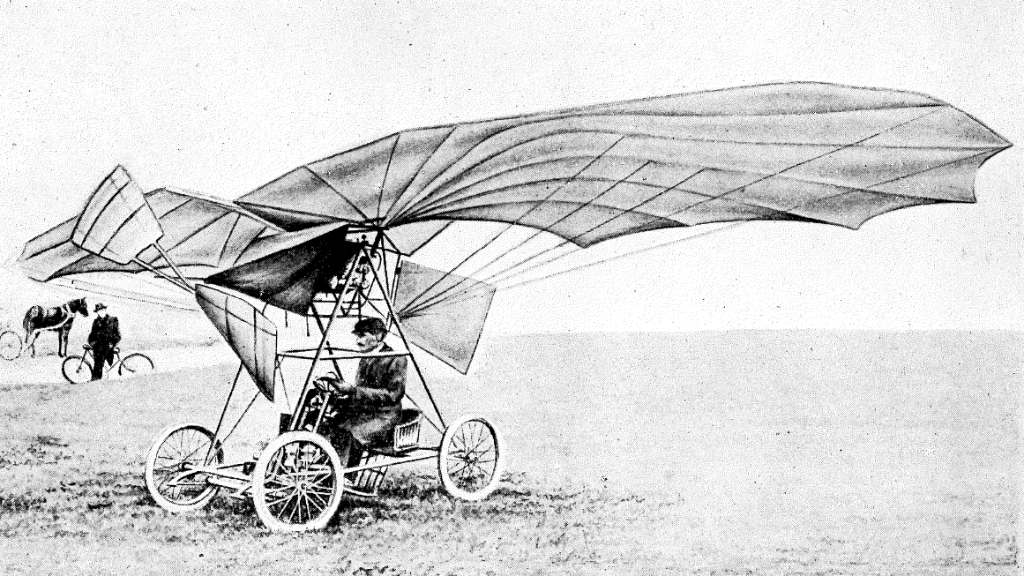
Despite this, Vuia persisted. By the end of 1905, he had completed his first aircraft, officially designated the Vuia I but commonly nicknamed the Bat because of its wing shape. Powered by a 20 hp engine designed by Vuia himself and fuelled by carbonic acid gas, the aircraft weighed approximately 250 kg and had a wing area of about 14 m². However, its engine could only operate for around five minutes.
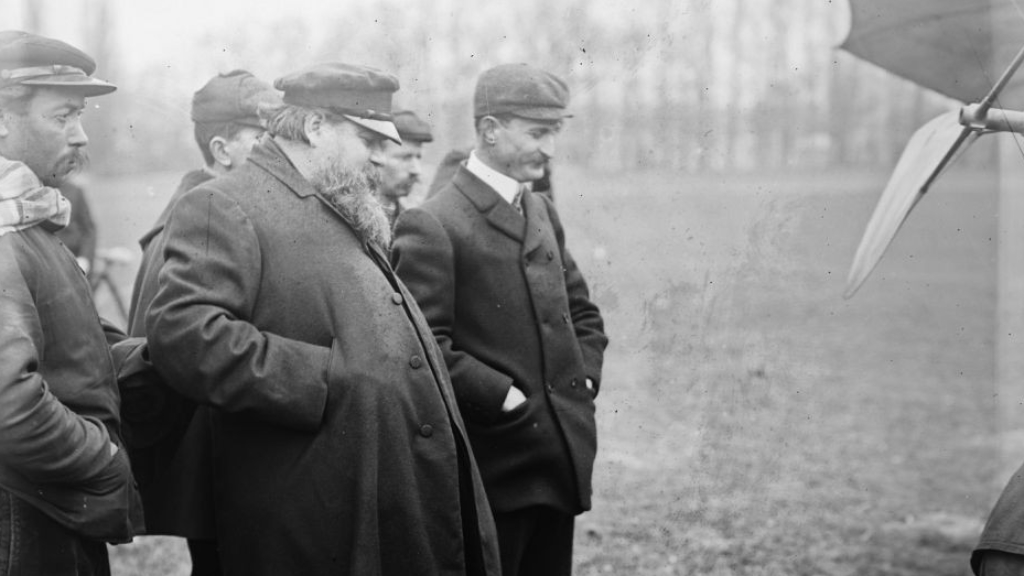
The Vuia I made its first flight on 18 March 1906 at Montesson, near Paris. After a ground run of roughly fifty metres, the aircraft lifted-off to a height of one metre and flew a distance of twelve metres before running out of fuel and landing safely.
Initially, the flight attracted little attention. However, following its official recognition in August 1906, Vuia gave a public demonstration in October. His achievement was widely reported and recognised as the first successful take-off of a heavier-than-air aircraft from a flat surface without external assistance. By contrast, the Wright brothers’ Flyer, although flown earlier, required a launch rail.
In 1907, Vuia built a second aircraft, the Vuia II, powered by a 25 hp Antoinette engine. Although lighter and smaller, it achieved only a short hop of about twenty metres before sustaining damage on landing.
Vuia’s later aviation work included experimental rotorcraft, which made brief take-offs in 1920 and 1922. Ultimately, he abandoned helicopter development to focus on theoretical research, concluded in his publication Études expérimentales sur les plans inclinés en rotation (“Experimental Studies on Inclined Rotating Aeroplanes”), issued in 1929. During the 1930s, he worked on a catalytic combustion generator for aircraft propulsion, a project halted by the outbreak of the Second World War.
After the war, Traian Vuia returned to Romania, where he died on 3 September 1950 at the age of 78.
Full story here.
Cover photo: The Vuia I aircraft (Wikipedia, Public Domain)