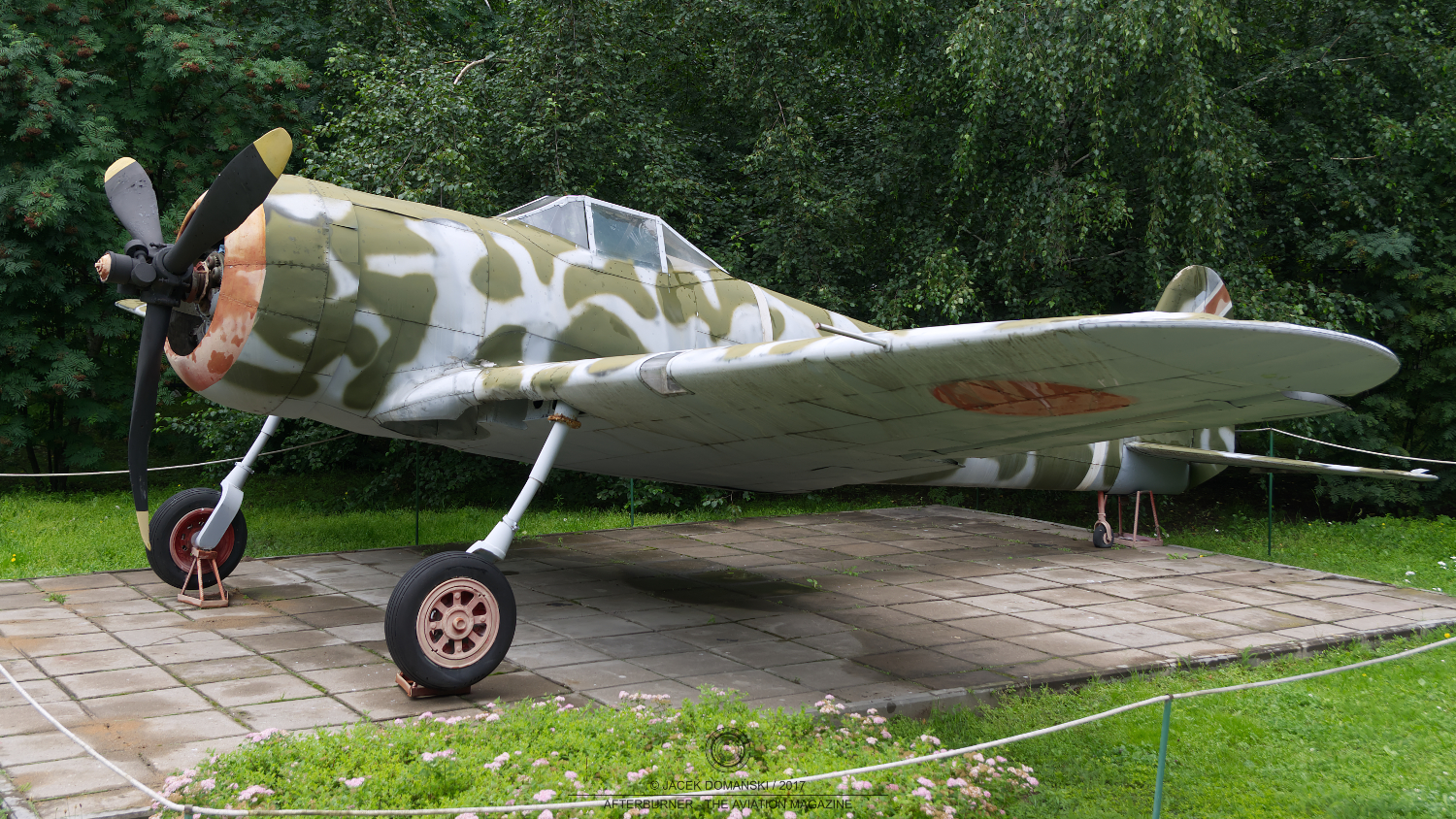
 Nakajima Ki-43-II Hayabusa (c/n unknown; a replica built using original parts from an unknown number of wrecks), on display at Парк Победы (Victory Park) WWII memorial in Moscow, July 2017.
The Ki-43 fighter aircraft was developed in the late 1930s in response to the Imperial Japanese Army Air Service requirement for a successor to the Nakajima Ki-27 (Type 97; Allied reporting name “Nate”). Intended for use as both an interceptor and an escort fighter, the new aeroplane had to be faster and offer greater range, while retaining the Ki-27’s climb rate and manoeuvrability.
The new Nakajima fighter was designed by Hideo Itokawa, a young aeronautical engineer who would later become known as “Dr Rocket” and the father of Japanese space development. The prototype performed its maiden flight in January 1939, but proved to be a complete disappointment, as it failed to meet any of the specified requirements.
It took almost a year to redevelop the aircraft and only the thirteenth design iteration was finally approved for serial production. The new army fighter received the designation Nakajima Ki-43 Hayabusa (“peregrine falcon”) or, formally, the Army Type 1 Fighter.
Interestingly, although the Ki-43 received the official Allied reporting name “Oscar”, the aircraft was often nicknamed the “Army Zero”. This was because both the Ki-43 and the Mitsubishi A6M “Zero” (Allied reporting name “Zeke”) were powered by the Nakajima Sakae radial engine. Due to the shared type of powerplant, the two aeroplanes had a broadly similar general layout, although the Ki-43 featured more aerodynamically refined lines.
The first production version of the Hayabusa, the Ki-43-I, entered service in February 1941. The fighter soon became renowned for its outstanding manoeuvrability and climb rate. However, the initial variant was characterised by limited combat effectiveness, primarily due to its weak armament of only two 7.7 mm synchronised machine guns.
In February 1942, the second variant was introduced under the designation Ki-43-II. This version featured a three-bladed propeller, a new enlarged canopy, additional armour protection for the pilot, and rubber-coated fuel tanks. The armament was upgraded to two more powerful 12.7 mm Ho-103 machine guns. Later modifications included drop-tank racks and the ability to carry up to 500 kg of bombs. Serial production of the Ki-43-II commenced in November of that year.
In April 1944, a more powerful variant, the Ki-43-III powered by the Nakajima Ha-115-II engine, was introduced.
The Ki-43 was widely used by the Imperial Japanese Army Air Service until the end of the war. The aircraft saw combat in China, Burma, the Dutch East Indies, the Philippines, over the Pacific islands, and in the defence of the Japanese home islands.
Like other Japanese fighter designs of the period, the Ki-43 proved superior to early Allied aircraft during the initial phase of the war. However, with the arrival of a new generation of Allied fighters, it quickly lost most of its advantages, apart from its exceptional manoeuvrability.
After the war, some abandoned Hayabusa aircraft were reportedly used by the French Air Force in Indochina and by the newly established Indonesian Air Force.
The Ki-43 was manufactured by two aviation companies: Nakajima and Tachikawa. Serial production continued until August 1945, with nearly 6,000 aircraft built in total.
The Ki-43 featured in our Photo of the Week series was assembled using original parts that were recovered from Shumshu Island – within a project launched in Russia in the early 2010s with the aim of recovering wrecked Japanese equipment from the Kuril Islands.
As in the case of the Kawasaki Ki-48, the Ki-43 replica on display at Victory Park is far from perfect. It offers only a rough representation of the aircraft and its silhouette due to the absence of several important components, such as the undercarriage and canopy. Nevertheless, it is the only Hayabusa currently on display in Europe. All other surviving original examples are exhibited in Australia, Japan, and the United States.