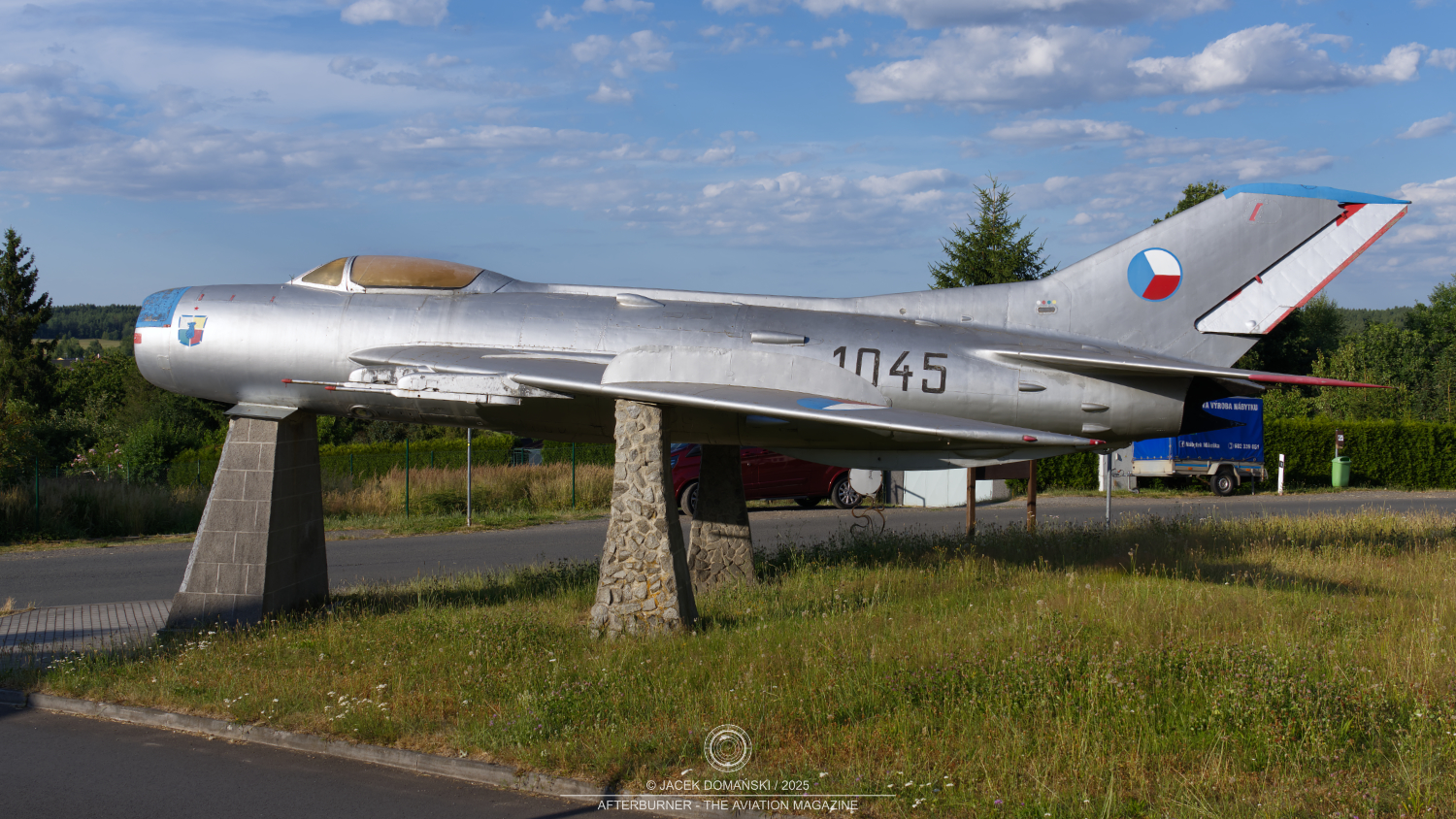
 Mikoyan-Gurevich MiG-19PM (c/n 651045, formerly “1045” of Československé letectvo / the Czechoslovak Air Force), on display at an intersection in Líně, near the Plzeň-Líně airfield, July 2025
At the beginning of the 1950s, the Soviet aviation industry began developing the country’s first supersonic fighter aircraft. The new aeroplane was intended to replace MiG-15 and MiG-17, two successful jets designed by the Mikoyan-Gurevich design bureau, officially known as Опытно-конструкторское бюро ОКБ-155 (the Experimental Design Bureau OKB-155).
The first testbed aircraft, designated СМ-1 (SM-1) or I-320, was built in April 1950. It was based on the MiG-17 (or the MiG-15bis, according to some sources) and equipped with two Mikulin AM-5 turbojet engines – a scaled-down version of the powerplant used in the Tupolev Tu-16 bomber.
The new engines significantly altered the flight characteristics of the aircraft under evaluation. Even without afterburners, the two AM-5 powerplants generated more thrust than the original Klimov VK-1 engine with an afterburner. In addition, they were approximately 90 kg heavier than the VK-1, but smaller in size, which allowed the installation of additional fuel tanks. Shortly afterwards, the SM-1 was fitted with an improved variant of the Mikulin engines, known as the AM-5A.
In August 1950, work began on the second version of the aircraft, designated СМ-2 (SM-2) or I-360, which soon became the basis for the future supersonic escort fighter. The first prototype, the SM-2/1, successfully performed its maiden flight on 24 May 1952.
The new aeroplane was 1.6 metres longer and more than 1.5 tonnes heavier than the SM-1. The prototype featured a new swept wing with a 55° angle and a T-tail configuration, as well as was powered by two AM-5A engines without afterburners.
It was soon discovered that the SM-2 was unable to exceed the speed of sound in level flight. Therefore, the aircraft was equipped with an upgraded variant of the Mikulin engines, known as the AM-5F, generating 21.08 kN of thrust dry and 26.48 kN with afterburner. With the new engines, the prototype reached a speed of Mach 1.19.
A series of evaluation flights exposed several shortcomings in the new design. Consequently, the prototype underwent significant redevelopment. Subsequent versions of the SM-2 received a new conventional tail configuration, the shape of the air intake was modified, and the fighter was equipped with a new radio suite and upgraded onboard cannons. However, the most significant change concerned the engines, which were upgraded again. The redeveloped prototype was fitted with two AM-9B powerplants (later known as the Tumansky RD-9), generating 25.50 kN of thrust dry and 31.87 kN with afterburner.
The final prototype of the new Soviet supersonic fighter, known as the SM-9/1, performed its first flight on 5 January 1954. In a very short time, on 17 February 1954, the MiG-19 (NATO reporting name: Farmer) was officially approved for serial production, even before completing the factory test flights, which were concluded only in September that year.
The first examples of the new fighter were delivered to combat units in June 1955. On 3 July of that year, the MiG-19 was displayed to the public for the first time, when a formation of forty-eight aircraft participated in an air show at Tushino airfield in Moscow.
The MiG-19 remained in serial production until 1968, with approximately 2,200 aircraft built in total. For a considerable period, the fighter served as a primary aircraft of the Soviet Air Defence Forces. The aeroplane underwent continuous development, and more than ten modernised variants were later introduced into operational service.
In addition to Soviet service, the MiG-19 was acquired by more than a dozen air forces worldwide, including Albania, Cuba, Czechoslovakia, Egypt, Hungary, Pakistan, and Poland.
Consequently, the MiG-19 has a long record of air-to-air encounters with NATO aircraft along the borders of the Soviet Union and Warsaw Pact countries. Notable engagements include the interception of F-84F Thunderstreak and F-100 Super Sabre aircraft over what was then Czechoslovakia, and the downing of an RB-47H Stratojet over the Barents Sea, as well as RB-66C Destroyer and T-39 Sabreliner aircraft over the then East Germany.
Another important task assigned to the MiG-19 within the Warsaw Pact forces was to intercept and destroy Western reconnaissance balloons.
The MiG-19 was also built under licence in Czechoslovakia (as the S-105, with 104 examples produced) and in China (as the Shenyang J-6, with more than 4,500 aircraft built). Chinese-produced aircraft were also exported to more than a dozen countries, including North Korea, Somalia, Vietnam, and Zambia.
The Czechoslovak Air Force received its first MiG-19 aircraft in January 1958. In total, the country’s armed forces acquired 183 examples of the fighter in S, P, and PM versions (including the aforementioned S-105s). The MiG-19 was operated by Czechoslovak fighter squadrons based in Brno, Bechyně, České Budějovice, Ostrava, Pardubice, Piešťany, Plzeň, and Žatec. The aircraft remained in active service until the early 1970s.
The aircraft featured in our Photo of the Week series commemorates the MiG-19’s service with 5. stíhací letecký pluk (the 5th Fighter Aviation Regiment) at the Plzeň-Líně airfield, as well as the history of this fighter unit which was established in 1945 and disbanded in 1991.