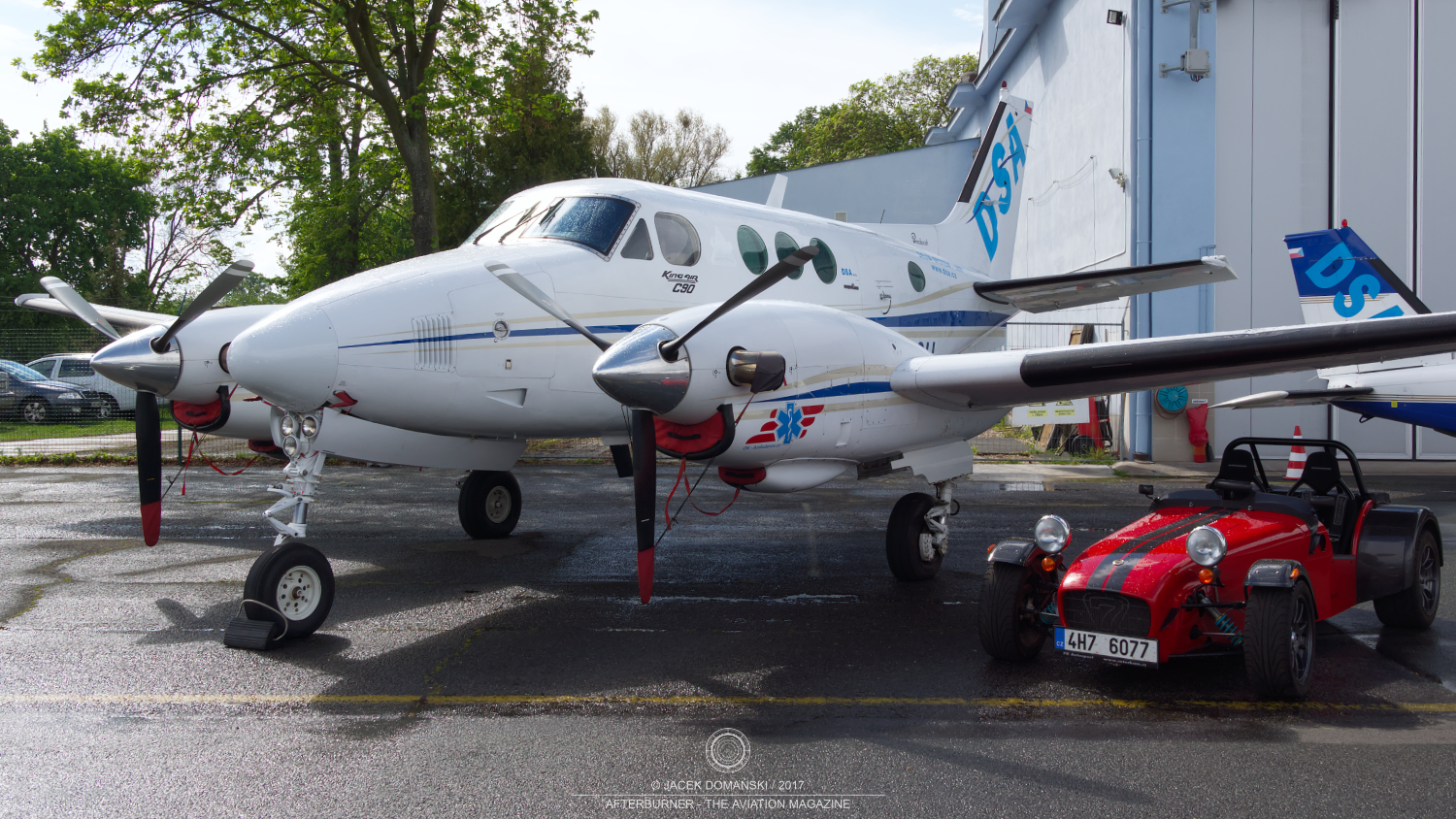
 Beechcraft King Air C90 (c/n LJ-837, OK-DSH, operated by DSA a.s.), on static display during the 2017 edition of the Helicopter Show, Hradec Králové, May 2017.
The Beechcraft Model 90 series was developed in the early 1960s, based on the company’s earlier design, the Queen Air twin-engine light aircraft, which made its maiden flight in August 1958.
Initially designated Model 120, the new aircraft was intended to be powered by two Turbomeca Bastan VI engines. On 15 May 1963, the first test aircraft – known as the Model 87 and rebuilt from a Queen Air airframe – successfully completed its maiden flight. This prototype was equipped with two Pratt & Whitney Canada PT6A-6 turboprop engines and proved sufficiently promising that Beechcraft abandoned the original concept and continued development of the revised configuration.
On 24 January 1964, the definitive prototype of the new twin-engine light aircraft, now designated the Model 65-90, took to the skies for the first time. Shortly thereafter, the aeroplane was approved for serial production and officially marketed as the Beechcraft King Air. The earlier prototype was subsequently delivered to the US Army for further evaluation.
In October 1964, the first production aircraft was delivered to its launch customer. Within a short period, the King Air had established itself as a highly popular utility aircraft, operated by both civil and military users worldwide. Over time, the aeroplane evolved into several dozen variants, collectively referred to as the Model 90 and Model 100 series.
In the early 1970s, Beechcraft introduced a new generation of twin-engine light utility aircraft derived from the original Model 90/100. This design featured a T-tail configuration and an increased maximum take-off weight. Initially marketed as the Super King Air, the new family became known as the Model 200 and Model 300 series.
In total, approximately fifty variants of the King Air were produced, including prototypes, for both civil and military customers. The majority were powered by various versions of the PT6A engine family, which delivered between 500 and 750 shp, although several prototypes were fitted with Garrett TPE331 turboprop engines.
Military variants of the King Air were used for liaison, training, light utility and VIP transport duties. Other specialised conversions included radio relay, signals intelligence (SIGINT), electronic warfare and jamming, as well as electronic surveillance platforms. The United States armed forces were the largest military operator of the type, followed by the Japan Maritime Self-Defence Force. Smaller numbers of Model 90/100 aircraft were also operated by approximately twenty other military users worldwide.
The serial production of the Beechcraft King Air 90/100 line was definitively discontinued in 2021. By that time, more than 3,700 aircraft had been built.
The King Air C90 featured within our Photo of the Week series is powered by two 550 shp PT6A-21 engines. The aircraft is based on the previous B90 version but features the Model 100 cabin environment and pressurisation system.
Manufactured in 1979, the aeroplane operated in the United States as N364D for many years. In 2004, the aircraft was acquired by DSA a.s., a Czech company based in Hradec Králové that provides flight training and air ambulance services.
Following its acquisition, the King Air was adapted for medical evacuation duties; however, its primary configuration as a VIP transport aircraft for up to six passengers remained unchanged. In 2023, the aeroplane received a new dark blue and white livery (not depicted in the photograph).