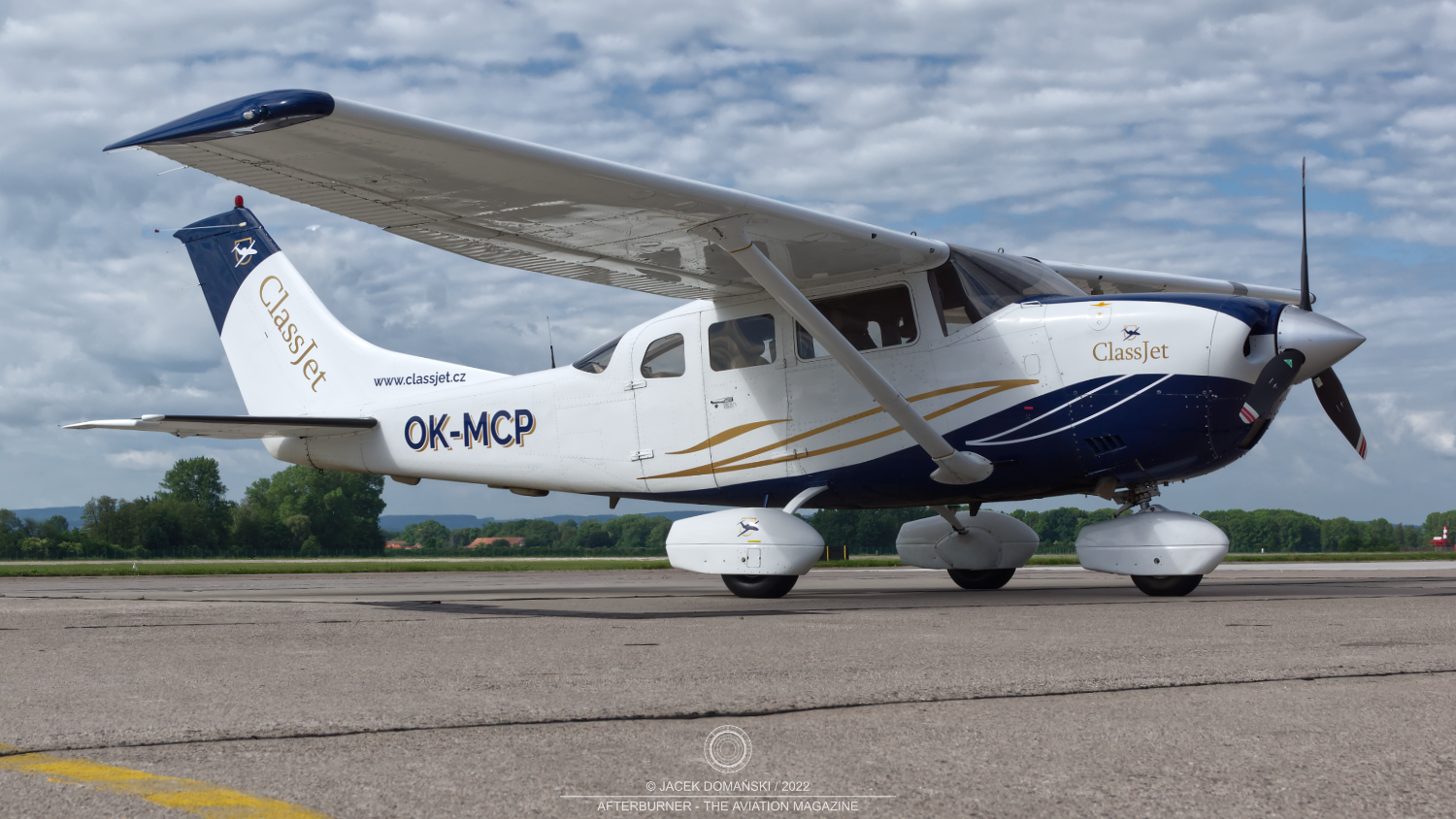
 Cessna T206H Turbo Stationair (c/n T206-08172, OK-MCP), static display at the 30th edition of the Aviatická pouť (Aviation Fair) air show, Pardubice, May 2022.
In 1957, the Cessna Aircraft Company introduced to the market its new light aircraft, designated the Cessna 210. Initially, it was a four-seat, high-wing aeroplane powered by a single 260 hp Continental IO-470 engine.
The Model 210 was based on the company’s earlier development, the Cessna 182, which had entered production a year earlier. The main upgrades of the new aeroplane included a retractable landing gear, new wings, and a swept tail.
At the end of 1962, the Cessna Aircraft Company introduced to the aviation market a derivative of the 210, initially designating the aeroplane as the Model 210-5. It was, essentially, a six-seat variant of the aircraft, equipped with a fixed landing gear and a Continental IO-470-S engine. Although originally certified as the 210-5, the aeroplane was soon marketed as the Cessna 205.
The Model 205 was manufactured for only two years, before being succeeded in 1964 by its modernised variant, the Cessna 206. The aeroplane was aerodynamically improved and no longer had the characteristic engine cowling bulge used to house the nosewheel in the 210 series. The 206 was equipped with a door on the pilot’s side and a large rear door allowing for easy access to the two rear seat rows or facilitating the loading and unloading of cargo. The aircraft was powered by a Continental IO-520-A engine, generating 285 hp.
In 1969, the company introduced yet another variant of the aircraft, the Model 207. Initially a seven-seater, it was later modified to accommodate eight passengers and was fitted with a 300 hp Continental IO-520-F engine.
The Cessna 206 was initially marketed as the “Super Skywagon”, later renamed the “Stationair”, a contraction of the phrase “Station Wagon of the Air”. Some later variants were also marketed as the “Super Skylane”, although they were not related to the Model 182 Skylane. The Cessna 207 was commonly referred to as the “Skywagon” or the “Stationair 7”.
However, the official company designations differed significantly. The initial variant of the Model 206 was designated the U206, where the letter U stood for “utility”. The subsequent turbocharged version became the TU206, while the aeroplane equipped with additional passenger doors was designated the P206.
The Cessna 205/206/207 aircraft family proved successful on the general aviation market. These aeroplanes were used as personal light aircraft and bush planes, as well as by commercial air service operators, and could be equipped with floats, amphibious floats, and skis. Approximately a dozen variants of the Cessna 205/206/207 family were developed and used by civilian and military operators around the world.
In 1984, the Cessna Aircraft Company was sold to General Dynamics. Although the brand name was retained, production of all piston-powered aeroplanes ceased within two years. By that time, more than 5,700 aircraft from the 205/206/207 family had been built.
Almost a decade later, Cessna was acquired by Textron. The change of ownership also led to the revival of the Model 206, which returned to the market in 1998. Now designated the 206H “Stationair”, the aircraft retained the appearance of the classic U206 variant and was powered by a 300 hp Lycoming IO-540-AC1A engine. Shortly thereafter, a turbocharged version was introduced – designated the T206H “Turbo Stationair” and powered by a 310 hp Lycoming TIO-540-AJ1A engine.
The Model 206H remained in production until the 2010s, while the turbocharged version is still offered by Textron as the Cessna Turbo Stationair HD. The aeroplane is now equipped with a modern Garmin avionics suite, including two multifunction displays, USB power outlets, and an updated interior design.