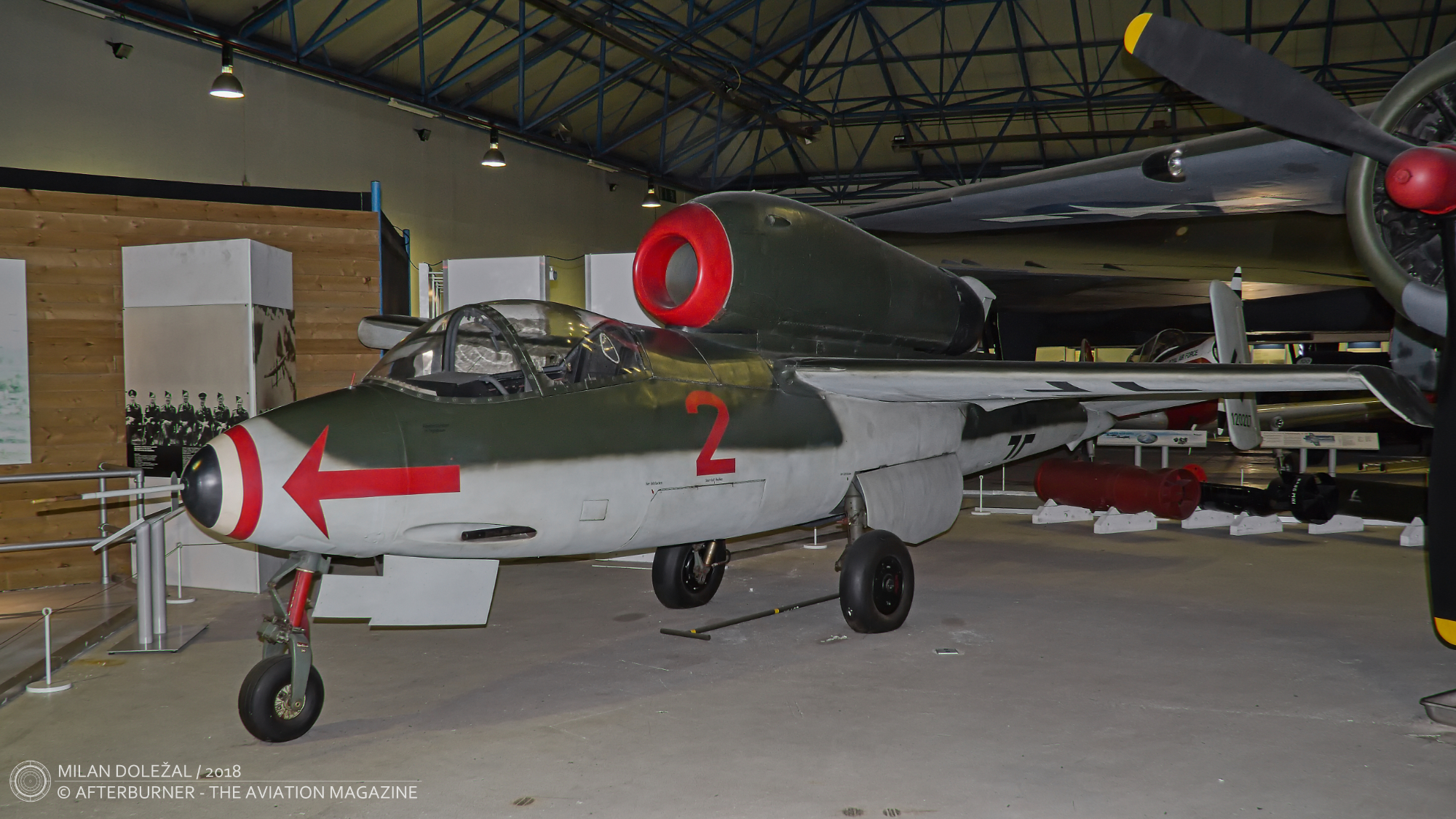
 On 6 December 1944, the new German single-engine jet fighter, the Heinkel He 162, made its maiden flight.
The aircraft was developed under Jägernotprogramm (Emergency Fighter Programme), issued by Reichsluftfahrtministerium (Ministry of Aviation) on 3 June 1944. The programme focused on creating a fighter aircraft that was simple and inexpensive yet still effective against Allied bomber formations.
The competition for the new fighter was opened in August 1944 and officially named Volksjäger (“People’s Fighter”). The aeroplane had to be easy to produce and mostly made of wood with minimal use of metal. It also had to be powered by a simple jet engine and easy to operate, even for inexperienced pilots. Just as the Volkswagen (“People’s Car”) was intended for the German automotive industry, the new Volksjäger was meant to serve German fighter aviation.
The competition was won by Heinkel with his Spatz (“sparrow”) design. It was a small aircraft (9.05 m in length, with a wingspan of 7.2 m), powered by a single, top-mounted BMW 003 turbojet engine. The aeroplane was made largely of wood, with only limited use of light alloys. It was designed for ease of production and minimal maintenance – if serious issues arose, it was preferable to scrap the aircraft rather than repair it
Heinkel’s design was quickly approved for serial production under the official designation He 162. However, the aeroplane soon became known by several informal nicknames, including the aforementioned Spatz, Salamander (taken from the code name of the wing-development programme), and, of course, Volksjäger.
On 6 December 1944, just three months after the competition, the He 162 made its maiden flight. In January of the following year, Volksjäger entered active service.
Although Volksjäger was intended to be one of Wunderwaffen (the “wonder-weapons”) that would give Germany a chance to win the Second World War, the He 162 proved to be just another failure and another programme that consumed resources to no real effect.
The shortcomings of the aircraft were quickly exposed during its operational service. Its light and compact structure meant that it could not carry sufficient fuel, the engine endurance was poor and – most importantly – Volksjäger was very difficult to fly, even for experienced pilots. Operating the He 162 was utterly impossible for rookies with only basic glider training, as initially envisioned by the authorities.
Although approximately 350 aircraft of this type were built by the end of the war, only around 120 examples were delivered to Luftwaffe combat units. Their combat history was extremely brief and largely ineffective. It is highly probable that the He 162 did not shot down any Allied aircraft. The usual assumption, based on German accounts, is that it achieved two aerial victories, but neither has ever been officially confirmed.
Full story here.