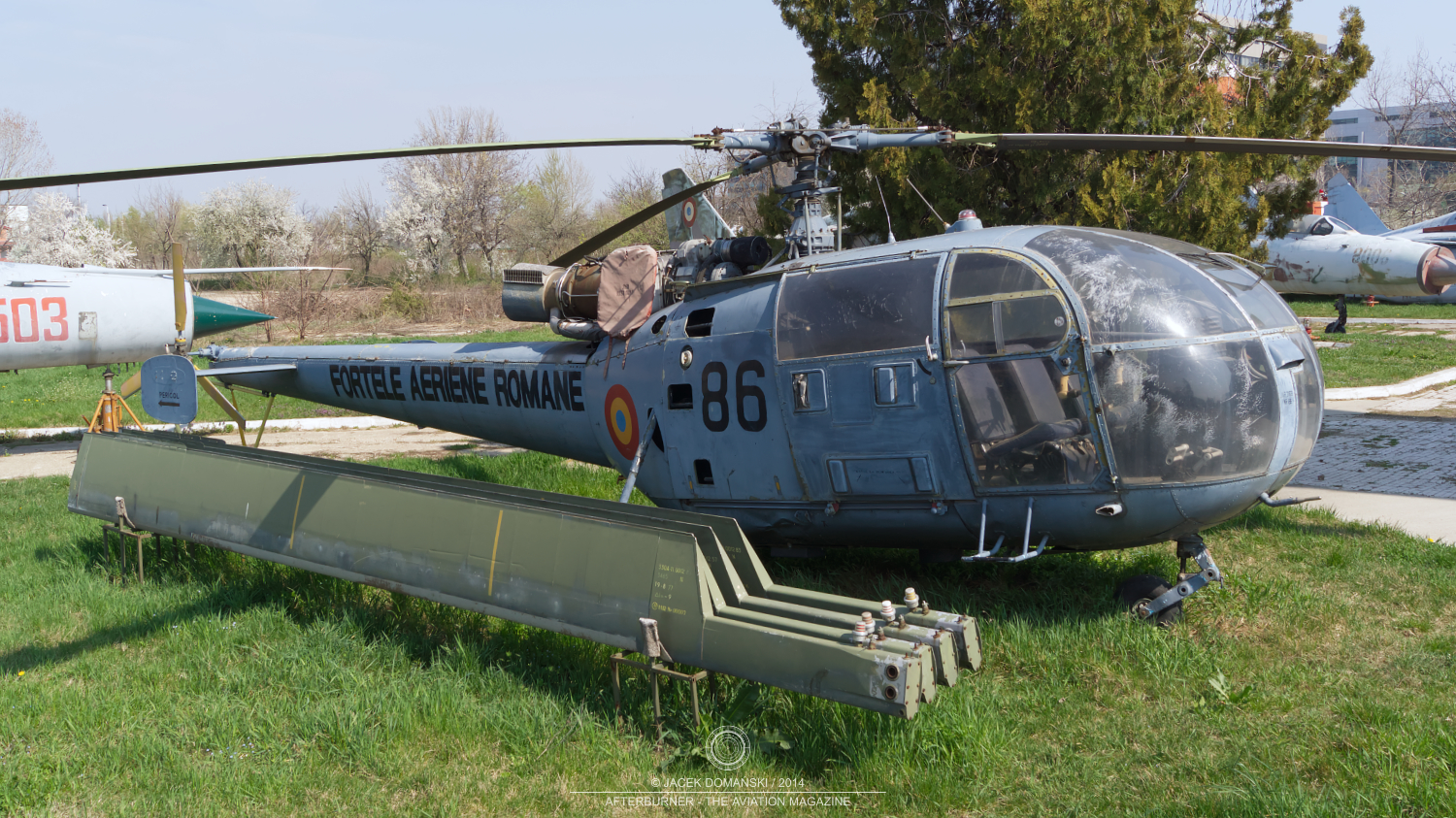
 IAR 316B (c/n 171, formerly “86” of Forțele Aeriene Române / the Romanian Air Force), exhibited at Muzeul Naţional al Aviaţiei Române (National Romanian Aviation Museum) in Bucharest, March 2012.
In the early 1950s, the French aviation manufacturer Société nationale des constructions aéronautiques du Sud-Est (SNCASE, commonly known simply as Sud-Est) developed a light utility helicopter SE.3120 Alouette (“lark”). Although rotorcraft was successfully flown for the first time in July 1951, it never entered serial production.
Nevertheless, the development of the SE.3120 was only the beginning of a successful series of light rotorcraft designed by the French company.
Four years after the maiden flight of its predecessor, Sud-Est presented a derivative of the initial design, known as the SE.3130 Alouette II. In March 1955, the helicopter took to the skies for the first time and shortly afterwards was approved for serial production.
In 1957, the Sud-Est company merged with Sud-Ouest (Société nationale des constructions aéronautiques du Sud-Ouest – SNCASO) to create Sud Aviation. The Alouette II was introduced to the market in the same year, and the change in company structure was reflected in its official designation – the initial variant was known as the SE 313, while later versions were designated the SA 318.
The Alouette II quickly conquered the market. The helicopter was used by approximately forty air forces, as well as by several government and civilian operators around the world. More than 1,300 examples of the rotorcraft were built until 1975, when its serial production was finally ceased.
Shortly after the first flight of the Alouette II, Sud Aviation began work on a larger and more powerful variant of the rotorcraft. The prototype, officially designated the SE.3160 Alouette III, performed its maiden flight on 28 February 1959. In June of that year, the new rotorcraft was showcased to the public for the first time during the Paris Air Show at Le Bourget.
In December 1961, the Alouette III was officially introduced to the market. Due to the aforementioned restructuring of the French aviation industry, the helicopter was redesignated the SA 3160 or the SA 316. Following another merger of aviation manufacturers in 1970 and the subsequent establishment of Aérospatiale, the rotorcraft was marketed under the new brand.
Similarly to its earlier, smaller variant, the Alouette III quickly became one of the most popular light utility helicopters in the world. It was (and in some cases still is) operated by more than eighty air and naval forces worldwide, as well as by a countless number of civilian companies.
In 1971, Industria Aeronautică Română (the Romanian Aeronautical Industry) began licensed production of the SA 316B rotorcraft at its aviation plant located in Ghimbav, Brașov County.
Production of the Romanian variant of the helicopter, designated IAR 316B, continued until 1987. In total, 250 examples were built and half of them was intended for the domestic market. The IAR 316B was operated by the Romanian Armed Forces, police and air ambulance services.
The remainder of the production was earmarked for export, and the list of IAR 316B customers included such countries as Angola, Guinea and Pakistan. Interestingly, it was in Africa that the SA-316B and its derivatives were intensively used for ground support, supply and combat operations. The rotorcraft became known for its versatility and reliability and played an instrumental role in the Border War in Angola and in counter-insurgency operations against SWAPO.
Interestingly, the IAR 316B also served as the basis for the prototype of a Romanian attack helicopter, known as the IAR 317 “Airfox”. However, the rotorcraft was built in only a single example and never entered serial production.
The photograph of the IAR 316B “86”, featured in our Photo of the Week series, was taken in March 2012. At that time, the helicopter was exhibited at the National Romanian Aviation Museum – where it came in 2005, after retirement from active service – albeit in poor condition.
Around 2017, the rotorcraft was partially restored and repainted, receiving a new dark- and light-green camouflage scheme. Since 2019, the “86” has been exhibited at Expoziţia permanentă Aeronautica Moldovei (literally the Permanent Exhibition of Moldavian Aeronautics, but commonly referred to as Muzeul Aviației Tecuci / Tecuci Aviation Museum) in Tecuci, Galați County.