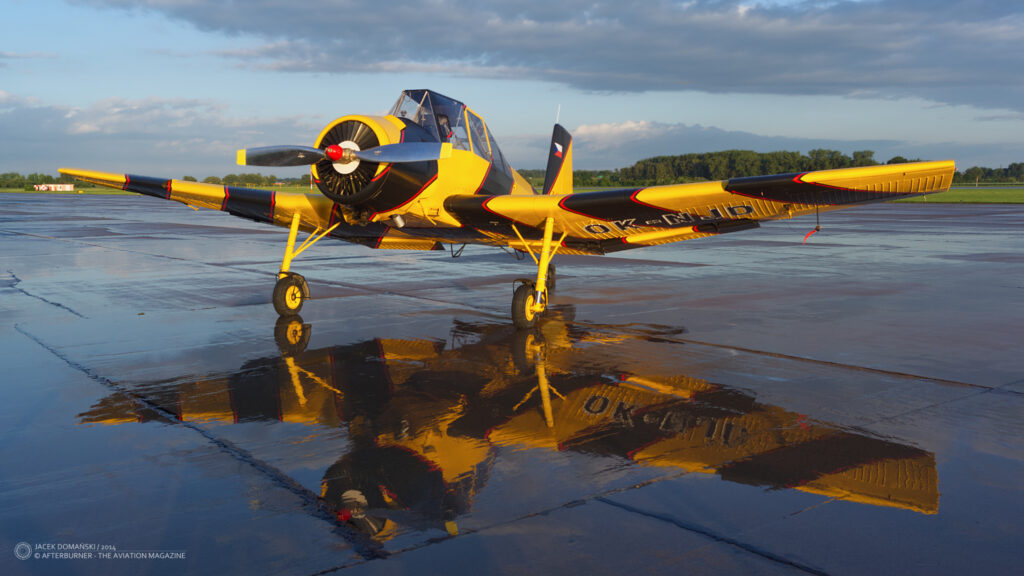
Let Z-37A-C3 Čmelák (c/n 25-06, OK-NJD), static display at 2014 edition of Aviatická pouť air show, Pardubice, May 2014.
The history of crop dusting or, formally speaking, aerial application, in what was then Czechoslovakia dates back to 1926. At that time, two Aero A-11 military biplanes were used to combat forest pests. Reportedly, the initial spraying operation was unsuccessful and had to be repeated the following year. A few more aerial application missions took place during the 1930s, but they remained isolated cases rather than becoming common practice.
After the Second World War, crop dusting was introduced in Czechoslovakia on a much larger scale. Initially, a variety of aircraft types were employed for the task, ranging from the Polikarpov Po-2 and various sport and training aeroplanes to captured German Fi 156 Storch aircraft. Then, in the mid-1950s, the first factory-equipped crop-dusting aircraft, the Aero L-60 Brigadýr, was introduced. More than sixty examples of the L-60B, as the aerial application variant was designated, were manufactured and subsequently acquired by the state-owned company Agrolet.
Nevertheless, the need for a purpose-built crop-dusting aircraft was evident, and this sparked a broad discussion about its design not only in Czechoslovakia but also throughout the Eastern Bloc. As a consequence, the Council for Mutual Economic Assistance (Comecon) announced a competition to design a standardised crop-dusting aircraft for all its member countries Among the principal requirements were STOL capability, the ability to operate from unpaved airstrips, excellent low-level flight characteristics, good cockpit visibility, robust construction and low maintenance requirements.
The challenge was accepted by Let Kunovice and Moravan Otrokovice, two well-known Czechoslovak aviation manufacturers. Their initial concept involved an inline engine, but this was soon replaced by a radial powerplant. The chosen engine was the 260 hp Ivchenko AI-14; however, the aircraft proved to be underpowered. Consequently, the powerplant was replaced by the Avia M-462RF – a licence-built variant of the AI-14, modified to produce 315 hp. On 29 June 1963, the prototype of the new crop-duster, designated XZ-37, performed its maiden flight.
The new Czechoslovak agricultural aircraft was a cantilever low-wing monoplane of all-metal construction. It featured fixed landing gear with a tailwheel and a pilot’s cockpit situated directly above the engine. Behind the cockpit there was the chemical hopper, followed by a seat for a mechanic with a small side window. It should be noted that there have been speculations that the general design of the aeroplane was inspired by the Auster B8 Agricola, a British agricultural aircraft introduced in 1955 that never achieved commercial success. Nevertheless, these claims have never been confirmed or proven.
In 1965, serial production of the Z-37 Čmelák (Bumblebee), as the aircraft was officially named, was launched. Depending on the manufacturer, the aeroplanes were usually designated either Zlín or Let, indicating their origin from Otrokovice or Kunovice respectively.
The Z-37 was widely used throughout the former Czechoslovakia and was also exported to numerous other countries. Among its principal operators were the GDR, Hungary and Bulgaria, although examples also served in Yugoslavia, India, Iraq, Austria and Finland. The standard production version was designated the Z-37A. Several limited-production variants were also developed, including the Z-37A-2 and Z-37T-2 two-seat trainers, as well as the four-seat Z-37A-C3. In 1981, the prototype of a turboprop-powered variant performed its maiden flight. This aircraft subsequently entered production as the Z-37T Agro Turbo and later as the Z-137T.
Although the Z-37 gained recognition throughout the world, it was never destined to become the standard crop-dusting aircraft for the Comecon countries. As was often the case within the former Eastern Bloc, the idea collapsed almost as quickly as it had been created. Most notably, Poland and the Soviet Union – initially expected to become the largest operators of the aeroplane – never approved the Z-37 design and instead began developing their own agricultural aircraft.
In Poland, this quickly led to the creation of two renowned designs, the PZL-106 Kruk and the PZL-Mielec M-18 Dromader. The latter performed its maiden flight in 1976 and soon became so successful that the Comecon ordered the cessation of further Z-37 production. From 1977 onwards, Čmelák was to be replaced by the M-18 as the standard crop-dusting aircraft of the Eastern Bloc.
On the other hand, the M-18 was not accepted by Czechoslovak operators, particularly SlovAir – the country’s largest company specialising in aerial application and other aviation services. From that point, it was only a small step towards launching the development of a turboprop-powered variant of the Z-37, initially known as the XZ-37T Čmelák Turbo.
Eventually, more than seven hundred examples of the crop-duster aircraft from the Z-37/Z-137 family were produced.
Today, many Z-37s remain operational and continue to perform their original aerial application role. A considerable number is also used by aeroclubs as glider tugs, while others have been adapted for sightseeing flights.
The pictured Čmelák, OK-NJD, is one such example. The aircraft was originally manufactured as a two-seat variant, but additional seats were later installed. For this reason, it is now commonly designated the Z-37A-3, although only one genuine aircraft of that version was originally built – the one registered OK-HYA and made for the State Aviation Authority (and nicknamed “Hyena” due to its registration). That original Z-37A-3 aeroplane is now part of the collection at the Prague-Kbely Aviation Museum.