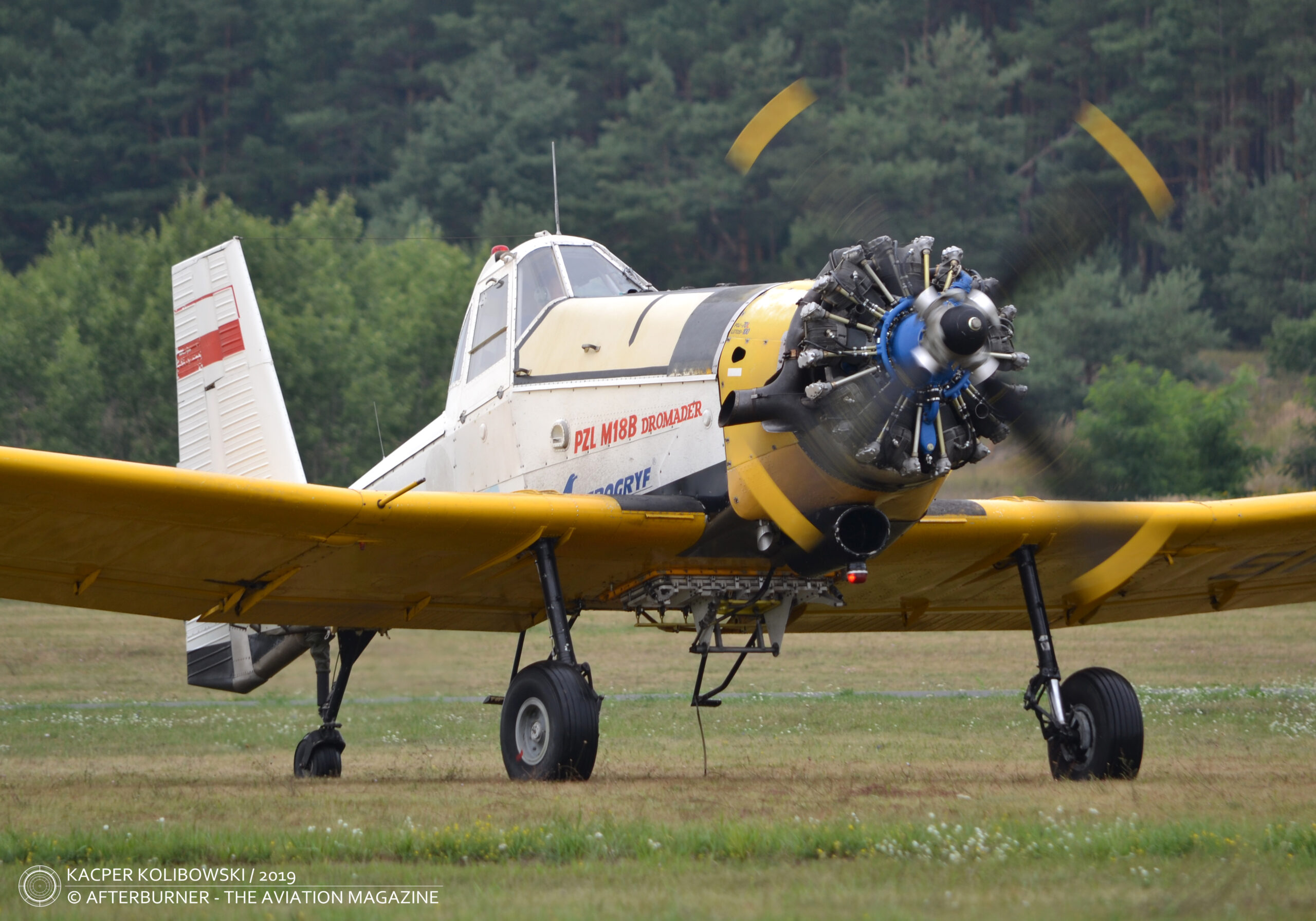
PZL M18B Dromader (c/n 1Z024-07, SP-FOH), taxiing after a water-drop display during the air show held as part of the 11th FAI European Advanced Aerobatic Championships 2019 in Toruń, Poland.
The PZL M18 Dromader is a Polish agricultural and firefighting aircraft which origins date back to the first half of the 1970s, when WSK Mielec (now PZL Mielec), a Polish aircraft manufacturer, established a partnership with the American aviation company Rockwell. As a result, Rockwell offered its Polish partner the opportunity to launch licensed production of the Rockwell 111 and 112 touring and utility aircraft (which ultimately never happened), together with the manufacture of the Rockwell S-2R Thrush Commander agricultural aeroplane.
The original S-2 aircraft were usually powered by surplus US military Pratt & Whitney engines, and this could have become an issue for the Polish manufacturer in the future. However, at the same time, WSK Mielec was also producing Antonov An-2 biplanes powered by the Soviet ASh-62IR radial engine, which was more readily available in Poland, as it was manufactured locally by WSK PZL Kalisz.
Although the Antonov engine was significantly more powerful than its American counterpart – producing 1,000 hp compared with the 600 hp Pratt & Whitney R-1340 Wasp used in the Rockwell S-2R – a team of engineers from the WSK Mielec research and development department, led by M.Sc. Eng. Józef Oleksiak, decided to use the ASh-62IR. As a result, a new aircraft was developed based on the S-2 design. The new aeroplane was larger, approximately 40 per cent heavier, and offered a significantly greater payload capacity, being capable of carrying up to 1,850 kg or 2,500 litres of liquid.
Work on the new project began in the autumn of 1974, and the aircraft was designated the M18 Dromader (the dromedary camel). Although the Polish aircraft was largely based on S-2R components supplied from the United States, it underwent substantial redesign. The central and rear sections of the fuselage structure, the cockpit, the outer wing panels and elements of the control system were derived from the American aircraft. Redesigned or newly developed were the forward fuselage structure, the centre section of the wing, all control surfaces, the landing gear and the chemical tank. In addition, a modified An-2 propeller was used and the cockpit was sealed.
The first flight of the PZL M18 Dromader prototype, piloted by test pilot Andrzej Pamuła, took place on 26 August 1976 (or 27 August, according to some sources) at Rzeszów-Jasionka Airport. One year later, the aircraft was officially presented at the Paris Air Show.
An initial production batch of M18 aircraft was completed in 1978, together with a prototype firefighting variant. Shortly afterwards, Dromader entered full-scale production. Although initially intended only for the domestic market and export to the United States, the PZL M18 quickly gained international recognition, and its operators eventually expanded to more than twenty countries worldwide, including Argentina, Australia, Brazil, Bulgaria, Canada, China, Croatia, Cuba, Czechoslovakia, France, Germany, Greece, Hungary, Iran, Italy, Nicaragua, Portugal, Spain, Turkey, the United States, Yugoslavia and Venezuela.
In total, more than 765 Dromaders of several versions were produced, including the M18A, equipped with a back-to-back seat for a mechanic behind the cockpit; the M18B, powered by the more powerful K-9 engine and capable of carrying up to 2,200 kg of payload in addition to a mechanic; and the M18BS, a training version with dual controls, featuring a student pilot’s cockpit installed in place of the chemical tank and capable of carrying up to 700 kg of payload. For many years, the PZL M18 Dromader was among the best-selling products of WSK/PZL Mielec. Moreover, in 1996, a contract to establish a Dromader assembly plant in Brazil was finalised. Although production was suspended during the 2000s, it was never officially terminated but, according to the official PZL Mielec website, the aircraft is not a part of the company’s portfolio anymore.
In addition to the aforementioned variants, a turboprop-powered version of the aircraft was developed for the US market. Designated the PZL T45 Turbine Dromader, it was powered by a Pratt & Whitney PT6A-45AG engine. There were also plans to develop several other versions of the aircraft – the PZL M-21 Dromader Mini (smaller), the PZL M-24 Dromader Super (enlarged) and the PZL M-25 Dromader Mikro (the smallest member of the Dromader family) – but none progressed beyond the prototype stage.
One particularly interesting chapter in the aircraft’s history was the combat use of M18s during the Croatian War of Independence between 1991 and 1995. During the early years of the conflict, Croatia did not possess a fully developed air force. Consequently, the “First Airborne Unit of the Croatian Army” was established, consisting of approximately thirty aircraft of various types from an agricultural aviation base near Osijek. Among them were the PZL M18 Dromader and PZL-built An-2 aircraft manufactured in Mielec. Improvised armed versions of Dromader, alongside An-2 biplanes, carried out night bombing missions against Serbian positions around the besieged city of Vukovar, often referred to as the “Croatian Stalingrad”.
Today, approximately sixty aircraft of this type remain in operation in Poland, primarily for firefighting and pest-control duties. One of them is pictured above – the PZL M18B Dromader registered SP-FOH and operated by the Polish aviation company Aerogryf.
Each year, from March to October, Aerogryf maintains several temporary operating bases throughout north-western Poland as part of the State Forests fire-protection system. In 2019, the SP-FOH was operating from one such base located at the airfield of the Pomeranian Aero Club (Aeroklub Pomorski) in Toruń. This provided an excellent opportunity to perform a water-bombing demonstration during the final day of the 11th FAI European Advanced Aerobatic Championships 2019.