 Dario Costa, an Italian aerobatic pilot and former Red Bull Air Race competitor, is widely recognised for accomplishing aviation feats that had never been achieved before. In 2021, he flew through two highway tunnels outside Istanbul within the Tunnel Pass project. In 2025, he performed the world’s first flight along the legendary Streif ski slope in Kitzbühel. Now, at the beginning of 2026, Costa has returned to Turkey to face another extraordinary challenge, known as the Train Landing project.
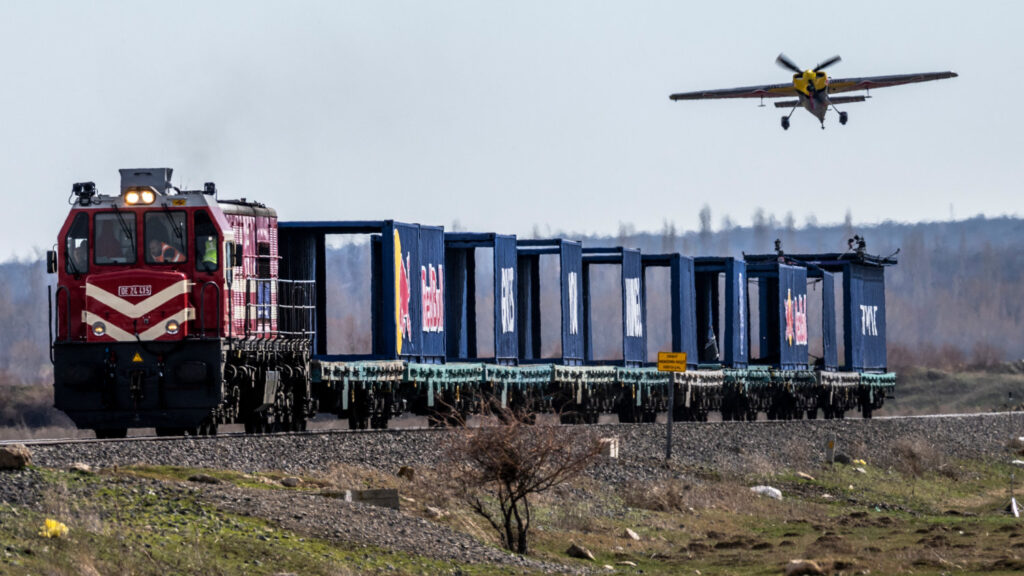
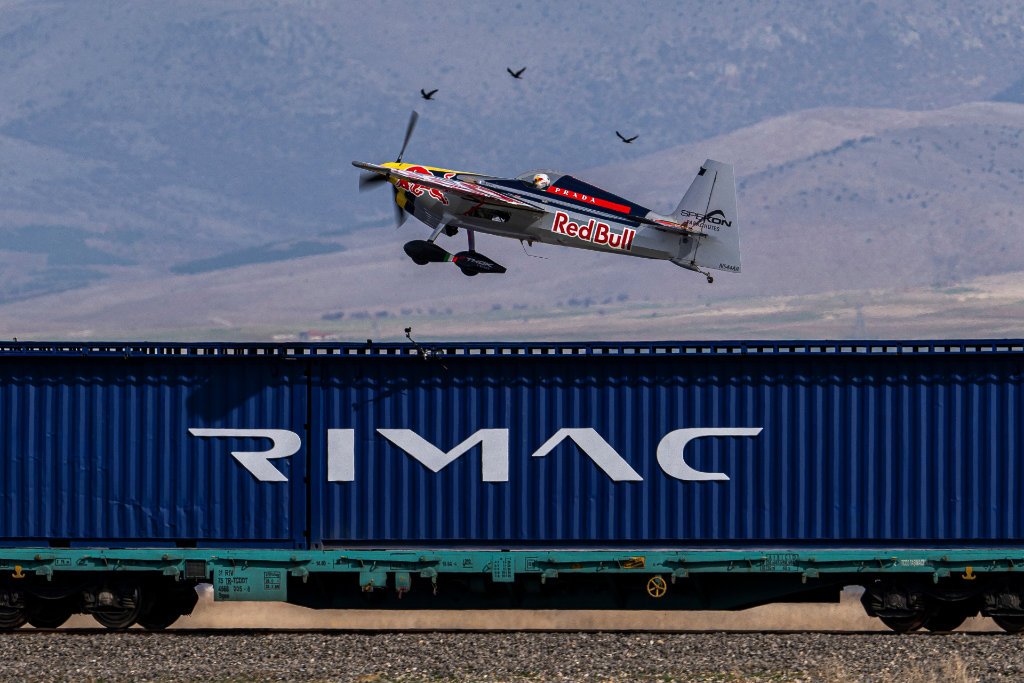
In a recent press release, the Red Bull company announced that, on 16 February 2026, Dario Costa performed a world-first manoeuvre in Afyonkarahisar by landing his Zivko Edge 540 aircraft on top of one of the containers carried by a moving cargo train, and then taking off from it.
Following the successful Tunnel Pass project in 2021, Dario Costa returned to Turkey to explore the feasibility of achieving a new aviation milestone. During his visit, he encountered a nostalgic passenger train in Kars, north-eastern Turkey. Inspired by the sight, Costa started to consider an unconventional concept that extended far beyond any static environment – to land an aeroplane on a moving train and then take off from it again.
After detailed analysis and field research, Afyonkarahisar was ultimately identified as the optimal location for this extraordinary initiative. Its railway infrastructure, operational conditions, and geographical characteristics enabled the project to be carried out in a controlled and safe environment.
Next, Dario Costa and a team of specialists embarked on several months of engineering analyses, simulation work, developing safety protocols and comprehensive flight preparation. Additionally, in order to precisely estimate the level of turbulence and the reduction in airflow caused by the moving train, extensive aerodynamic research was undertaken.
To meet the challenges associated with the project, Dario Costa underwent cognitive training at the Red Bull Athlete Performance Centre in Thalgau, Austria. One of the key elements of this practice was the “time-motion-anticipation” exercise, which proved to be crucial for achieving a successful landing.
A three-day testing session using a moving platform was also conducted in Pula, Croatia, in collaboration with Rimac Automobili. Using the company’s all-electric Nevera R hypercar as a precision moving platform, Costa refined his positioning accuracy and reaction times.
The Train Landing project did not require any major modifications to Costa’s Edge 540 aeroplane; however, its configuration was optimised for lower-speed flights. Two custom strakes designed by engineer Pietro Terzi and six (3+3) small vortex generators developed by engineer Hartmut ‘Siggi’ Siegmann were installed on the aircraft to enhance its aerodynamic performance.
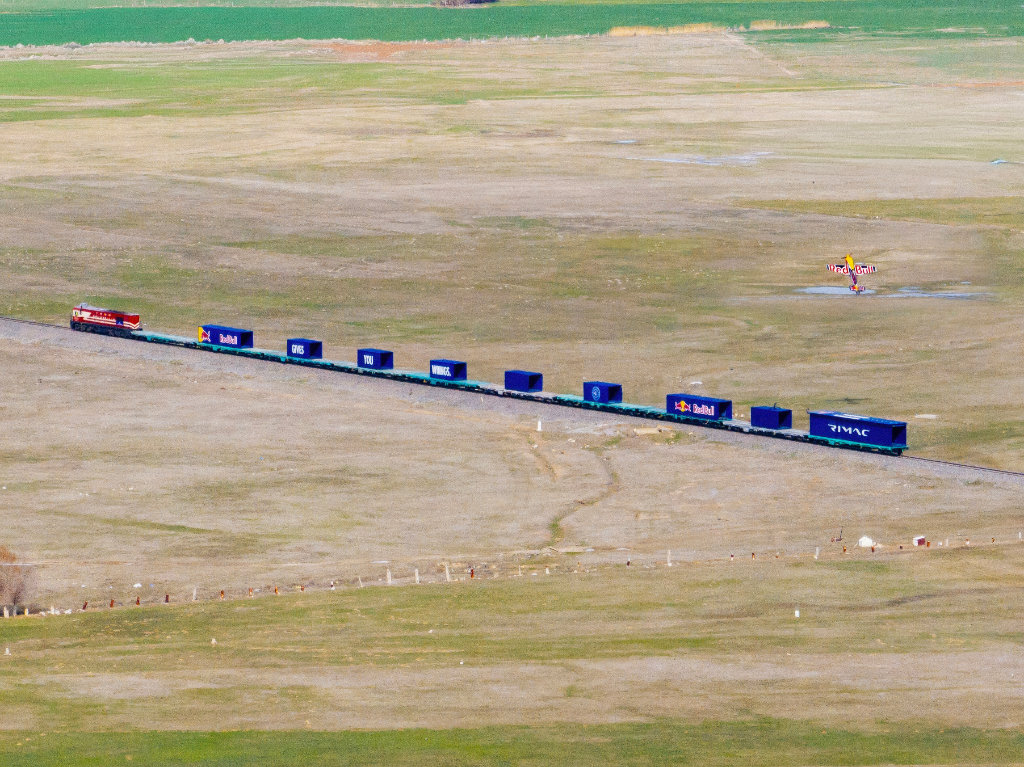
Landing on a moving “runway” in the form of a relatively small shipping container required precise speed management. Therefore, Costa first aligned his aircraft with the ninth and final container of the freight train, which was travelling at its maximum operating speed of 120 kph (65 kts). Simultaneously, he slowed the aircraft down to its minimum controllable speed of 87 kph (47 kts).
During the manoeuvre, the speeding train caused an unstable airflow and significant turbulence above the container. The speed of the air over the container decreased by 33 kph (18 kts), making the task even more challenging. To maintain longitudinal and lateral control relative to the train, the pilot had to constantly adjust the position and speed of the aircraft.
Approaching from the south-east towards the north-west, Costa precisely aligned the flight path with the direction and speed of the train. In this scenario, even a slight deviation of a few centimetres could have resulted in overshooting or undershooting the narrow upper surface of the container.
Throughout the entire approach, due to the design of the aircraft – with its nose and wings angled approximately eight degrees upwards relative to the horizon – and the dimensions of the train, the wagon on which Costa intended to land remained outside his direct line of sight. In this situation, the Italian pilot could rely solely on his cognitive training and flight proficiency. Moreover, Costa only had a 50-second time window to achieve his goal.
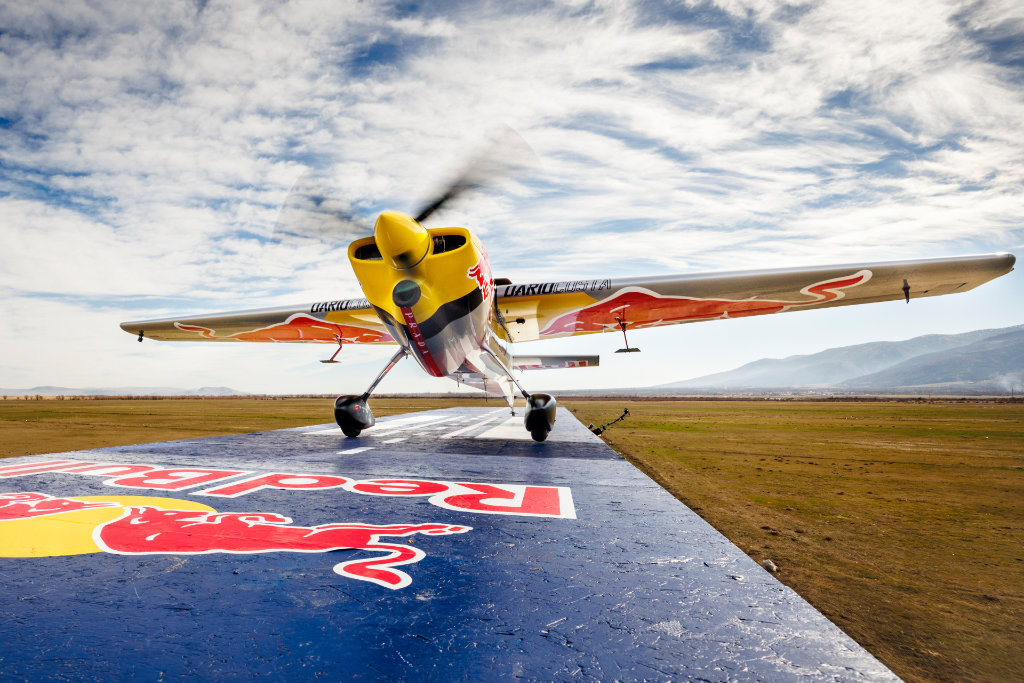
Finally, at a near-stall speed, all three wheels of the Edge 540 touched down on the container. Costa then initiated a controlled, highly precise acceleration, taking off and almost immediately transitioning into a vertical climb. In doing so, he achieved the world’s first landing and take-off sequence of this kind.
“Train Landing was one of the most challenging and demanding projects of my career. There were so many variables to measure, but the greatest test was learning to land blind on a very small moving runway – relying only on cognitive and flying skills,” – said Dario Costa about his latest aviation feat and added – “Despite the difficulty, it was a great experience. For the first time, an aircraft successfully interacted with a moving train, bringing together the oldest motorised transportation with the newest. It was a complex project that required precision, teamwork, and trust – and I’m proud we executed it as planned.”
“The most critical aspect was the alignment with the train, so precision had to be absolute, and he achieved that. During a project like this, there’s no room for emotions – Dario is a true magician.” – emphasised Filipo Barbero, the Aviation Consultant on the Train Landing project.
Landing on, and then taking off from a container mounted on a moving train represents a significant achievement in terms of both aerodynamics and piloting skills. Performing that stunt at the train’s full speed and the aircraft’s near-minimum speed is a perfect example of how data-driven preparation and precise flying can extend the boundaries of controlled flight under highly unconventional conditions.
Cover photo: Predrag Vuckovic / © Red Bull Content Pool. Information from the Red Bull company press release were used.