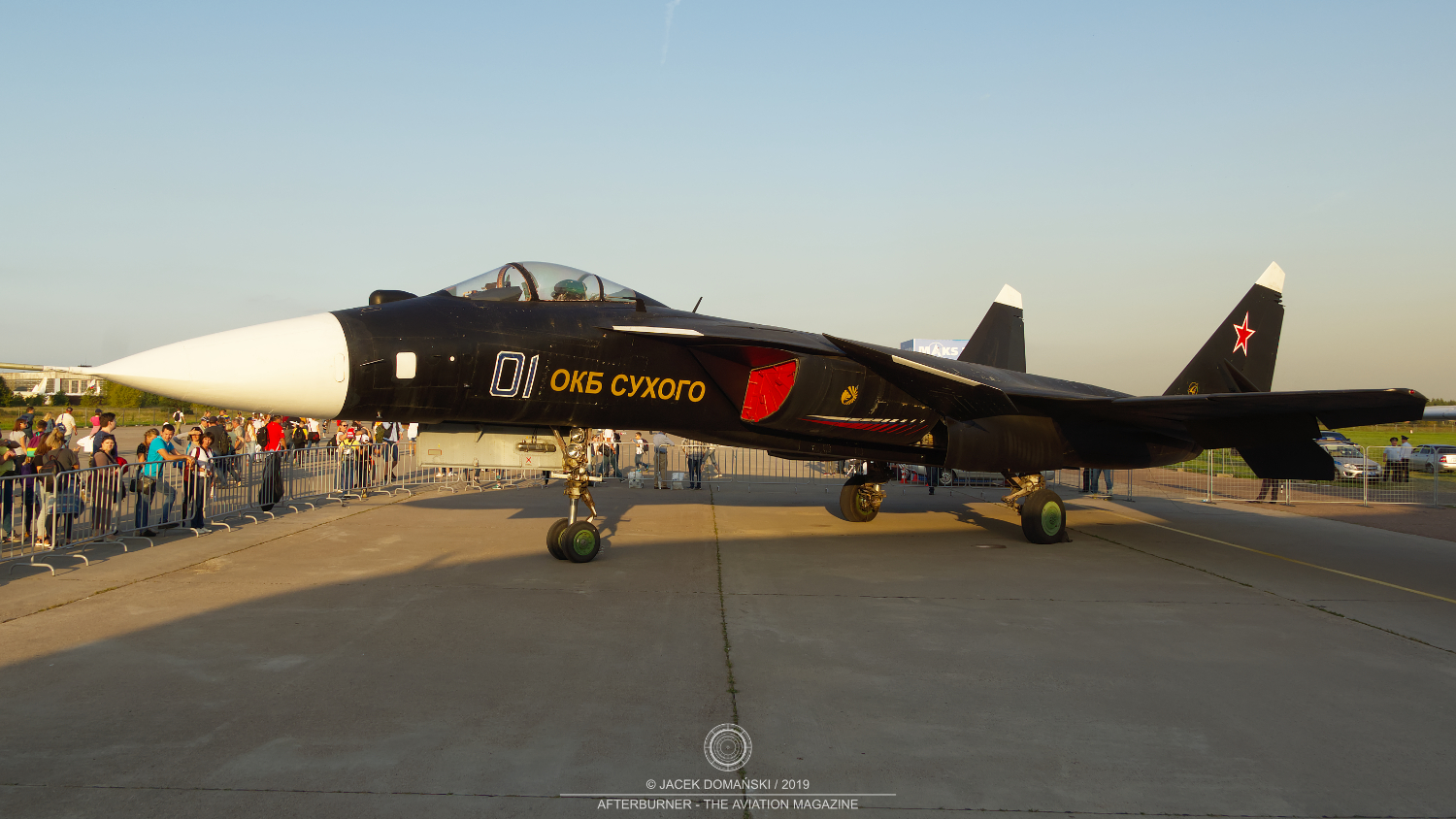
 Sukhoi Su-47 „Berkut“ (technology demonstrator, NATO reporting name: Firkin), exhibited at the XIV International Aviation and Space Salon MAKS-2019, Zhukovsky, August 2019.
In the early 1980s, the United States launched the Advanced Tactical Fighter programme, aimed at developing a next-generation air superiority fighter. The programme ultimately led to the creation of the YF-22 demonstrator, which was later refined and produced as the F-22 Raptor.
In response to the American initiative, the Soviet Union opened its own project, officially known as И-90 / истребитель 1990-х годов (I-90 / the fighter for the 1990s). Within a short time, Центральный аэрогидродинамический институт – ЦАГИ (the Central Aerohydrodynamic Institute – TsAGI) issued its recommendations for a Soviet fifth-generation fighter capable of matching US developments.
At the same time, the Sukhoi Construction Bureau (OKB Sukhoi) started developing its own next-generation fighter aircraft. Although the project, internally designated S-22, showed some promise, it was eventually abandoned, and the company instead focused on the further development of the Su-27 fighter and its derivatives.
In 1983, the fifth-generation fighter project was officially assigned to the Mikoyan Construction Bureau under the development programme codenamed Комплексная целевая программа (Comprehensive Target Programme). This resulted in two conceptual designs: the MFI (originally МФИ – многофункциональный фронтовой истребитель / multifunctional frontline fighter) and the LFI (ЛФИ – лёгкий фронтовой истребитель / light frontline fighter) fighter aircraft. Almost two decades later, this development effort culminated in the maiden flight of the MiG 1.44 aircraft.
Nevertheless, also in 1983, Министерство авиационной промышленности СССР (the Ministry of Aviation Industry of the USSR) tasked OKB Sukhoi with developing a forward-swept wing (FSW) fighter aircraft as part of a broader industrial research programme.
Working in cooperation with TsAGI, the Sukhoi Construction Bureau created eight aerodynamically distinct aircraft configurations. Following a five-year evaluation period, one of these designs was considered promising and approved for further development.
In 1988, the governmental FSW aircraft programme was officially closed. However, the Soviet Navy assumed responsibility for the continued development of the Sukhoi design, as it sought a new carrier-borne fighter aircraft. A new design team was established within the company, with Mikhail Pogosyan (Михаил Погосян) appointed chief designer. The project was internally designated S-32 and was sometimes referred to as the Su-27KM, derived from the Russian term корабельный модифицированный (“ship-borne modified”).
It was expected that the prototype would be ready to fly in 1991 or 1992, at the latest. The aircraft was to be powered by two Soyuz R179-300 turbofan engines, derived from the R79 used in the Yakovlev Yak-41 supersonic V/STOL fighter. However, the collapse of the Soviet Union brought this programme to an end.
Although government funding for the FSW fighter was terminated, Sukhoi continued development on a limited scale. The primary objective was to align the project with the aforementioned MFI programme as part of a more advanced fifth-generation fighter initiative.
The aircraft, now designated the S-37, was fitted with two D-30F6 engines, also used in the MiG-31 interceptor. On 25 September 1997, the Sukhoi-built FSW fighter performed its maiden flight.
However, the MFI programme was officially cancelled later that year, due to the high cost of development.
In 1999, Sukhoi publicly revealed the FSW aircraft by displaying the S-37 at the MAKS air show. The aeroplane attracted considerable interest from both aviation professionals and the general public. The following year, it was officially renamed the Su-47 Беркут (Latinised as “berkut” and meaning “golden eagle”).
At the same time, the Mikoyan company made its final attempt to develop a Russian fifth-generation fighter. The MiG 1.44 prototype was removed from its hangar, completed and, on 29 February 2000, flown for the first time by test pilot V. M. Gorbunov.
However, a series of financial scandals that hit the MiG company in the early 2000s effectively ended the MFI programme. In 2002, a new development initiative, officially designated ПАК ФА – Перспективный авиационный комплекс фронтовой авиации (PAK FA – Prospective Aeronautical Complex of Front-Line Aviation), was announced, entrusting the development of Russia’s next fifth-generation fighter to Sukhoi.
The Su-47 was subsequently incorporated into the programme as a technology demonstrator, with several elements of the new fighter being tested using the Berkut airframe. After completing more than two hundred test flights, the Russian FSW aircraft was officially retired in 2010.