 On 31 July 1894, a biplane developed by Hiram Maxim performed an uncontrolled flight over a distance of approximately 600 ft.
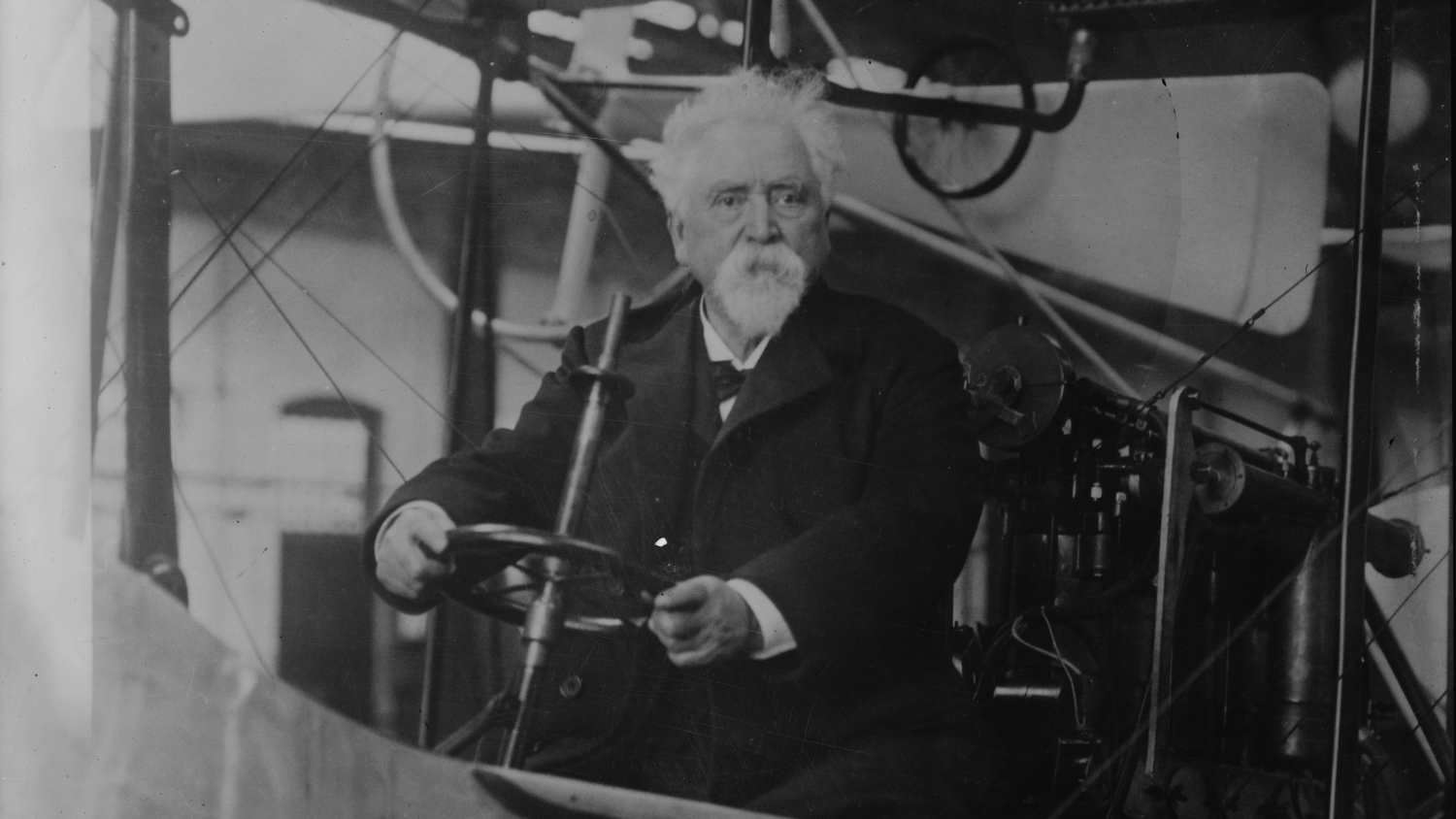
Sir Hiram Stevens Maxim was born on 5 February 1840 in Sangerville, Maine, in the United States, into a family of French Huguenot origin. Coming from a poor background, he received only a five-year elementary education before becoming an apprentice in a carriage-making workshop at the age of fourteen.
Ten years later, Maxim was hired by his uncle, Levi Stephens, to work at an engineering works in Fitchburg, Massachusetts. He worked as an instrument maker and draughtsman. This position also gave him an opportunity to teach himself technical drawing before undertaking further technical and scientific studies. The next step in his career was employment with Oliver Drake, a gas machine builder and instrument maker.
In 1866, Maxim received his first patent, for a hair-curling iron. He quickly demonstrated an extraordinary talent for invention, and the iron was soon followed by a device for generating illuminating gas and a locomotive headlight.
Maxim’s career as an engineer and inventor gained momentum in the 1870s. He first became a senior partner at a gas and steam company in New York and was later appointed chief engineer of the US Electric Lighting Company.
In 1884, Hiram Maxim moved to England and opened a workshop in Hatton Garden. Soon afterwards, he decided to focus on firearms production. He founded the Maxim Gun Company and began developing a fully automatic machine gun, the invention that brought him worldwide recognition. In 1889, the Maxim gun was adopted by the British Army. The Royal Navy followed in 1892 and, within a short time, armies around the world were equipped with the Maxim gun or one of its derivatives.
In 1899 (or 1900, depending on the source), Maxim became a naturalised British citizen. The following year, he was knighted by Queen Victoria.
Also during the 1890s, Maxim turned his attention to flying machines. Although his first helicopter concepts, equipped with two counter-rotating rotors, dated back to 1872, he now decided to develop a fixed-wing aircraft powered by a steam engine. During his experiments with various aircraft concepts, he used both a wind tunnel and a whirling-arm test rig.
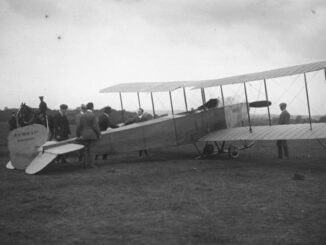
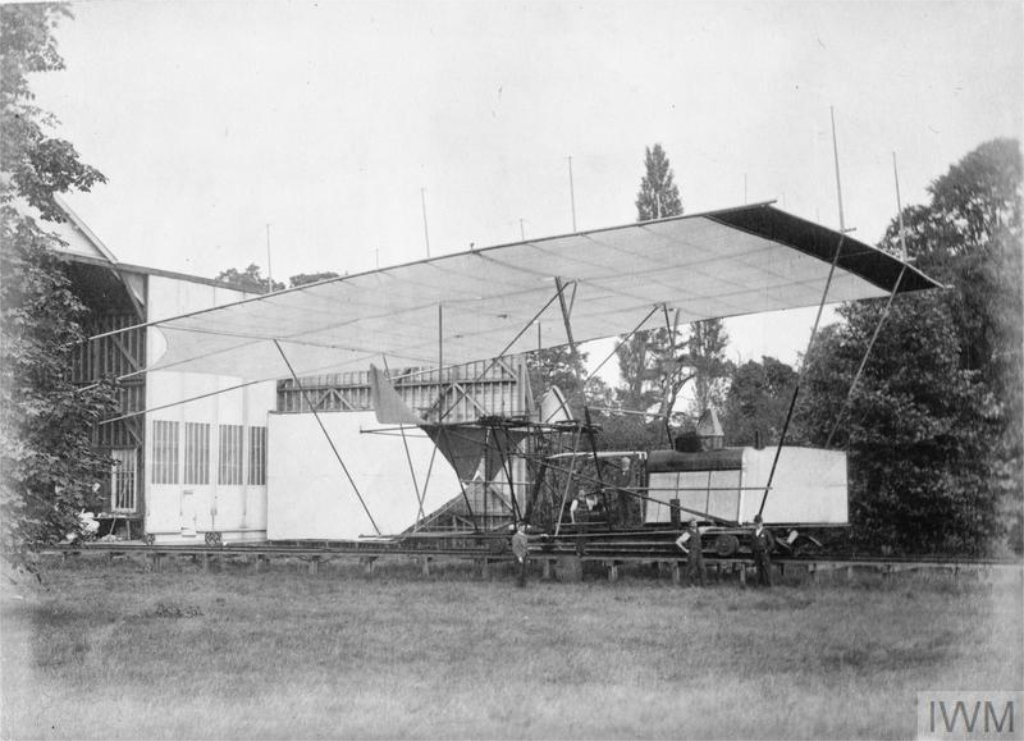
In 1889, Hiram Maxim began construction of a large experimental biplane. The aircraft was 12 m (40 ft) long, weighed 3.5 tonnes (7716 lbs) and had a wingspan of 34 m (110 ft). It was powered by two 180 hp steam engines that drove two wooden propellers, each measuring 5.2 m (17 ft) in diameter.
The aircraft was initially intended as a test rig, and Maxim never expected it to fly. He built a long rail track at Baldwyn’s Park in Bexley to conduct his experiments. In addition, to prevent the machine from becoming airborne, it was fitted with heavy cast-iron wheels and later with four-wheeled outriggers.
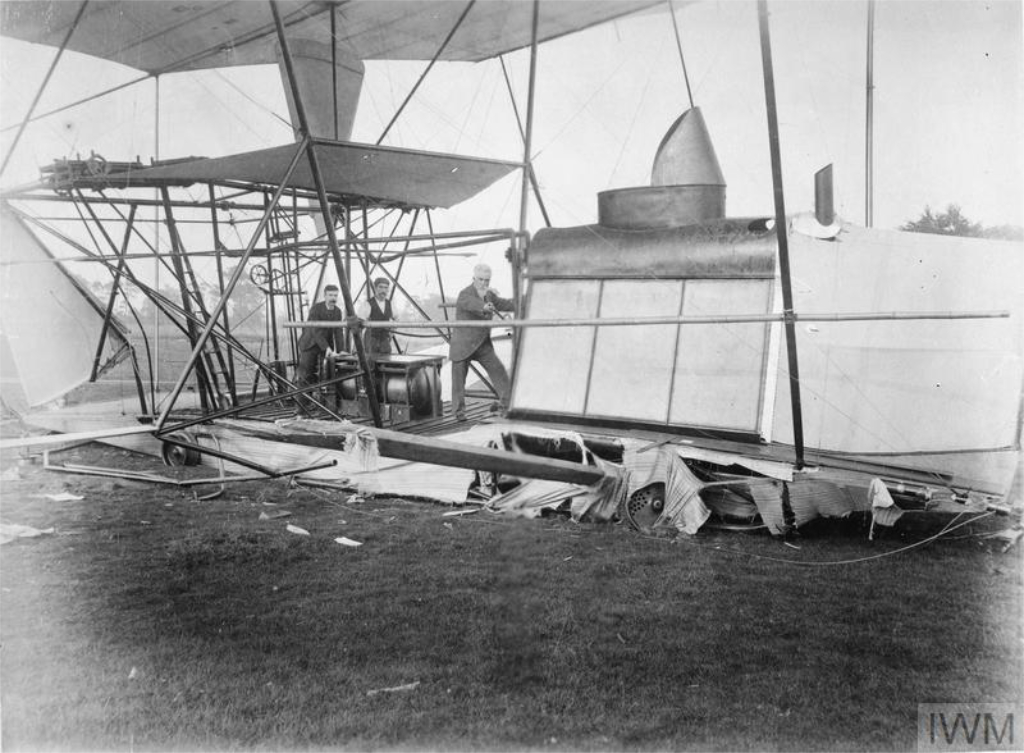
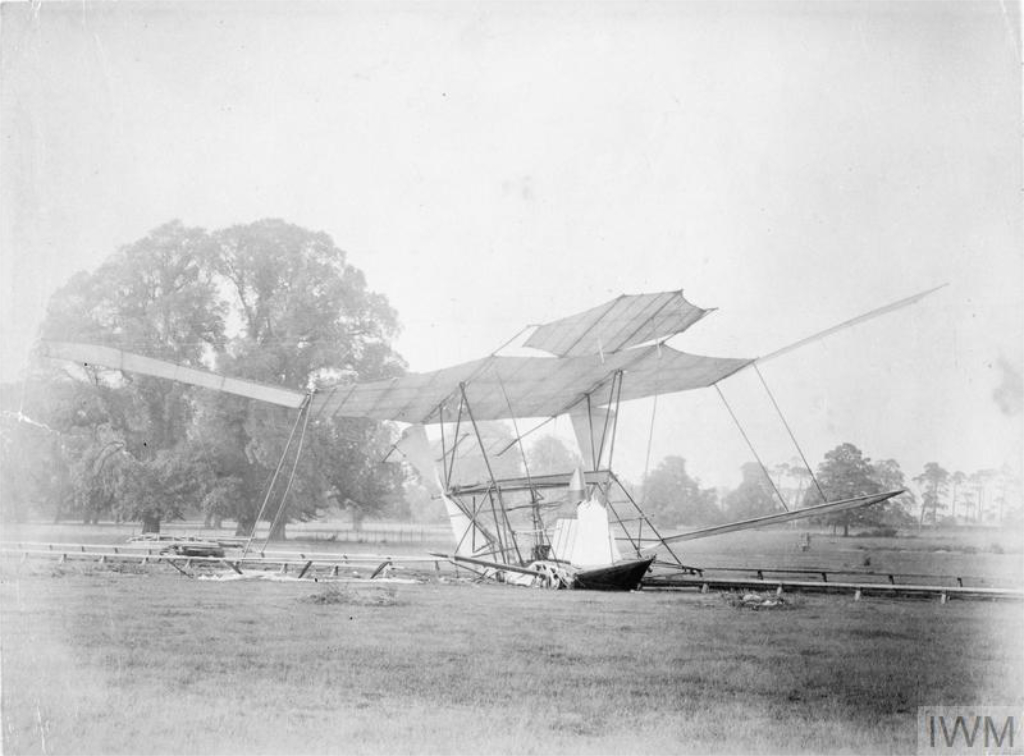
However, on 31 July 1894, during one of the tests, Maxim’s biplane became airborne, with the inventor and three other people on board. The aircraft generated sufficient lift to leave the rails and fly uncontrolled for approximately 600 ft at an altitude of less than one metre (3 ft) and at a speed of around 40 mph before coming to a halt.
Based on the test results, Maxim concluded that steam engines would not provide sufficient power for practical aircraft and that an internal-combustion engine was essential. However, he abandoned further work on flying machines due to his deteriorating health and the fact that the land at Baldwyn’s Park was required for public use.
Sir Hiram Stevens Maxim died on 24 November 1916, at the age of seventy-six.
Besides the machine gun, his long list of inventions included a pocket menthol inhaler, eyelet and riveting machines, aircraft artillery, an aerial torpedo gun, coffee substitutes, a wide range of oil, steam and gas engines, a mousetrap, an automatic sprinkler system, and water and vacuum pumps.
Cover photo: Sir Hiram Stevens Maxim (photo: Library of Congress, George Grantham Bain Collection, LC-B2- 4064-2)
All Imperial War Museums´ photos used under IWM Non-Commercial licence.