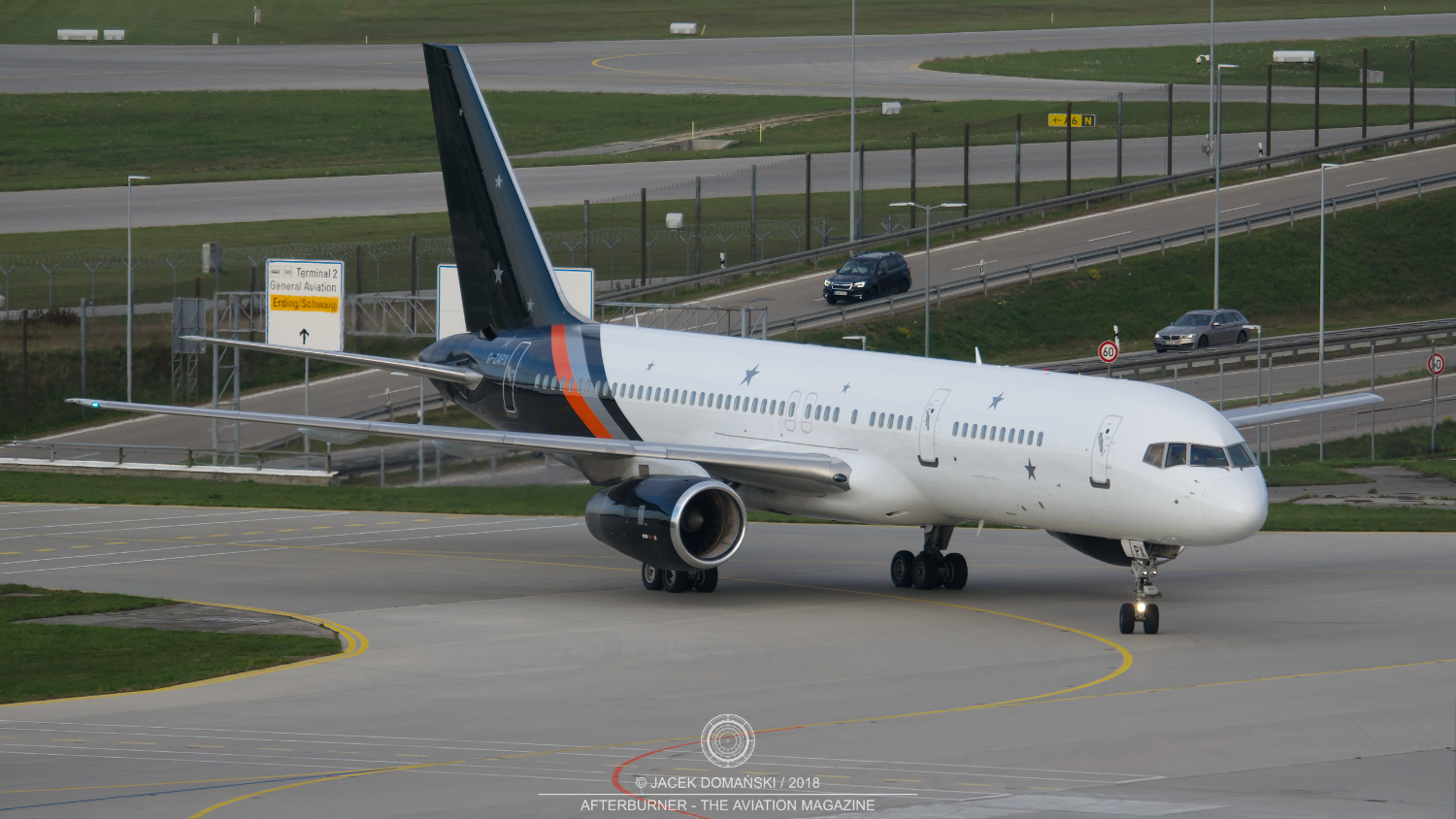
 Boeing 757-200 (c/n 29309-936, G-ZAPX of Titan Airways), taxiing at Franz Josef Strauss Airport, Munich Airport, October 2018.
In the mid-1970s, Boeing began working on a successor to the company’s best-selling narrow-body airliner, the 727. Initially, development followed two paths: a stretched version of the 727 and a completely new aircraft, designated the 7N7.
Although upgrading the existing design seemed like the easier and cheaper option, studies carried out by the company clearly showed that there was much greater potential in a new, modern aircraft. Consequently, work on the stretched 727 was abandoned and, from 1978 onwards, Boeing focused solely on the 7N7.
Initially, the airliner was planned to enter the market in only two variants: the 7N7-100 for 160 passengers and the 7N7-200 with more than 180 seats. As early as August 1978, the new aircraft was pre-ordered by Eastern Air Lines and British Airways, which committed to purchasing at least forty examples of the new jet. In March of the following year, the contracts were officially concluded and the aeroplane was given its name, the Boeing 757.
The new Boeing airliner was developed with the aim of improving its overall efficiency compared with previous generations of passenger jets. This was to be achieved by use of modern lightweight materials, improved aerodynamics, new engines and reduced fuel consumption.
On 13 January 1982, the prototype of the new airliner rolled out of the Boeing plant in Renton. A month later, on 19 February, the 757 successfully completed its maiden flight. The prototype was built in the 757-200 configuration, as development of the shorter variant had already been abandoned due to a lack of customer interest.
Interestingly, the prototype, as well as the aircraft completed for the two aforementioned launch customers, were equipped with two Rolls-Royce RB211-535C turbofan engines. The powerplant was selected by the airlines and it was the first time a Boeing passenger aircraft had been equipped with engines manufactured outside the United States.
The 757 entered operational service on 1 January 1983, flying with Eastern Air Lines from Atlanta to Tampa. British Airways followed on 9 February of the same year, when the new Boeing airliner entered service on the London–Belfast route.
Although both launch customers confirmed the efficiency of the new 757 jet and stated that it met their expectations, initial sales were very slow. Among the main reasons were fuel prices and competition from existing, smaller airliners. The situation only changed in the late 1980s, partly due to new noise regulations.
Within a short time, the 757 became one of the most popular airliners in the United States, replacing the ageing Boeing 707 and 727, as well as the Douglas DC-8 fleets. The new jet also became popular in Europe, with British Airways, Iberia and Icelandair being among the largest customers of the 757.
The Boeing 757 was manufactured until 2004, when it was effectively succeeded by the 737 Next Generation family. More than 1,000 examples of the aircraft were built and operated by airlines all over the world.
The aircraft was produced in four main variants, including the initial 757-200 version, the 757-200PF freighter introduced in 1985, the 757-200M that entered the market in 1986 and was a passenger-freighter combi variant, and the stretched 757-300, which was introduced in 1999. Additionally, several modifications and upgrades of the main versions existed, as well as special variants developed for corporate, VIP and government customers.
Interestingly, one example of the 757 was converted into a testbed aircraft in 1998 and used for testing avionics and other equipment intended for the Lockheed Martin F-22 Raptor stealth fighter. Another 757 testbed was used by BAE Systems within the Tempest sixth-generation fighter programme.
The Boeing 757-200 featured in our Photo of the Week series was manufactured in 2000 and was initially operated by Iberia, registered as EC-HIS. However, most of its service life was linked with Titan Airways, as G-ZAPX. Although the seating configuration was changed several times, it mostly followed the Y202 standard, offering 20–40 business-class seats and 108–162 standard seats.
In mid-2023, this 757 reached the end of its service life. The aircraft was purchased by Jet2 and initially registered as G-LSAO. However, within a short time it was permanently grounded and used as a source of spare parts for the Jet2 fleet.