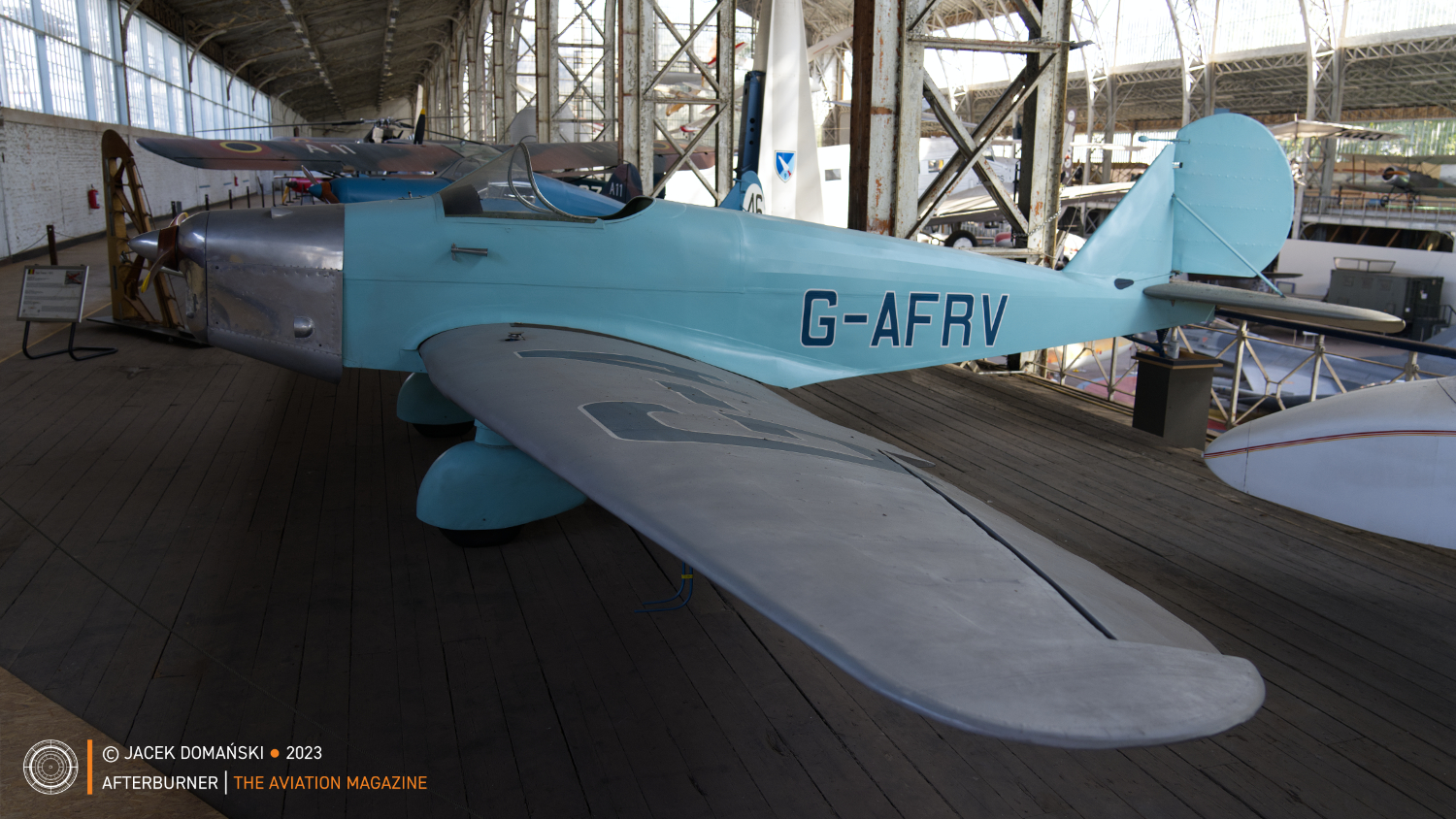
 Tipsy Trainer 1 (c/n 10, G-AFRV), exhibited at the Royal Museum of the Armed Forces and Military History, Brussels, September 2023.
Ernest Oscar Tips, born on 2 October 1893 in Tielrode, was a Belgian aircraft designer and aviation pioneer. In 1908, together with his brother Maurice, Ernest Tips built his first canard aeroplane, followed by a biplane they built a year later.
During the Great War, Ernest Tips studied aeronautical engineering at Short Brothers and became a close friend of Charles Richard Fairey. In 1915, Fairey and Tips founded the Fairey Aviation Company. After the war, Tips returned to Belgium and, in 1931, opened a subsidiary of the company there, named Avions Fairey.
Until the outbreak of the Second World War, Avions Fairey was one of the suppliers of aircraft to the Belgian Air Force, providing the Fairey Firefly II, Fox, Fantôme and Battle. In addition, Ernest Tips created a whole family of light civil and sports aircraft that achieved great success and became widely known as “Tipsy”. These included the single-seat Tipsy S and S.2, the tandem-seat Tipsy M trainer, and the Tipsy B, which featured a side-by-side seating configuration.
The Tipsy B was developed in the mid-1930s, alongside the aforementioned Tipsy S and S.2. The aeroplane successfully completed its maiden flight on 8 May 1937. Soon afterwards, series production began at both Avions Fairey and the UK-based Tipsy Light Aircraft Company.
The two-seat Tipsy B was similar to its predecessors. It was a single-engine, cantilever monoplane with a wooden frame covered with plywood and fabric. The aircraft was equipped with a conventional fixed undercarriage and powered by a 60 hp Walter Mikron four-cylinder in-line engine.
A total of twenty-four Tipsy B aircraft had been built by May 1940. They were completed in both open- and enclosed-cockpit configurations, designated the Tipsy B and Tipsy Bc, respectively.
However, the British factory encountered certification issues with its Tipsy aircraft. The aviation authorities questioned the design of the rudder, and, as a remedy, its area was increased by approximately 18%. Following this modification, the aircraft received its certificate of airworthiness and was renamed the Tipsy Trainer. Another change was introduced with the ninth aircraft, whose maximum permitted weight was increased to 544 kg, compared with 450 kg for the initial variant. This aircraft was subsequently designated the Tipsy Trainer 1.
During the war, the Belgian company’s personnel were evacuated to England, where they worked for Fairey. Production of the Tipsy B / Trainer aircraft resumed after the war, bringing the total number built to forty-two.
The Tipsy Trainer 1 featured in our Photo of the Week series was built in 1939 and registered as G-AFRV. According to information available at the Royal Museum of the Armed Forces and Military History, the aircraft was damaged in an accident at the end of that year, but was subsequently repaired and flew again in 1941.
However, the Tipsy Trainer 1 was involved in another accident on 15 September 1979. The aircraft was classified as damaged beyond repair, and its registration was finally cancelled in 1987.
Two years later, G-AFRV was acquired by the Belgian museum. In 2005, the Brussels Air Museum Restoration Society began restoring the aircraft. After almost ten years of hard work, which included constructing of new wings and a new tail, the Tipsy Trainer 1 took its place in the museum’s exhibition, next to the Avions Fairey Belfair, a two-seat light aircraft produced by the company in the 1950s.