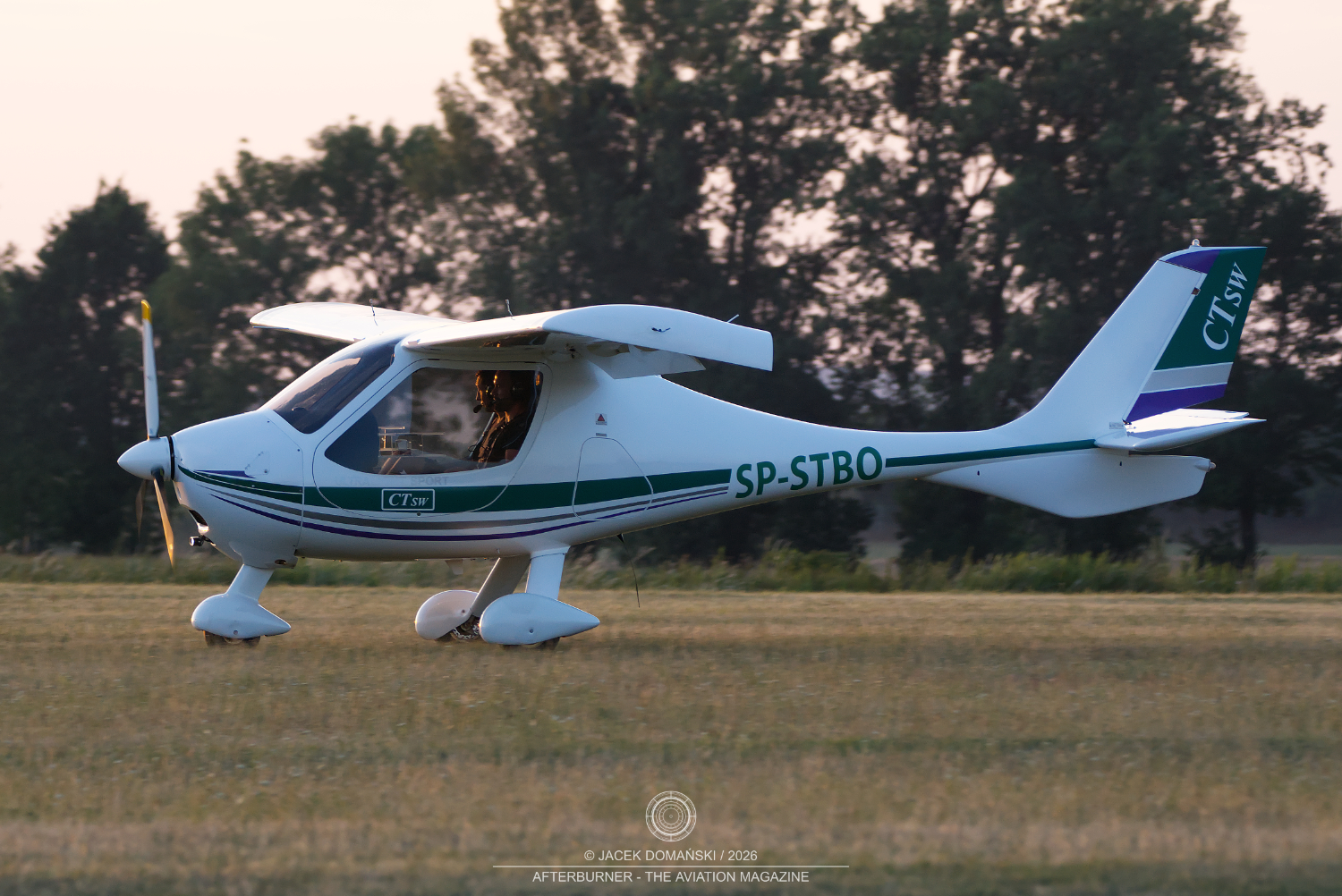
 Flight Design CTSW (c/n 05-10-13, SP-STBO), taxiing on the runway at Świebodzice airfield, Świebodzice, July 2026.
The CT (standing for “composite technology”) range of light aircraft was developed in the mid-1990s by Flight Design GmbH, a German company founded by Matthias Betsch and based in Leinfelden-Echterdingen, near Stuttgart.
The CT aircraft were designed as ultralight-microlight aeroplanes. The first, basic CT model made its maiden flight in March 1996 and was subsequently certified by EASA. Although the aircraft was developed by the German company, its serial production was launched at a manufacturing plant in Ukraine.
The CT is a two-seat, high-wing monoplane equipped with fixed tricycle landing gear. The aeroplane is powered by a single 80 or 100 hp Rotax 912 engine and features an all-composite structure made of carbon fibre and Kevlar.
Although the aeroplane is mainly intended for recreational flying, it can also be used for glider towing. Reportedly, when the CT was being developed, there was also an idea to offer the aeroplane to military and law enforcement customers as a light reconnaissance and surveillance aircraft. This was supposed to have a significant impact on the aircraft’s design, including its high-mounted wings and detachable doors to allow the installation of surveillance cameras.
However, the CT failed to generate interest among military customers. On the other hand, the aircraft became one of the most popular ultralight aeroplanes in the world. The aforementioned European certification was soon followed by ones from FAA, Canadian and Chinese authorities. In the mid-2000s, CT aircraft were being manufactured at a rate of ten examples per month. In 2015, a second production plant was opened in China.
Over the years, the CT concept underwent constant development. In 1999, the improved second-generation CT2K was introduced to the market. The following year, it replaced the basic version. Soon, the CT model range was supplemented by the CTSW (“composite technology short wing”). It featured a shorter wingspan and redesigned wings, and was equipped with a Ballistic Recovery System parachute and a simplified autopilot. In addition, the CTSW was powered by a 101 hp Rotax engine and offered a higher cruise speed.
In 2008, the CTLS (“light sport”) version was introduced, followed by the CTHL (“high lift”) variant for glider towing. In 2020, the F2 model was developed, intended for flight training.
In 2017, Flight Design was acquired by German LIFT Air GmbH, with its headquarters at Eisenach/Kindel airfield. Currently, the company offers three variants of the aircraft – the CTLS, the CT Super Series (an upgraded derivative of the CTSW) and the F2.
According to the manufacturer’s website, more than 1,900 aircraft from the CT family have been produced to date. They have been sold to 43 countries worldwide.
Interestingly, CT aircraft have been used at least twice to circumnavigate the world. In 2007, a single CTSW microlight was flown by Wing Commander Rahul Monga and Wing Commander Anil Kumar of the Indian Air Force to mark the service’s Platinum Jubilee. Their round-the-world flight covered 40,497 kilometres across 19 countries, with a cumulative flight time of 247 hours.
This feat was repeated in 2010 by two Swiss pilots, Yannick Bovier and Francisco Agullo, who flew two CTLS aircraft around the world. Their expedition, known as “Azimut 270”, commemorated the 100th anniversary of Swiss aviation. The flight lasted 51 days and covered 44,000 kilometres.