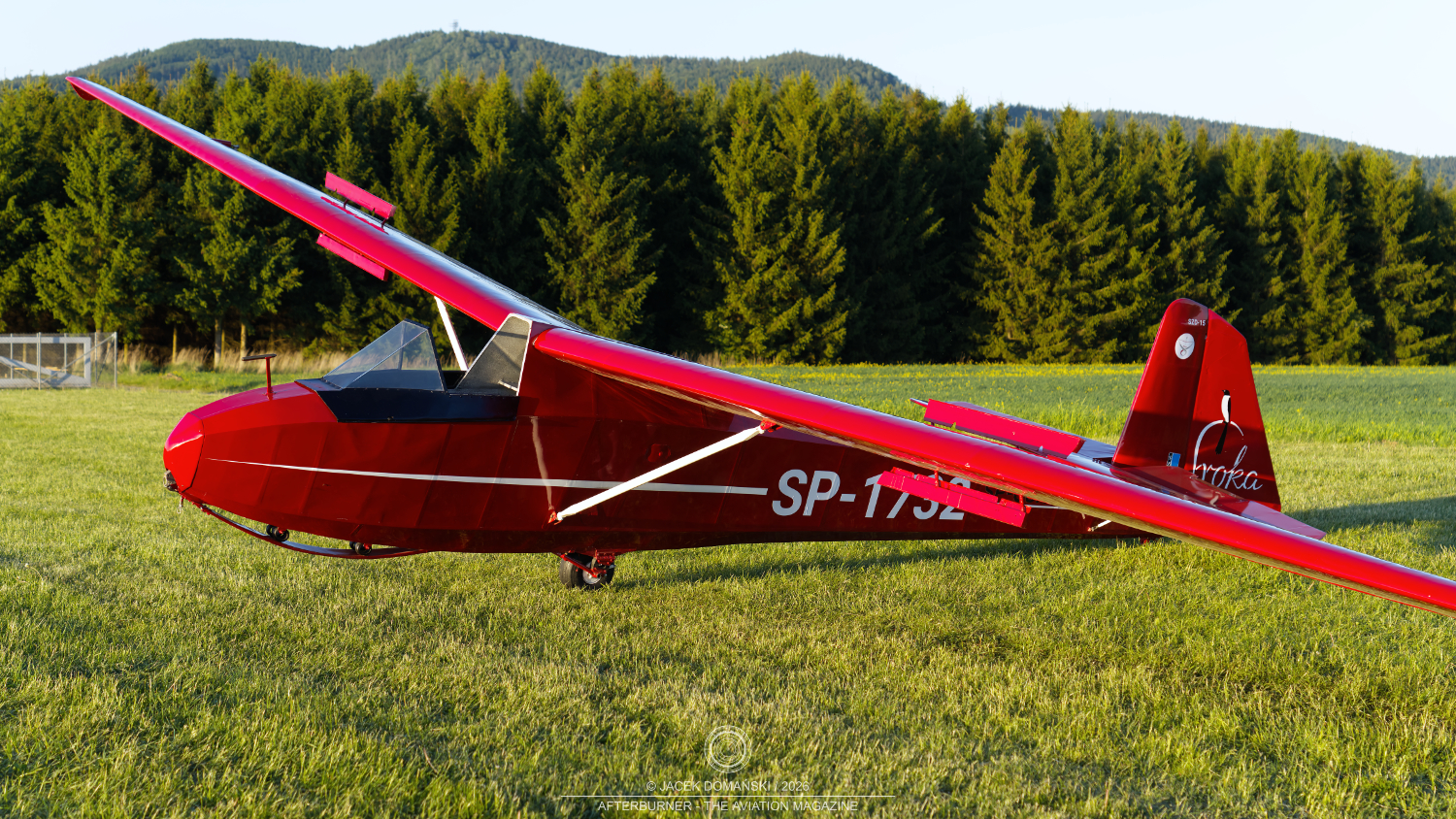
 SZD-15 Sroka (c/n: ?, SP-GSKA, formerly SP-1732 and Ла-0451) participating in the International Vintage Glider and Classic Hang Glider Rally, Witków, May 2026.
The new Polish sailplane, later known as the SZD-15 Sroka (Eurasian magpie), was created on the initiative of Liga Przyjaciół Żołnierza (the League of Soldier’s Friends), a paramilitary organisation that, in the 1950s, was responsible for sport aviation in Poland.
The sailplane was intended to replace the IS-B Komar (Mosquito), a glider developed in the late 1940s but with its origins dating back to the mid-1930s. In 1955, Liga Przyjaciół Żołnierza defined the technical requirements for the new aircraft and assigned its development to Szybowcowy Zakład Doświadczalny (Glider Experimental Works – SZD) in Bielsko-Biała.
However, those requirements did not differ significantly from the characteristics of the IS-B. Therefore, SZD attempted to propose a more advanced design, named the SZD-16 Gil (Eurasian bullfinch), but this idea was rejected by the authorities.
SZD therefore began developing a new glider in accordance with the original specification. Initially designated the SZD-16 Pionier (Pioneer), the sailplane was designed by Zbigniew Badura.
On 25 February 1956, the first prototype, already officially renamed Sroka and registered as SP-1598, made its maiden flight. It soon became apparent that the aircraft had numerous shortcomings and required substantial redesign. The second, revised prototype, registered as SP-1718, made its first flight on 1 February 1957.
Although Sroka was soon approved for serial production, the glider never gained much popularity. This was largely due to its flight characteristics, which offered no real improvement over the IS-B. Reportedly, the production SZD-15s even performed worse than their predecessor.
In consequence, only twenty examples of the SZD-15 Sroka were built before production ceased. The completed gliders were allocated to aeroclubs, and few of them remained in service until the mid-1990s.
Interestingly, during the 1980s, some examples of Sroka were converted into powered gliders. These conversions, known (after the surnames of their designers) as the Zięba-Maj “Moto-Sroka“, Myśluk “Moto-Sroka” (also known as “Kubuś“), Maj “Moto-Sroka” and Koźmiński “Moto-Sroka“, were powered by Trabant, Volkswagen, Hirth or Rotax engines.
The glider SP-1732, featured in our Photo of the Week series, followed a similar path. In the mid-1980s, it was first converted into a motor glider by K. Zięba and M. Maj using a Trabant engine. The aircraft was subsequently purchased by K. Myśluk, restored and fitted with a Hirth engine.
Later, the Hirth engine was replaced with a 46 hp Rotax 503 powerplant. The glider subsequently flew with the Ukrainian registration Ла-0451 and carried the name Lady in Red.
In the early 2020s, the aircraft was acquired by the newly established Muzeum Szybownictwa Polskiego (Museum of Polish Gliding) and restored to its original configuration.
During the last weekend of May 2026, the rare SZD-15 Sroka sailplane took part in the International Vintage Glider and Classic Hang Glider Rally. The event was held at Witków airfield in Poland, where our featured photograph was taken.