On 22 April 1991, the Lockheed YF-22, developed by Lockheed in cooperation with Pratt & Whitney, was announced the winner of the United States Air Force competition for a new air-dominance fighter.
The origins of the Advanced Tactical Fighter (ATF) programme date back to 1981, when the USAF issued requirements for a next-generation air superiority fighter under the codename ‘Senior Sky’. The aircraft was intended to replace the McDonnell Douglas F-15 Eagle and complement the General Dynamics F-16 Fighting Falcon, while also countering the emerging Soviet designs such as the Sukhoi Su-27 and Mikoyan MiG-29.
The new fighter was to incorporate advanced technologies, including stealth capabilities, powerful engines and sophisticated flight control systems. However, many initial requirements proved to be either too costly or impractical, leading to the abandonment of features such as STOL capability and certain sensor systems.
Following a competitive process, Lockheed and Northrop were selected to build demonstrators. In consequence, two prototypes were created: the YF-22 and the Northrop YF-23. Both aircraft flew in 1990 and underwent extensive evaluation.
Ultimately, the YF-22 was selected due to its superior manoeuvrability, thrust-vectoring capability, and lower projected cost, despite the YF-23’s more advanced and unconventional design. This decision marked the start of the Engineering and Manufacturing Development (EMD) phase, leading to the first pre-production aircraft, later designated the Lockheed Martin F-22 Raptor.
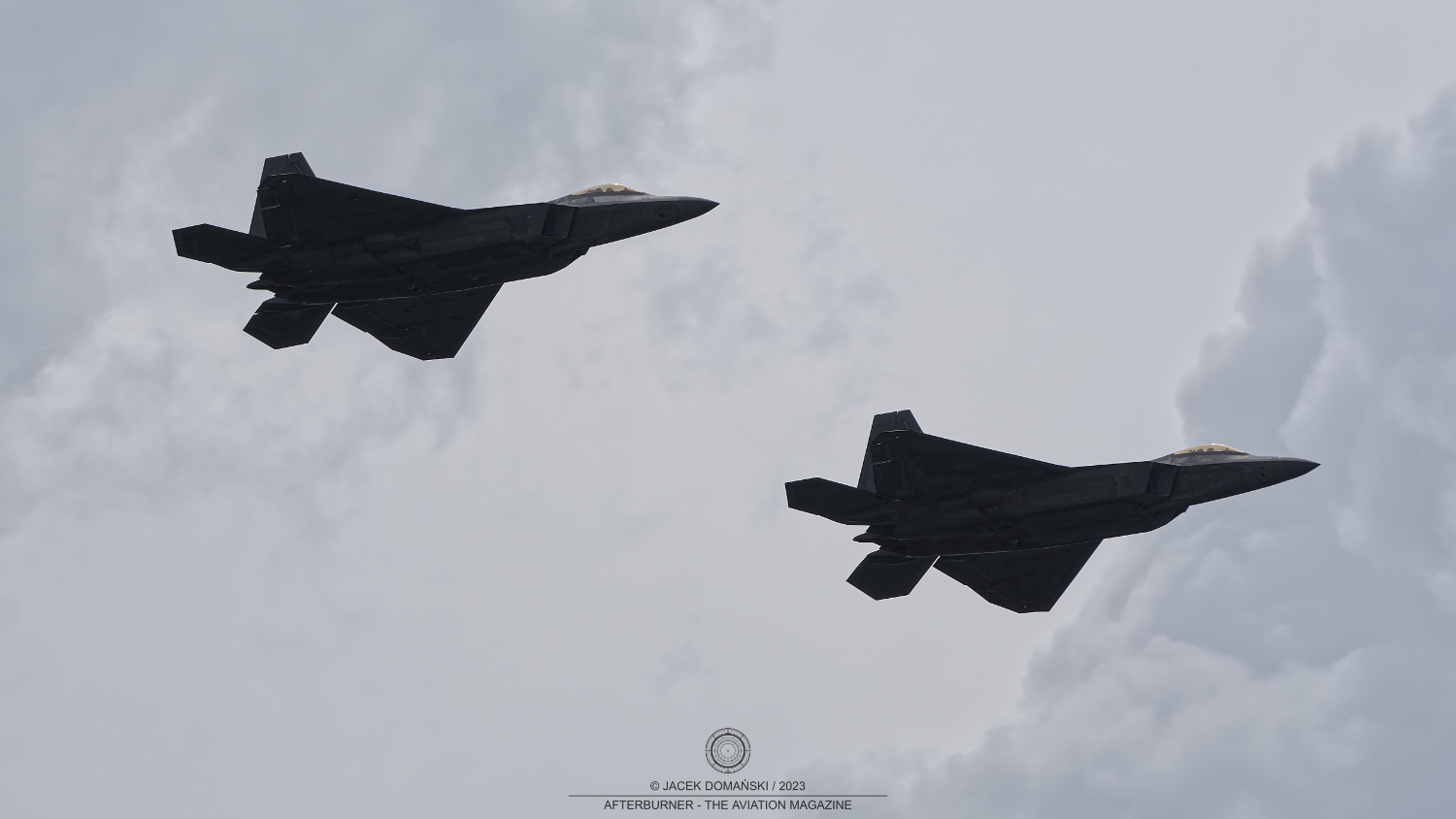
The first F-22 EMD aircraft was unveiled in 1997 and flew later that year. Despite initial plans to procure up to 750 aircraft, rising costs and political pressure resulted in successive reductions, and ultimately only 187 operational aircraft were produced before production ended in 2011.
The ATF programme became one of the most expensive fighter projects in history, with total costs exceeding 65 billion USD. Export of the F-22 was prohibited by US law to protect its advanced technologies and equipment.
Although production has not been restarted, the F-22 fleet remains in service thanks to extension of its structural life. Modernisation programmes continue, including the recently announced “Raptor 2.0” initiative, which was unveiled at the 2026 Air and Space Forces Association Warfare Symposium. The upgrade package includes improved sensors, extended range, enhanced stealth capabilities and modernised avionics.
The upgraded F-22 is intended to maintain US air superiority against emerging threats, particularly those posed by China. It will also serve as a bridging solution until the next-generation air dominance platform is introduced.