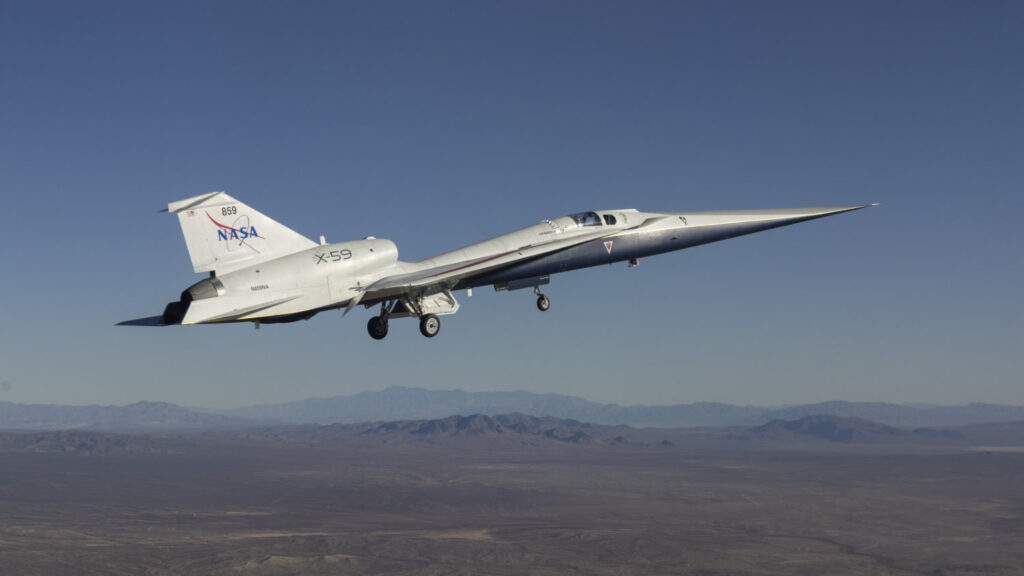
 On Friday, 20 March 2026, NASA’s X-59 Quiet Supersonic Technology (QueSST) aircraft made its second flight, followed by the third flight a week later.
For its second flight, the aeroplane took off from the Edwards Air Force Base, located near the NASA Armstrong Flight Research Center, on 20 March at 10:54 a.m. PDT (17:54 UTC). Unfortunately, the flight lasted only a short time due to a technical issue.
Just a few minutes after take-off, the X-59 pilot, Jim “Clue” Less, noticed that one of the warning systems on the aircraft had activated. Following standard flight procedures, he returned the aeroplane to base and landed safely at 11:03 a.m. PDT (18:03 UTC).
“As we like to say, it was just like the simulator – and that’s what we like to hear,” said the test pilot Jim Less. “This is just the beginning of a long flight campaign.”
“Despite the early landing, this is a good day for the team. We collected more data, and the pilot landed safely,” stated Cathy Bahm, project manager for NASA’s Low-Boom Flight Demonstrator at the NASA Armstrong Flight Research Center in Edwards, California. “We’re looking forward to getting back to flight as soon as possible.”
The technical issue was soon revealed to be a false positive. During the post-flight investigation, it was found that the warning had been triggered by one of the instrumentation indicators being installed incorrectly. The engineering team working on the X-59 project managed to resolve the issue quickly.

According to information published on the official Facebook account of NASA Aeronautics Directorate, the X-59 experimental aircraft took to the skies again on Thursday, 26 March 2026, successfully completing its third test flight. However, neither NASA nor the manufacturer of the aeroplane, Lockheed Martin Skunk Works, has released any further details to date.
The X-59 aircraft is set to undergo a series of flight tests in 2026 to demonstrate its performance and airworthiness. During this process, known as envelope expansion, the test aeroplane is expected to gradually fly faster and higher before reaching supersonic speeds.
The aim of the NASA QueSST mission and the X-59 experimental aircraft is to enable commercial supersonic flight over land by allowing aircraft to break the sound barrier while generating only a quiet thump instead of the usual loud sonic boom.
If you would like to learn more about the NASA QueSST mission and the X-59 aircraft, please check our previously issued articles:
- NASA X-59 Quiet Supersonic Aircraft officially revealed;
- X-59 QueSST aircraft successfully completes its maiden flight.
Cover photo: NASA’s X-59 quiet supersonic research aircraft lifts off for its first flight on Tuesday, 28 October 2025, from U.S. Air Force Plant 42 in Palmdale, California. (Source: NASA Image and Video Library, AFRC2025-0168-045).
In this article, press releases and other materials of the National Aeronautics and Space Administration were used. All photos and quotations © National Aeronautics and Space Administration.