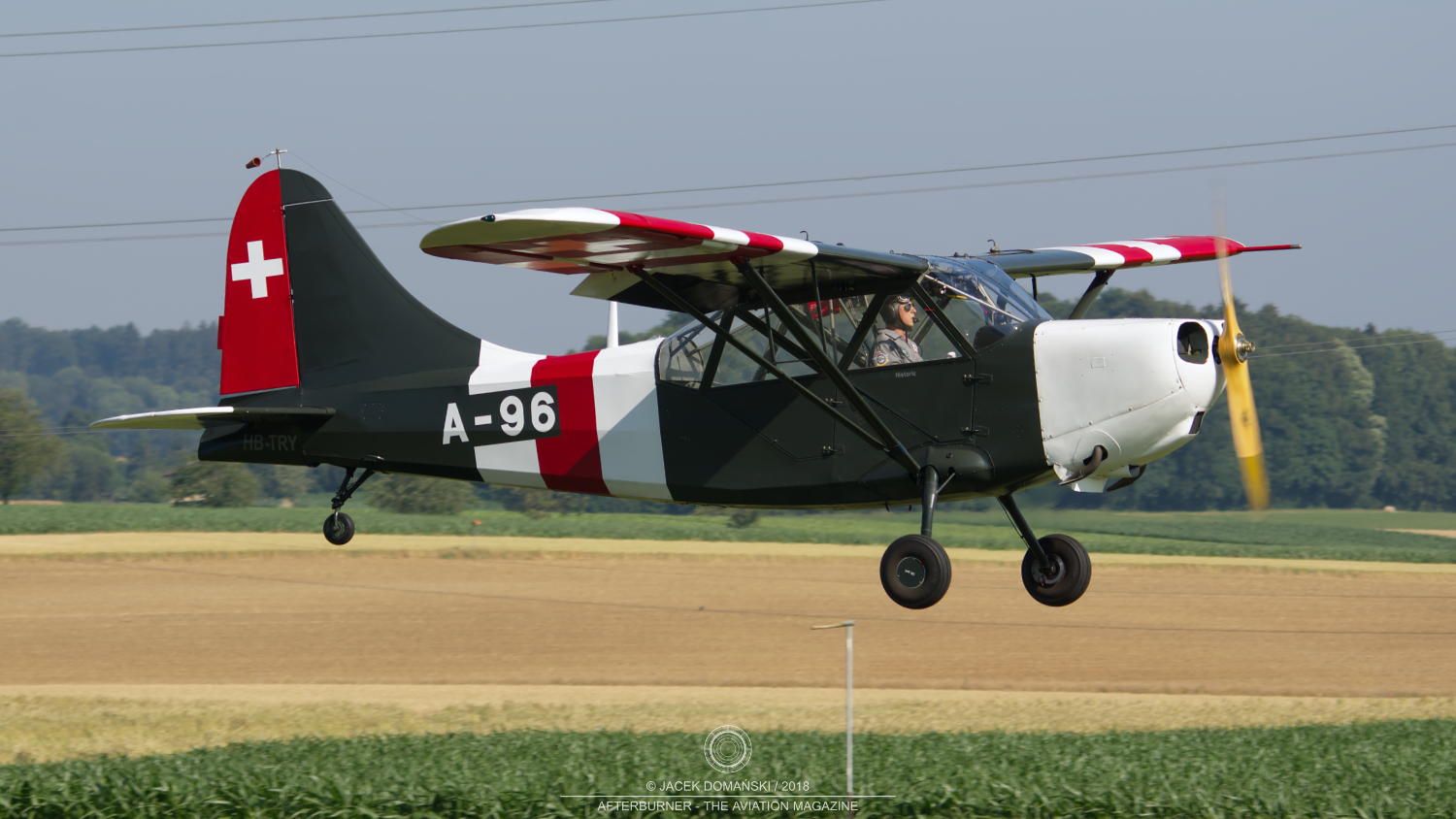
 Stinson L-5 Sentinel (c/n 76-142?, HB-TRY, formerly 42-99186 of the USAAF and A-96 of the Swiss Air Force), flying display at Flugtage Fricktal-Schupfart 2018 air show, Schupfart, July 2018.
In 1939, Stinson Aircraft Company introduced into market a high-wing light utility aircraft, designated the Stinson HW-75 (also known as the Model 105 or the Model 10, for a standard and an upgraded version, respectively). The aircraft achieved great market success and, before the USA entered the war, it was one of the most popular sport and training aircraft in the country.
In 1940, Stinson was acquired by Vultee Aircraft Corporation. Next year, the company developed another variant of the aircraft, the Model 10A Voyager, as well as an experimental aeroplane based on the original design. The latter, officially designated the Model 76 but commonly dubbed the “Flying Jeep”, performed the maiden flight on 23 June 1941. Shortly afterwards, it was proposed to the US military as a liaison and observation aircraft.
In January 1942, the aeroplane was approved for service and the first contract for the delivery of 275 examples of the Model 76 was signed. Initially, the aircraft received its military designation O-62 (O standing for “observation”) but within a few months it was changed to L-5 Sentinel (L for “liaison”).
The L-5 was widely used by the United States Army Air Forces, the United States Army Ground Forces and the United States Marine Corps. It was used for a variety of roles, including liaison and observation duties, officer transport, artillery spotting, medical ambulance, reconnaissance and aerial photography tasks, search-and-rescue missions, laying communication wires and aerial spraying. The L-5 was also used for propaganda purposes, such as dropping leaflets and broadcasting with external loudspeakers.
With almost 3,600 examples built by September 1945, the L-5 became the second most widely used liaison aircraft in the US military service, after the Piper L-4 Cub.
The A-96 aircraft featured within our Photo of the Week series has an interesting service history. Built in 1942, this L-5 was used as a liaison aircraft by the USAAF, with the military serial number 42-99186. In 1944, the aircraft was operated by the 324th Fighter Group in Europe.
On 12 October 1944, the aircraft was flying the liaison duties over France, piloted by 2nd Lt. Roy G. Abbot. During the flight, the L-5 crossed the Swiss border and immediately became a target for the country´s anti-aircraft units. The fire caused damage to fuel piping, forcing Abbot to land on Swiss teritory, just a few hundred metres from the French border. The aircraft was captured, repaired and then took over by the Swiss Air Force as the A-96.
After the war, Switzerland was required to return all the interned aircraft, including the Stinson A-96. The aeroplane was assigned to the American embassy in Bern and operated by the US Air Attaché until 1950. Then, the L-5 was sold to private owner and registered HB-TRY.
The Swiss Sentinel remained in active service until 1968. Next, the aircraft was used for exhibition purposes for more than a decade. In the early 2000s, the L-5 was carefully restored to airworthy condition.
Its second maiden flight took place in 2006. Since 2014, the L-5 has been flying with its former A-96 Swiss military livery from the late 1940s.