 On 13 February 1923, Charles Elwood “Chuck” Yeager, a USAF officer, combat ace, and test pilot, was born in Myra, West Virginia.
Chuck Yeager was born into a farming family. He spent his youth in West Virginia, where he attended Hamlin High School. Shortly after graduating, in September 1941, Yeager enlisted in the United States Army Air Forces (USAAF) and became an aircraft mechanic with the rank of private.
At that time, Yeager was not selected for pilot training because of his age and lack of the required education. However, soon after the United States entered the Second World War, the recruitment requirements were revised. In December 1942, Yeager again applied for flight training and was approved.
On 10 March 1943, Chuck Yeager graduated from pilot training and was assigned to the 357th Fighter Group. There, he was trained as a fighter pilot and sent to Europe in November of that year.
Based in the United Kingdom, Yeager was assigned to the 363rd Fighter Squadron, where he flew the North American P-51 Mustang. His personal aircraft was named Glamorous Glen, after his girlfriend, Glennis Faye Dickhouse.
During his operational career in Europe, Yeager was shot down over France. With the help of the French Resistance, he managed to escape to Spain and then returned to England. In October 1944, the young American pilot became an “ace in a day” when he shot down five enemy aircraft during a single engagement. In total, Yeager was credited with a total of 11.5 aerial victories on the Western Front.
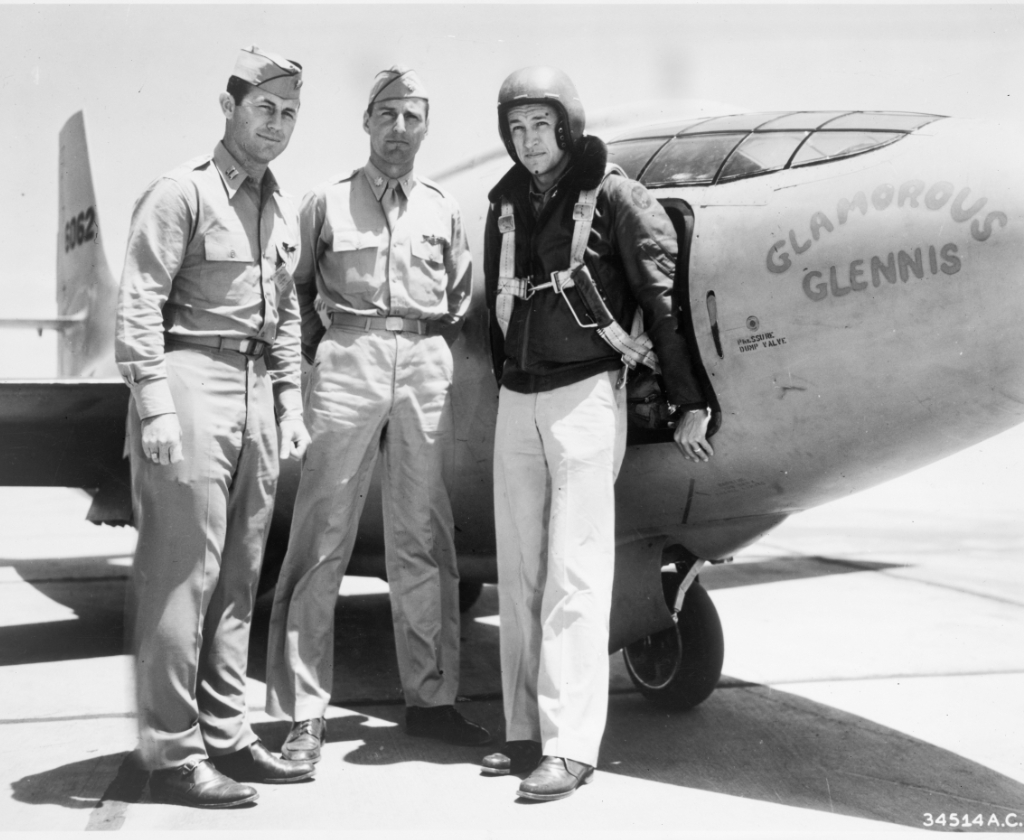
In February 1945, Yeager returned to the United States and married his girlfriend. He remained with the USAAF, becoming a test pilot at an airfield which is now known as Edwards Air Force Base. One of Yeager’s first assignments as a test pilot was to participate in the programme to break the sound barrier.
The American supersonic research programme was launched in 1944. It led to the creation of the X-1 rocket-powered experimental aircraft (also known as the Model 44 or XS-1), built by Bell Aircraft. In January 1946, the X-1 made its first flight, flown by Bell’s chief test pilot, Jack Woolams.
When Woolams was killed in August of the same year during the National Air Races, the position of primary X-1 test pilot was assigned to Chalmers “Slick” Goodlin. Together with Bell’s new chief test pilot, Alvin M. Johnston, he conducted a series of evaluation flights, bringing the X-1 close to the sound barrier.
However, as Yeager noted in his memoirs – and as several publications on the supersonic test programme have mentioned – Goodlin demanded an extraordinary bonus of USD 150,000 (an equivalent to approximately USD 2.2 million today) for breaking the sound barrier. As a result, the USAAF (and later, from September 1947, the United States Air Force) began searching for another pilot to undertake the high-speed phase of the programme. And it was Chuck Yeager who was selected for the task.
The historic flight was scheduled for 14 October 1947. However, it nearly had to be cancelledc when Yeager broke two ribs after falling from a horse two days earlier. The injury would normally have ruled him out of the mission. However, the young pilot kept the injury secret, had his ribs taped by a local doctor, and asked his friend and fellow test pilot, Jack Ridley, to help him get into the aircraft.
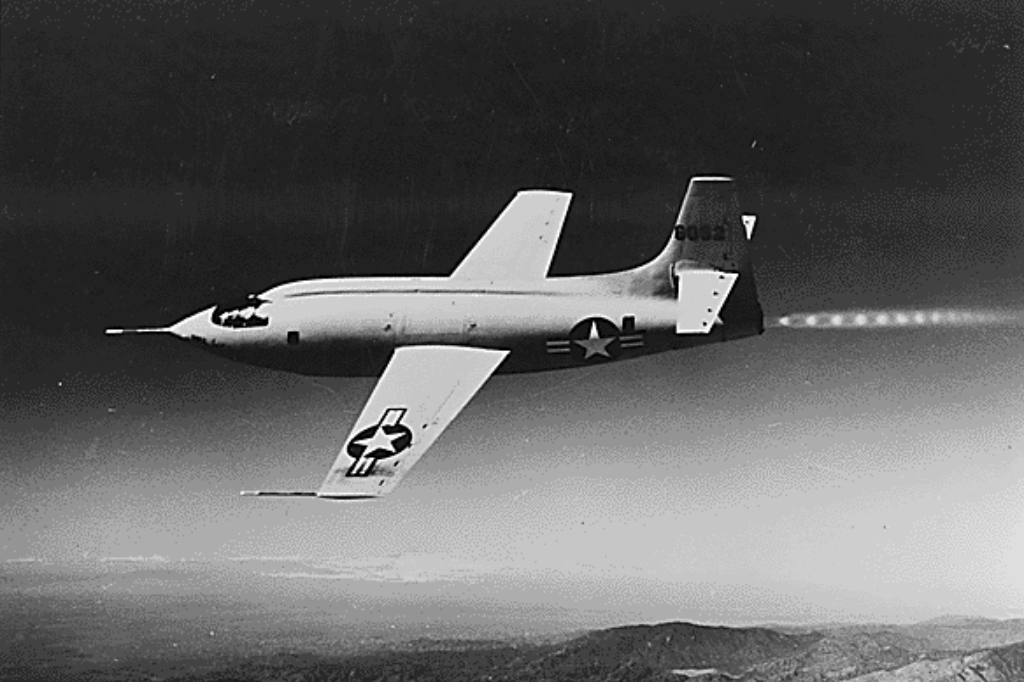
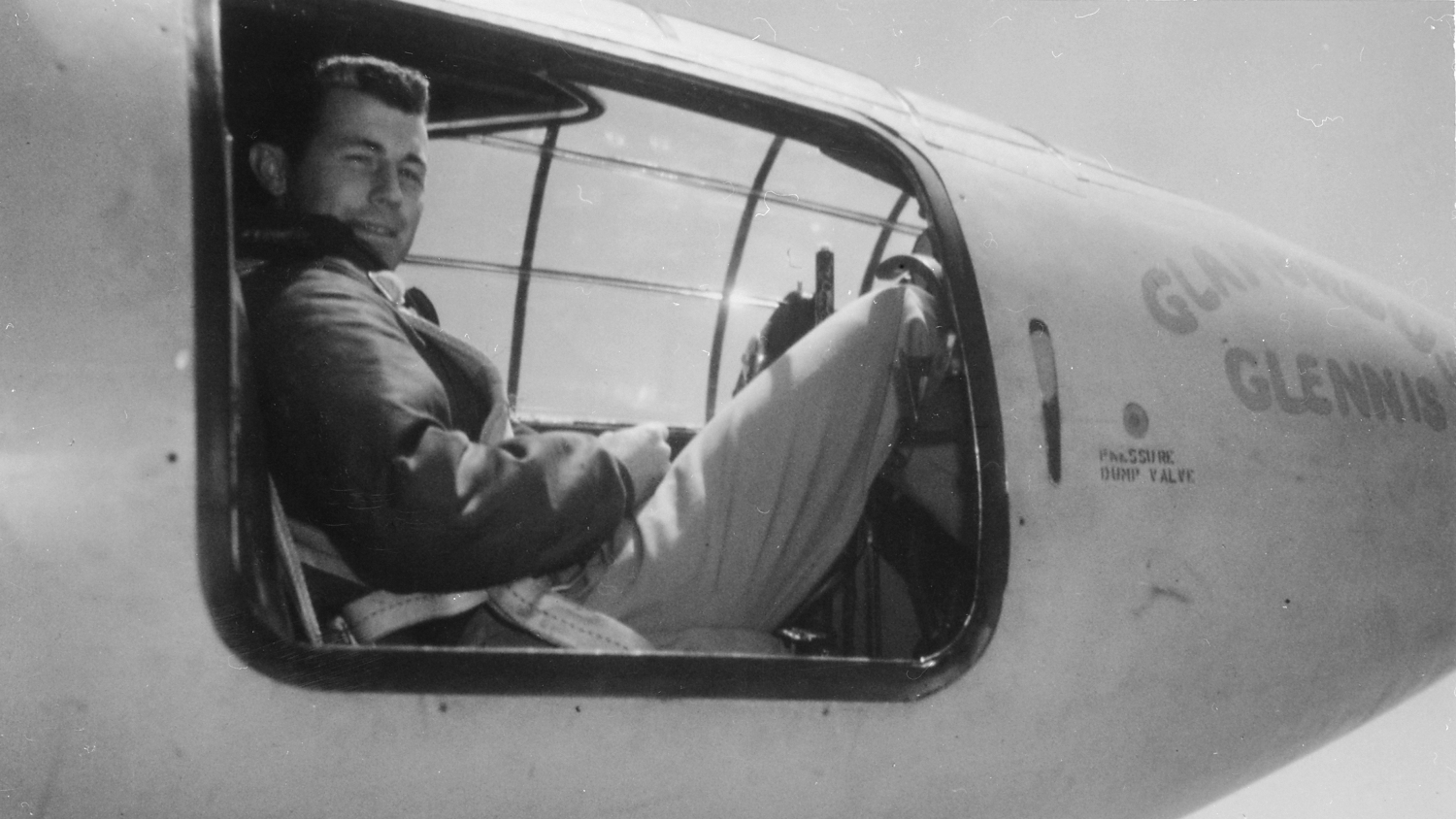
On 14 October 1947, the X-1 serial number 46-062, named Glamorous Glennis and flew by Chuck Yeager, was air-launched from a B-29 Superfortress. At an altitude of 45,000 ft (13,700 m), the aeroplane reached a speed of Mach 1.06 (1,127 kph; 700 mph). This made the X-1 and its pilot the first to officially fly faster than the speed of sound.
The supersonic test programme continued into the following year. The X-1 completed a total of seventy-eight test flights. On 26 March 1948, piloted by Yeager, the aircraft reached a speed of Mach 1.45 (1,540 kph; 957 mph) at an altitude of 71,900 ft (21,900 m). This was the highest speed achieved during the programme and the highest velocity attained by a manned aircraft at the time.
Following the completion of the supersonic test programme, Yeager continued his career as a military test pilot. In 1952, he attended the Air Command and Staff College. From the next year, the record-breaking pilot was involved in another milestone project, this time aimed at exceeding Mach 2 in level flight.
The goal was first achieved in November 1953 by Scott Crossfield in the Douglas D-558-II Skyrocket experimental aircraft. However, Yeager and Ridley decided to use the X-1A to beat this record.
On 12 December 1953, Yeager reached a speed of Mach 2.44 while flying at an altitude of approximately 80,000 ft (24,000 m). During the flight, the aircraft experienced inertial roll coupling, a catastrophic high-speed flight phenomenon that was not understood at the time. Yeager lost control of the aircraft, falling approximately 51,000 ft in roughly one minute, before regaining control of the X-1A. This extraordinary feat earned him the Distinguished Service Medal, awarded in 1954.
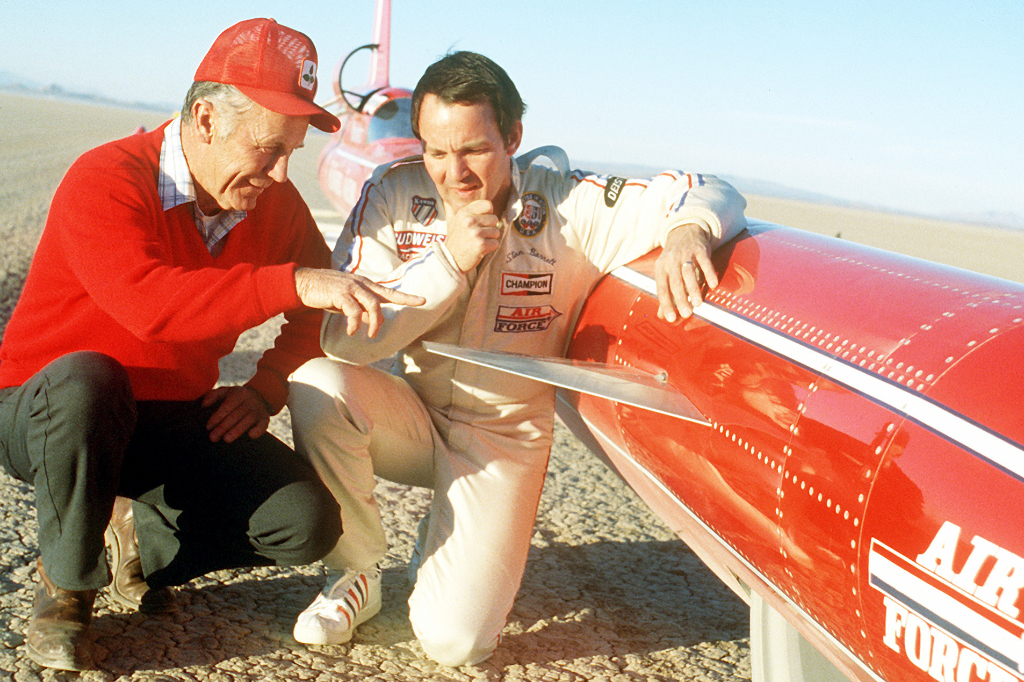
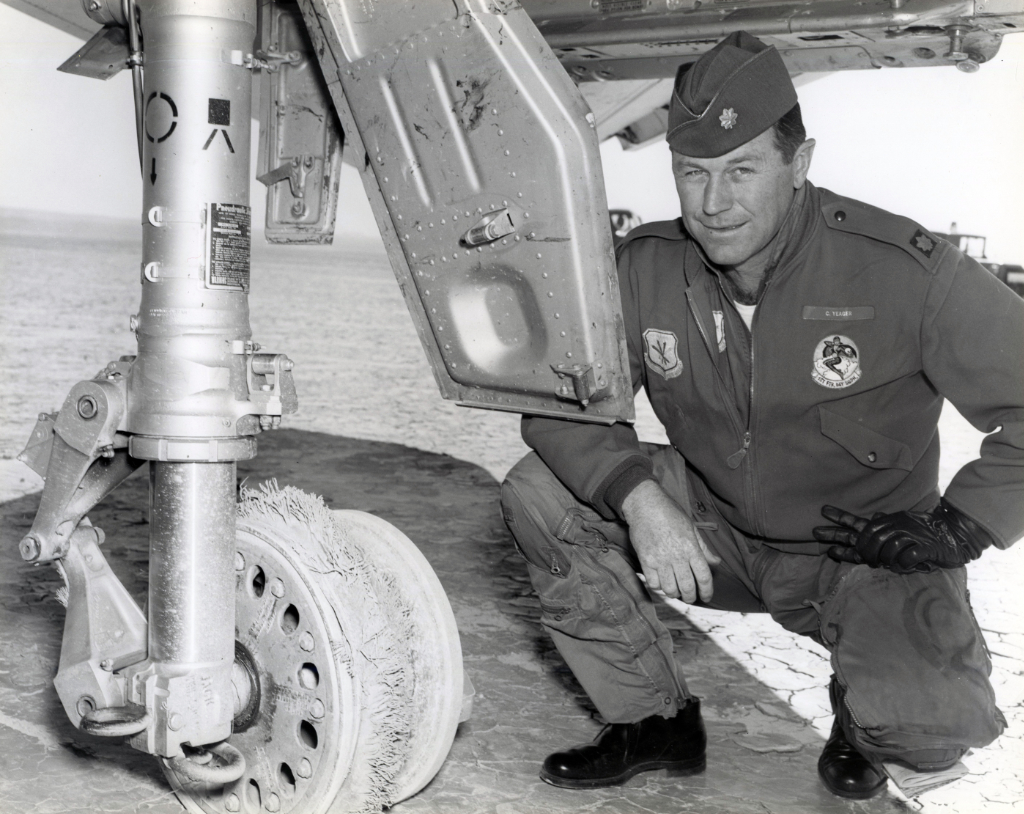
In the following years, Yeager was again deployed to Europe, where he commanded several fighter and fighter-bomber squadrons and wings in West Germany, France, and Spain. In 1962, he was promoted to the rank of full colonel and became the first commandant of the USAF Aerospace Research Pilot School.
In 1966, Yeager returned to combat flying. Appointed commander of the 405th Tactical Fighter Wing, he flew 127 missions over South Vietnam and Southeast Asia. Two years later, he took command of the 4th Tactical Fighter Wing.
In 1969, Chuck Yeager was promoted to brigadier general and became vice-commander of the Seventeenth Air Force. Between 1971 and 1973, he served as Air Attaché in Pakistan. On 1 March 1975, Yeager concluded his military career and retired from the USAF.
In the years that followed, he worked as a technical adviser to the automotive and film industries. On 14 October 2012, to mark the 65th anniversary of his historic flight Yeager once again broke the sound barrier, this time as co-pilot of an F-15 Eagle.
Charles Elwood Yeager passed away on 7 December 2020, aged 97.
According to the Federal Aviation Administration, during his aviation career Chuck Yeager flew more than 360 different types of military aircraft – including the P-51 Mustang, F/A-18, F-15, F-16 and SR-71 – and has accumulated a total of more than 18,000 flying hours.
Cover photo: Captain Charles E. Yeager, the Air Force pilot who was the first man to fly faster than the speed of sound, sits in the cockpit of the Bell X-1 supersonic research aircraft / original caption (National Archives, 542345)