 In 1920, the British Air Ministry issued Specification 5/20 which called for a twin-engine troop-carrier biplane. Two manufacturers responded: Armstrong Whitworth with the Awana and Vickers with the Victoria. Both designs were to be powered by two 450 hp Napier Lion engines.
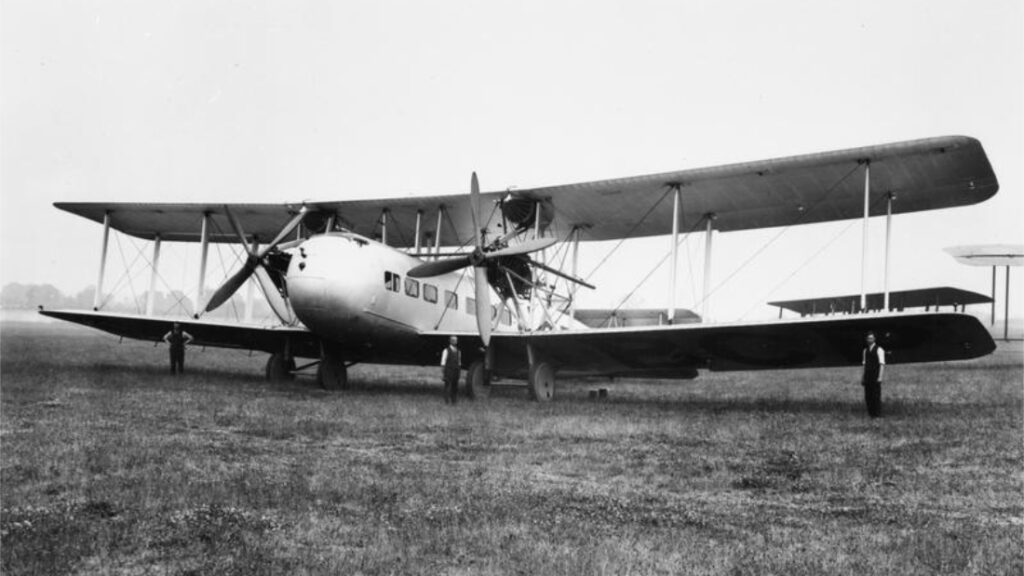
The Vickers design was based on two existing company aircraft, using the fuselage of the Vernon transport aeroplane and wings developed for the Virginia heavy bomber. It featured an enclosed cabin for twenty-four troops and an open cockpit for a two-person crew. Two prototypes, designated Mk I and Mk II, were built, differing mainly in the arrangement of their fuel tanks, engine nacelles and radiators. The Victoria Mk I made its maiden flight on 22 August 1922, followed by the Mk II in September.
The competing Awana first flew in June 1923 but it was deemed too weak for a heavy transport aircraft and difficult to control during landing. Consequently, the Air Ministry selected the Victoria and ordered fifteen aircraft in March 1925.
The first production variant, the Victoria Mk III, incorporated modifications derived from the Virginia, including back-swept wings and a metal-reinforced airframe. The first aircraft were delivered to the Royal Air Force (RAF) on 23 February 1926 and were deployed mainly with transport squadrons in Iraq and Egypt. The Victoria subsequently saw extensive service in the Middle East, including the Kabul Airlift of 1928–1929, and transport operations in Palestine, Jordan, Egypt and Cyprus.
The aircraft was also used for training purposes and conducted several long-range reconnaissance flights which helped establish future commercial air routes for Imperial Airways.
Production continued into the early 1930s, with successive variants receiving increasingly powerful engines and a gradually modernised, all-metal structure. The Victoria Mk V was powered by two 570 hp Napier Lion XIB engines, while the final Mk VI variant received two 660 hp Bristol Pegasus II engines.
In 1934, a significantly modernised version was introduced as the Valentia, which soon replaced the Victoria in its main transport role. From 1935 onwards, the remaining Victorias in RAF service were converted to the Valentia standard, with some upgraded aircraft continuing to operate in Iraq until 1944.
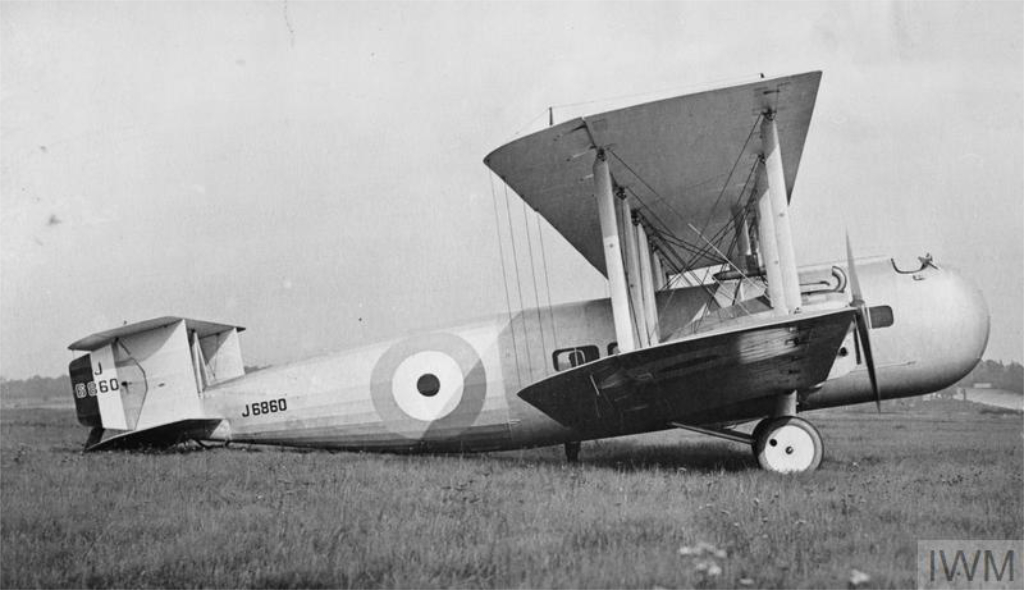
Cover photo: Vickers Victoria freighter and troop carrier biplane, serial number J6860 – original caption (photo: © IWM Q 67093). All Imperial War Museums´ photos used under IWM Non-Commercial licence.