On 17 April 1934, the prototype of the Fairey Swordfish torpedo bomber performed its maiden flight, with test pilot Chris Staniland at the controls.
In 1933, the Fairey Aviation Company initiated the development of a new three-seat naval aircraft. Designed as a private venture, the aircraft was initially designated “Torpedo-Spotter-Reconnaissance I” (T.S.R. I).
Construction of the T.S.R. I prototype coincided with two Air Ministry specifications, M.1/30 and S.9/30, both issued in 1930. They defined requirements for a new torpedo bomber and a two-seat carrier-borne torpedo bomber/spotter-reconnaissance aircraft, respectively.
The T.S.R. I design took part in the competition under Specification S.9/30. The aircraft first flew on 21 March 1933 but was lost in an accident in September of that year.
Drawing on that experience, the company began developing the T.S.R. II prototype. This was a more advanced aeroplane, designed to meet the requirements of the newly issued Specification S.15/33.
On 17 April 1934, the T.S.R. II prototype performed its maiden flight. Subsequently, the aeroplane competed against the Blackburn Shark and the Gloster TSR.38 for the role of a new carrier-borne torpedo bomber and reconnaissance aircraft.
In 1935, the Fairey design was approved for pre-production and the Air Ministry ordered three aircraft for further evaluation. The aeroplane also received its service name, the Swordfish. Following successful evaluation trials, an order for sixty-eight aircraft was placed next year.
The Swordfish officially entered service with the Fleet Air Arm in July 1936. By the outbreak of the Second World War, the Royal Navy operated thirteen squadrons equipped with this type of aircraft.
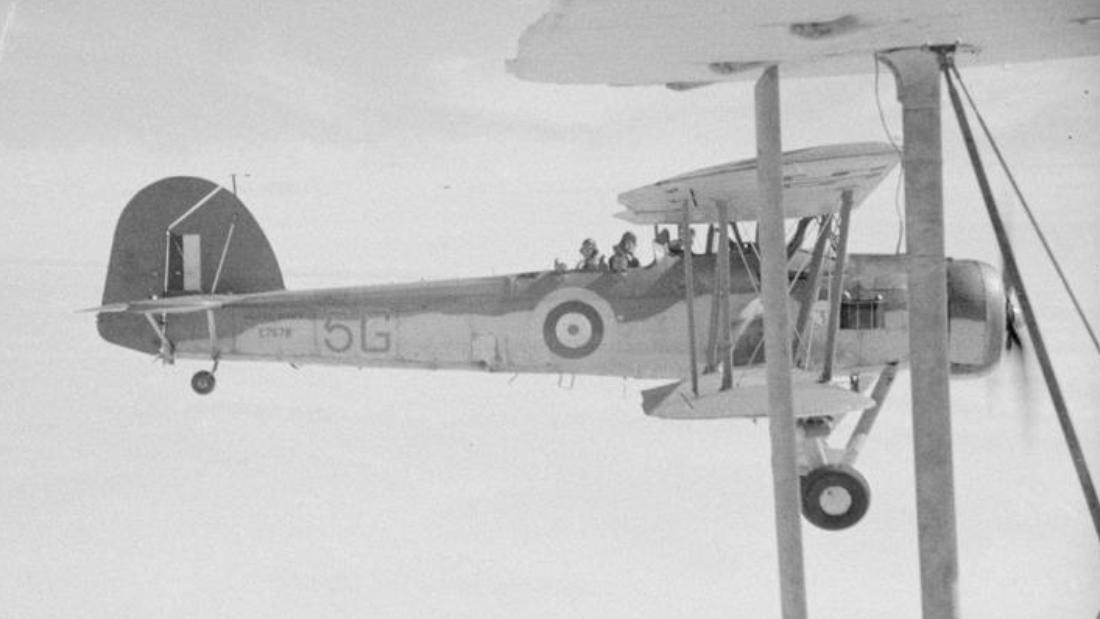
However, by the time of the Second World War, the aircraft – with its biplane configuration, open cockpit, struts and bracing, and a maximum speed of about 230 kph – was already obsolete. Nevertheless, attempts to replace it with more modern designs were unsuccessful, and the Swordfish remained in operational service until the end of the war.
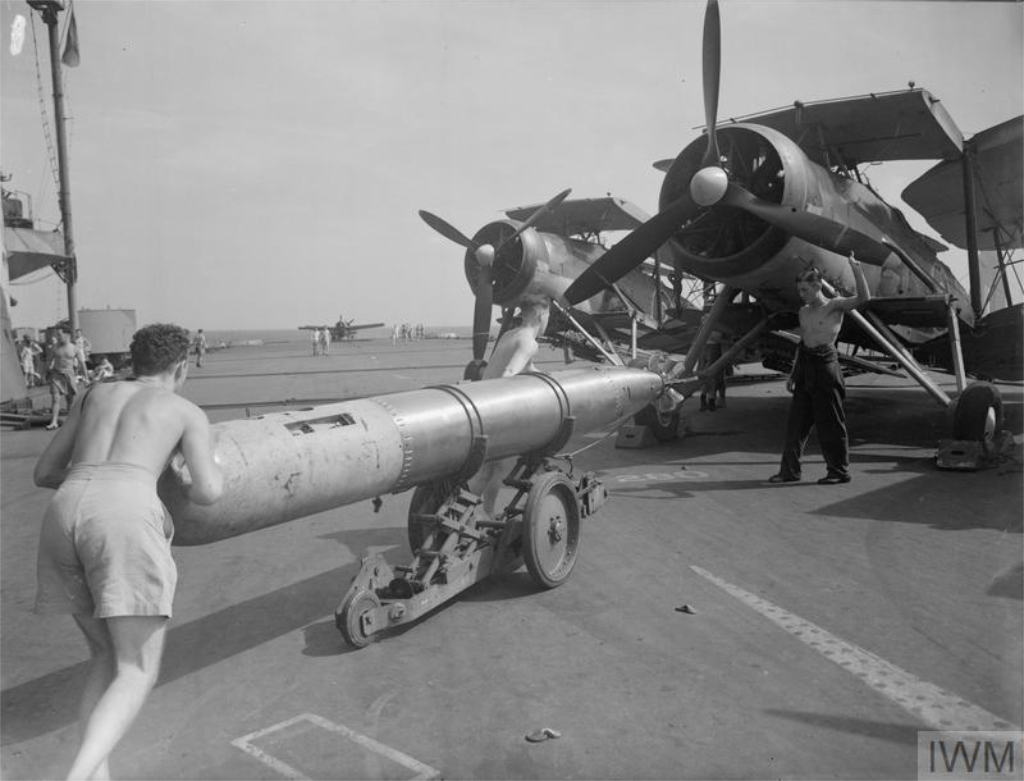
One of the Swordfish’s greatest advantages was its versatility. Originally designed as a torpedo bomber and reconnaissance aircraft, it was later employed as a dive bomber, anti-submarine aircraft, and in close support roles. This adaptability earned it the nickname “Stringbag”, reflecting its ability to carry a wide variety of weapons and equipment.
Production continued until August 1944, with approximately 2,400 aircraft built. According to a monograph by Ian G. Scott, the Swordfish sank a greater tonnage of Axis shipping than any other Allied aircraft during the war.
On 26 May 1941, Swordfish aircraft launched from the aircraft carrier HMS Ark Royal struck the German battleship German battleship Bismarck with torpedoes, damaging her stern and rendering the ship unmanoeuvrable.
This raid, being one of the most famous attacks in naval aviation history, was carried out by fifteen Swordfish aircraft from Nos. 810, 818 and 820 Squadrons. Flying at night in severe weather conditions, they successfully located Bismarck and struck her with two or three torpedoes. One hit the stern on the starboard side, causing both rudders to jam at 12° to port. As a result, the battleship could no longer steer effectively, preventing her from reaching Brest or escaping pursuit.
More information about sinking the German battleship can be found in our article 26 May 1941 – Sink the Bismarck!
Cover photo: An airborne Fairey Swordfish in flight, showing the position of the rockets used to assist the aircraft in take off. The Fairey Swordfish was operating from Royal Naval Air Station at Maydown in Northern Ireland. Note the radar dome mounted beneath the chin of the aircraft. – original war caption. IWM A 27683, cropped.
All IWM photos used under Non-Commercial licence.