 On 9 October 1890, French aviation pioneer Clément Ader made the first manned flight of a powered, heavier-than-air aircraft in history. Although the flight was uncontrolled and only reached a height of around 20 centimetres, this event marked an important milestone in the development of aviation.
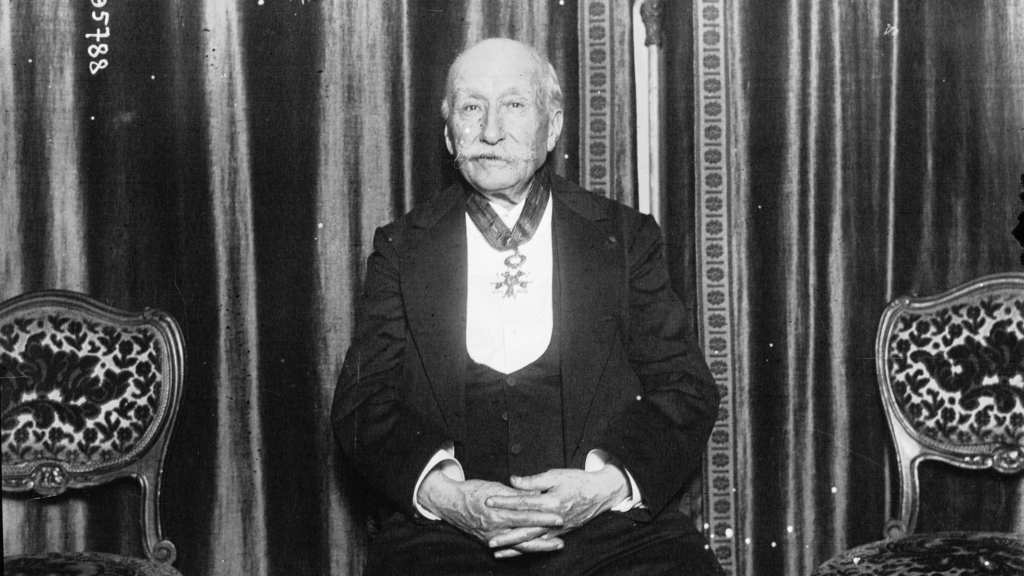
Born on 2 April 1841 in Muret, near Toulouse, Ader was a talented engineer and inventor. After initially working in railway engineering and later developing various inventions, including improvements to the telephone, he became increasingly interested in aviation. Inspired by studies of bird flight, he began developing his own aircraft in the 1880s.
His first aeroplane, Éole (named after the Greek god of wind, Aeolus), was completed in 1886. Resembling a large bat, it was powered by a lightweight 20 hp steam engine, also designed by Ader. On 9 October 1890, during a test at the Château d’Armainvilliers estate near Paris, Éole lifted off the ground and travelled approximately 50 metres before landing. Although the flight was neither controlled nor witnessed by independent observers, it is widely recognised as the first manned flight of a powered, heavier-than-air aircraft.
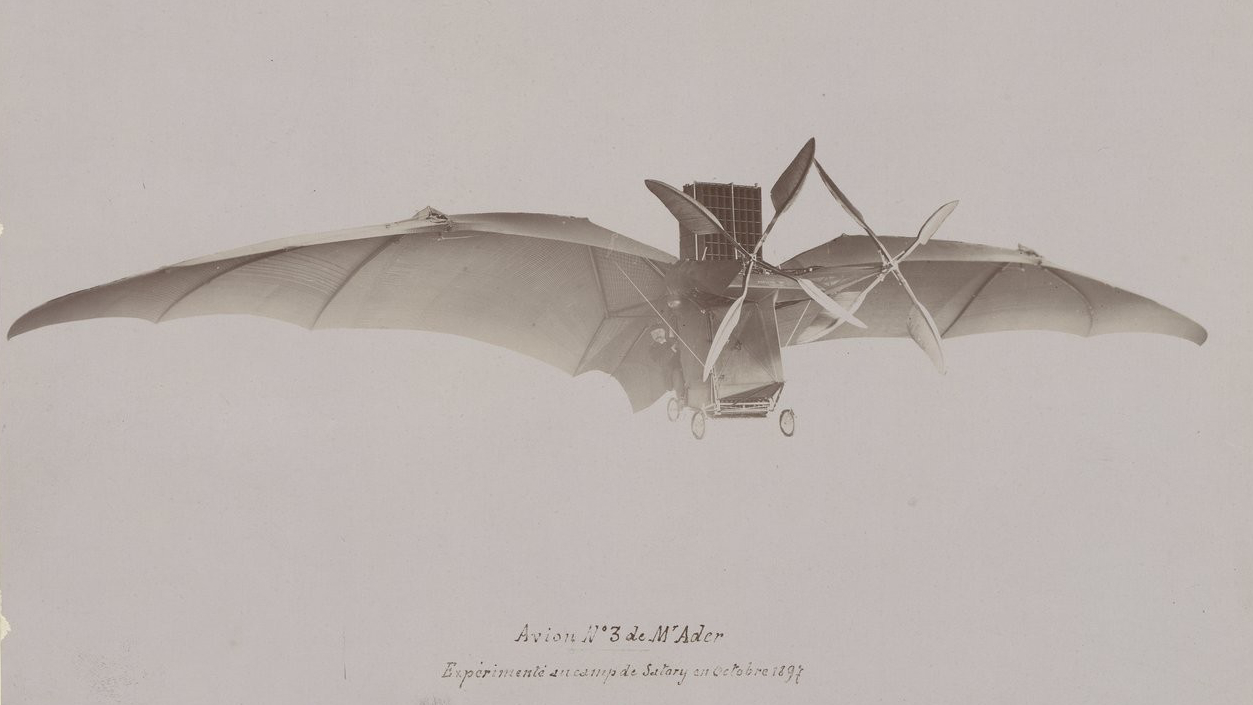
Ader continued his experiments, subsequently developing two further aircraft, Avion II and Avion III. The latter was tested in 1897 with financial support from the French Ministry of War but failed to take off successfully. Following the trials, military funding was withdrawn and Ader returned to his other engineering projects.
Nevertheless, he remained a passionate advocate of aviation. His 1909 book L’Aviation Militaire became highly influential, outlining principles of aerial warfare and introducing an early concept of a modern aircraft carrier.
Clément Ader died on 3 May 1925, aged 84. Although his name is less well known today, his pioneering work earned him a place among the early “fathers of aviation”. His legacy also survives in the French word avion, derived from the name of his aircraft.
The surviving Avion III is now exhibited at the Musée des Arts et Métiers in Paris.
The full story of Clément Ader and his pioneering aircraft was published in our earlier article, Clément Ader and the first powered flight of an aeroplane.
Cover photo: Avion III (source: gallica.bnf.fr / Bibliothèque nationale de France, ark:/12148/btv1b8514000t, cropped)