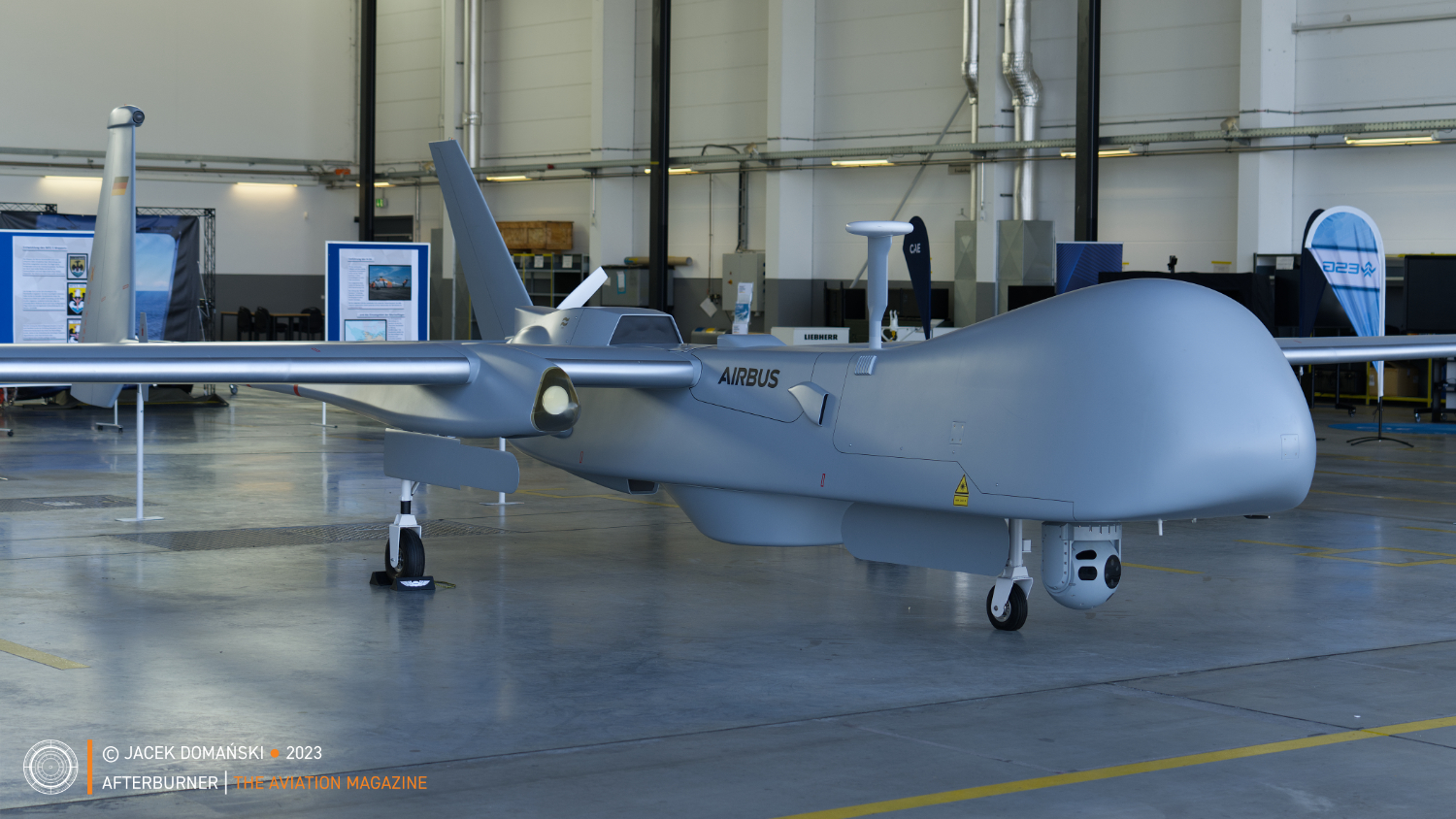
 EADS/Airbus Harfang (mock-up aircraft for exhibition purposes), static display during the 2023 Galileo SAR Meet, Nordholz, August 2023.
The story of the Harfang Medium Altitude Long Endurance (MALE) unmanned aerial vehicle began in the early 1990s. At that time, the MALAT (UAV) division of Israel Aerospace Industries (IAI) began developing the Heron (also known as Machatz-1) UAV. The aircraft performed its maiden flight in 1994 and, ten years later, became operational with the Israel Defence Forces.
In 1999, the Heron was displayed during the Paris-Le Bourget Air Show and attracted some interest from the French military authorities. Two years later, the development of a local derivative of the Israeli UAV was officially announced, with the programme assigned to the European Aeronautic Defence and Space Company (EADS).
The French military reconnaissance UAV system, officially known as Système Intérimaire de Drone MALE (SIDM), was initially branded as the Eagle 1 but later adopted the name Harfang, the French term for the snowy owl (Bubo scandiacus). The aircraft was based on the Heron but equipped with European-made reconnaissance equipment and sensors manufactured by EADS and Thales. These were supported by an onboard mission computer, custom-made by MALAT.
The EADS-made reconnaissance system consisted of two main elements – the UAV itself and the ground control station. The latter included four modules, designated M1 through M4, comprising a mission preparation station, a command and control unit, a data collection unit and a military intelligence module.
According to the official specifications, the Harfang UAV was able to remain airborne for more than 24 hours, carry a payload of up to 250 kg and reach an altitude of 9,150 metres. Like its predecessor, the Harfang was powered by a single 115 hp Rotax 914 four-cylinder piston engine.
On 9 September 2006, the Harfang UAV prototype successfully performed its first flight, taking off from Istres-Le Tubé (Base aérienne 125). The following year, the first examples of the UAV reconnaissance system were delivered to the French armed forces. On 3 June 2008, the Harfang officially became operational with Escadron d’Expérimentation des Drones (the Drone Experimentation Squadron) 1/330 “Adour” at Mont-de-Marsan, home of the Centre d’Expériences Aériennes Militaires (the Military Air Expertise Centre – CEAM).
After gaining the necessary experience in operating the Harfang system, the experimental drone unit was transferred to Cognac-Châteaubernard (Base aérienne 709) in 2010, and renamed Escadron de drones 1/33 “Belfort”.
The French reconnaissance UAV system was used operationally in Afghanistan (2009), during the Libyan conflict (2011), in Operation Serval in Mali (2013) and in domestic defence operations. However, in an interview given in 2010, Dr Stefan Zoller, the former CEO of Cassidian (the successor to EADS), mentioned that the Harfang had already been used operationally in 2007, to monitor the visit of Pope Benedict XVI to Lourdes.
Nevertheless, in 2013, the French military authorities decided to replace the Harfang system with US-made MQ-9 Reaper UAVs. This process was completed in early 2018, and the remaining three Harfang drones were sold to Morocco.
In the late 2010s, EADS’s former structures were finally merged into the Airbus Group. Its Airbus Defence and Space division continued to offer the Harfang system, displaying it at several aviation fairs and other professional events across Europe, including the 2015 Paris-Le Bourget Air Show, the 2018 ILA Berlin and the 2023 edition of the Galileo SAR Meet – where our current Photo of the Week was taken.