 The Lavochkin construction bureau, also known as OKB-301, is best-known for its propeller-driven fighters, such as the LaGG-1, the LaGG-3, the La-5 and its derivatives, widely used during the Second World War, as well as the post-war La-11.
Nevertheless, OKB-301 was also involved in the development of early Soviet jet fighters. Starting from Гу-ВРД (Gu-VRD), a ducted-jet aircraft from 1943, and then followed by a series of post-war jet-powered prototypes – the La-150, La-152, La-156 and La-160.
Following the announcement that British-made turbojet engines — the Rolls-Royce RB.41 Nene and RB.37 Derwent — might be acquired, Lavochkin began work on fighters capable of using these powerplants. According to a widely repeated account, the first prototype of the new aircraft was completed even before the arrival of a Rolls-Royce engine in the Soviet Union, with the design team relying solely on technical documentation.
This first prototype was designated “168” and represented a modern jet fighter with a swept wing, designed to achieve a speed of Mach 0.9 and to be powered by the RB.41 Nene engine. However, it was decided that the Derwent would be delivered to the Soviet Union as the first of the two aforementioned powerplants. Without abandoning development of the “aircraft 168”, Lavochkin created a slightly smaller and lighter derivative of the aeroplane that could use the less powerful RB.37 engine. This prototype was internally designated “174”.
The maiden flight of the “aircraft 174” took place on 8 January 1948, just a few days after that of its main competitor, the Mikoyan-Gurevich I-310. Unfortunately, severe vibrations plagued Lavochkin’s new jet, ultimately leading to the crash of the first prototype in May 1948. These issues were resolved in the second variant of the aircraft, designated “174D”.
A series of tests was conducted during the second half of 1948. Although the aircraft was generally well received by test pilots, it failed to inspire enthusiasm among the Soviet aviation authorities. The Lavochkin’s fighter was evaluated alongside the Yak-25 and the I-310. While it proved superior to the Mikoyan-Gurevich aircraft in terms of horizontal manoeuvrability and acceleration, the “aircraft 174”had a lower rate of climb and service ceiling than the Yak-25.
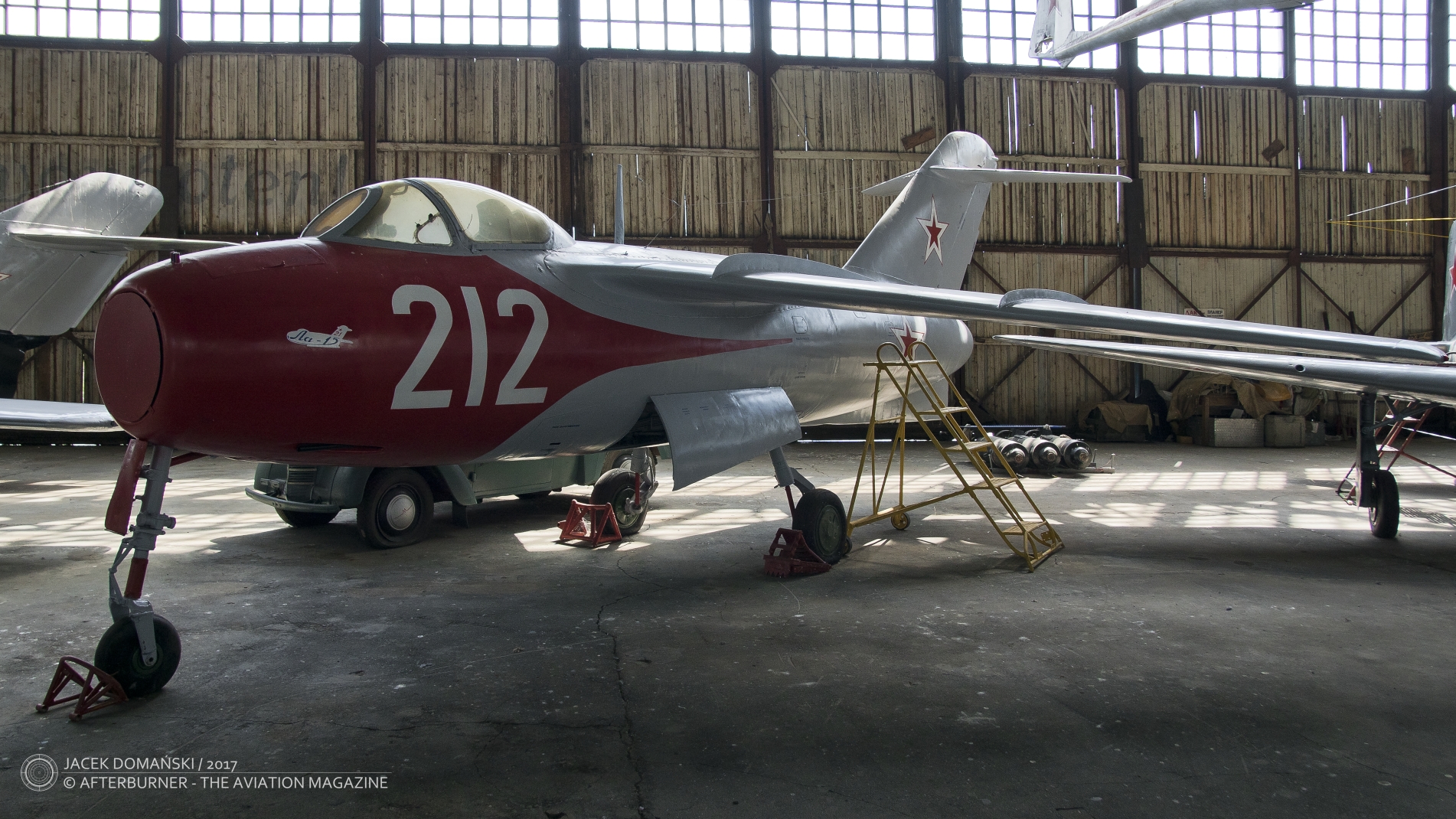
Nevertheless, both the “174” and the I-310 were approved for serial production under the designations Ла-15 (La-15, NATO reporting name: Fantail) and МиГ-15 (MiG-15) respectively. However, the mass production soon revealed the principal weakness of Lavochkin’s jet – its high manufacturing complexity and labour intensity, partly resulting from the adaptation of the “168” airframe to a much lighter engine. Despite a number of changes being introduced during early stage of production, as well as reduction in the man-hours required to manufacture the La-15, satisfactory results could not be achieved.
Although an initial order for 650 La-15 aircraft was placed, production ceased after only 235 examples had been completed. In consequence, it was the MiG-15 which became the primary fighter aircraft of the Soviet Air Force and of other Eastern Bloc air forces for the following years.
Cover photo: Lavochkin La-15 exhibited in the Central Air Force Museum in Monino, Russia, 2017