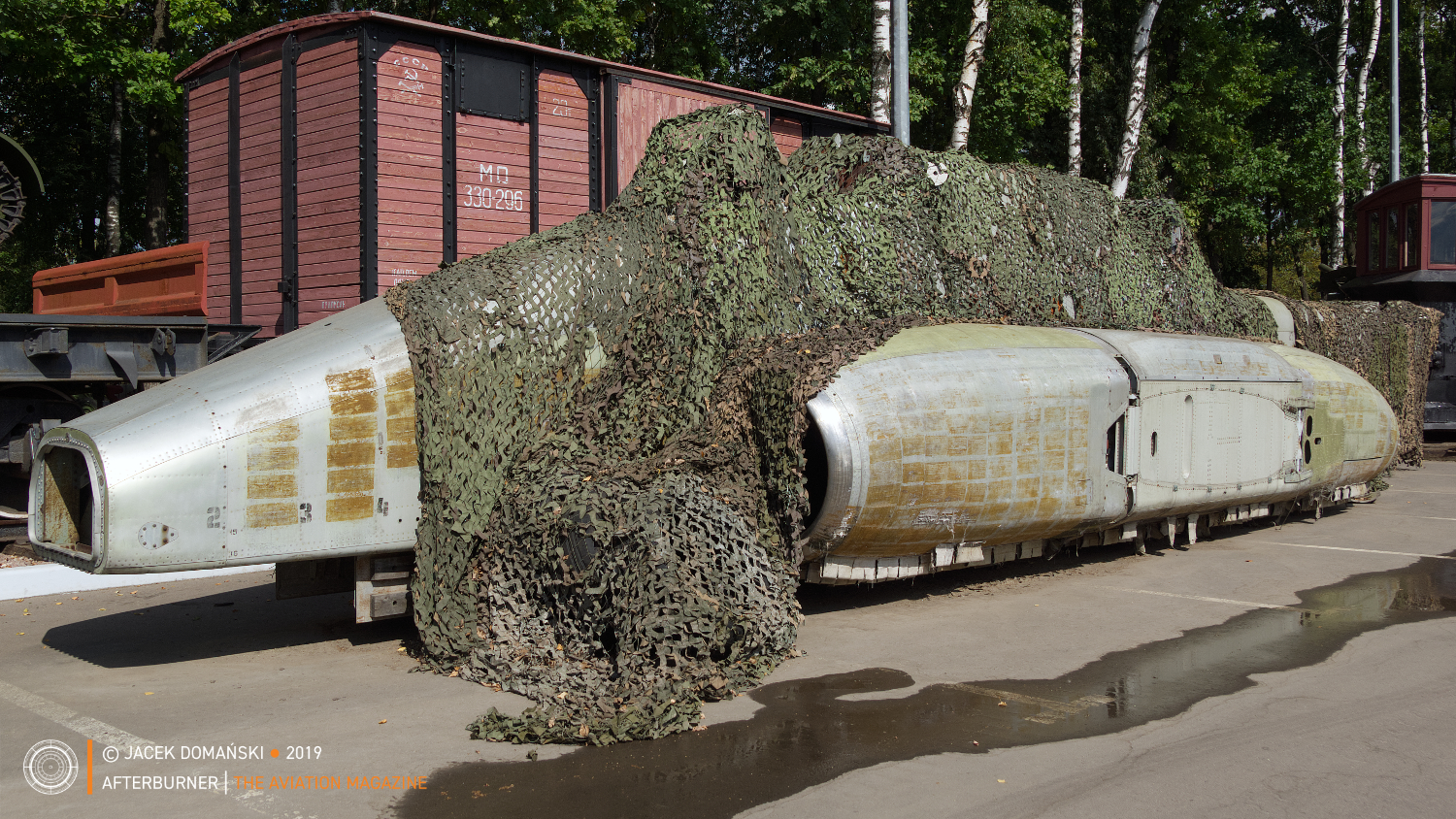
 Ilyushin Il-102 / Ил-102 (c/n 102010303010), stored at the Музей Техники Вадима Задорожного / Technical Museum of Vadim Zadorozhny, Arkhangelskoye, Krasnogorsky District, August 2019.
The story of Ilyushin-designed ground-attack aircraft began in 1939, with the first flight of the legendary Second World War aeroplane, the Ilyushin Il-2 (post-war NATO reporting name “Bark”).
Although many commentators, particularly in the West, regarded the Il-2 as one of the worst and least efficient combat aircraft of the war, the aeroplane went down in aviation history as the most-produced aircraft ever, with more than 36,000 examples built between 1941 and 1945. The Il-2 also became one of the icons of aviation of the Eastern Front, playing an important role in the victory over the Third Reich and its Nazi regime.
In a short time, the Russian term штурмовик – romanised as “shturmovik” or “shtormovik” – became a popular name for a ground-attack aircraft.
In 1944, the Il-2 gained a successor: a modernised version of the original design, known as the Il-10 (NATO reporting name “Beast”). Although only about 6,000 examples were manufactured, the Il-10 was widely operated by the Soviet Union and its allies. The aircraft remained in active service until the early 1970s, with China being the last country to retire the classic “shturmovik” design.
After the war, the Ilyushin Design Bureau developed a new ground-attack aircraft, known as the Il-20. Although it followed the original concept of a heavily armoured, single-engine, all-metal, low-wing aircraft operated by a crew of two, the Il-20 introduced several new ideas, including a cockpit mounted above the engine.
The Il-20 made its maiden flight in December 1948. However, the aircraft fell short of expectations, being too heavy and slow, as well as suffering from engine problems. Bearing in mind the further development of jet technology, the Soviet authorities cancelled the new “shturmovik” programme shortly after the initial flight tests. Although the OKB-240, as the Ilyushin Design Bureau was known at the time, proposed an alternative design – a ground-attack aircraft powered by two Klimov TV-2 turboprop engines – it was rejected as well.
In the early 1950s, following the experience gained during the Korean War, the Soviet authorities revived the idea of a modern ground-attack aircraft. The task of developing the new aeroplane was once again assigned to the Ilyushin Design Bureau, which soon produced the Il-40 (NATO reporting name “Brawny”), the first jet-powered “shturmovik”.
Nevertheless, even with the dawn of the jet age, Ilyushin and his design bureau remained committed to the original concept of a heavily armoured aircraft crewed by a pilot and a rear gunner. The Il-40, with a silhouette reminiscent of a double-barrelled shotgun, was a low-wing aircraft featuring an armoured shell to protect the crew and powered by two Mikulin AM-5 turbojets.
The Il-40 prototype successfully made its maiden flight on 7 March 1953. The aircraft was quickly approved for production, although some technical changes were recommended, including modifications to the armament and the installation of new, improved Tumansky RD-9V engines.
Preparations for the serial production of the first batch of forty aircraft began alongside work on a new prototype. However, the programme soon encountered several delays. In addition, Soviet military doctrine changed once again, with tactical nuclear bombing taking precedence over the concept of ground-attack aviation. In 1956, the Il-40 programme was officially cancelled.
Nevertheless, the Ilyushin Design Bureau continued work on the aircraft as a private venture. In 1967, when the Soviet military authorities revived the “shturmovik” concept once again, the OKB-240 came up with an upgraded design, designated the Il-42. This jet-powered aircraft was, as before, intended to be operated by a crew of two, but the rear gunner was now equipped with a pair of remotely controlled cannons. Once again, however, the Ilyushin design was rejected.
When Sergey Ilyushin announced his retirement in the mid-1970s, the design bureau was taken over by Genrikh Novozhilov. The jet-powered “shturmovik” programme continued over the following years and was eventually resulted in the Il-102, an experimental ground-attack aircraft.
Only two examples of the Il-102 were built. The first was intended for static testing, while the second served as a flying prototype. It was a heavily armoured, subsonic aeroplane powered by two Klimov RD-33 turbofans. As with its predecessors, the Il-102 was operated by a two-person crew, with the rear gunner operating a twin-barrelled GSh-23L cannon mounted in a remotely controlled tail turret. The pilot operated a 30 mm cannon mounted beneath the fuselage. The Il-102 could carry up to 7,200 kg of armament on sixteen hardpoints, including wing bomb bays and external pylons.
On 25 September 1982, the Il-102 prototype made its first flight. The aircraft underwent flight testing until 1984 and then again between 1986 and 1987. According to Russian publications, a total of 367 flights were performed. However, the design failed to arouse any interest among the Soviet military authorities and, in December 1987, the testing programme was cancelled.
Both Il-102 prototypes were stored for several years. In 2005, the flying prototype (c/n 00-01, although this designation has not been confirmed) was placed along the so-called Alley of Heroes (Аллея Славы ЛИИ), located within the Gromov Flight Research Institute. The second example, used for static testing, was taken over by the Technical Museum of Vadim Zadorozhny in 2017. This is where our current Photo of the Week was taken in 2019.
In 2023, the aircraft was transferred to Medyn airfield in the Kaluga region for storage at the second site of the Zadorozhny Museum.