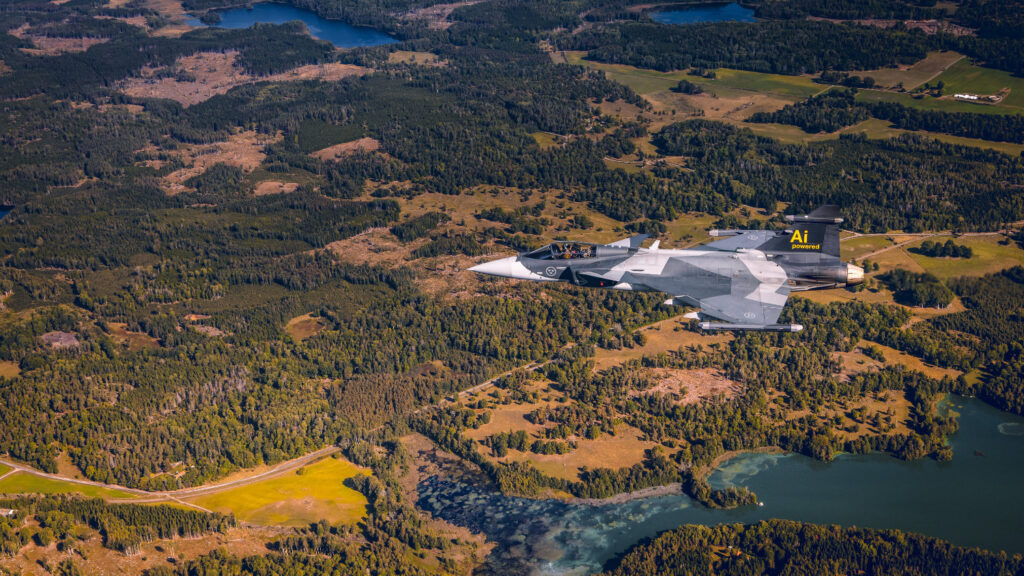
 Swedish defence company Saab has unveiled a family of internally developed artificial intelligence (AI) agents for future fighter systems. Announced on 3 November 2026, the technology has already been flight-tested aboard the Gripen E, demonstrating the company’s ability to develop, train and integrate its own AI agents into operational fighter aircraft.
Developed by the company’s Advanced Programs business unit, the agents employ various AI techniques to make tactical decisions in complex operational environments. Designed to learn, adapt and collaborate with pilots and operators across different mission tasks, they can either assist pilots in the cockpit or operate alongside crewed aircraft from unmanned platforms.
The AI Fighter Pilot Academy has also been established as a dedicated environment for training and evaluating agents through simulated air combat scenarios. The training process involves millions of simulated flight hours, enabling the systems to develop and refine their tactical decision-making capabilities. The infrastructure is designed to accommodate additional scenarios, capabilities and platforms without requiring a complete redesign.
“We have not only built our own AI agents, but we have also flown them. This demonstrates our capability to develop AI agents that can be integrated into operational fighter aircraft. The future of air combat will not be defined by individual platforms acting alone, but by networks of crewed and uncrewed systems working together as a coordinated force. Through our ownership of the entire technology stack, we are building the capabilities needed for that future,” said Peter Nilsson, head of Advanced Programs at Saab’s business area Aeronautics.
During flight trials aboard the Gripen E, one of the AI agents autonomously controlled the aircraft in beyond-visual-range (BVR) air combat scenarios. The tests were made possible by the fighter’s software-defined architecture, which allows new AI software to be integrated and evaluated directly on an operational aircraft without requiring a dedicated experimental platform. This architecture also enables rapid testing and integration of new technologies in civilian airspace. Such an approach is intended to shorten development cycles and accelerate the introduction of new capabilities into operational use.
These technological advancements are also supported by Sferical AI, a Swedish initiative established to provide secure, large-scale computing capacity for advanced artificial intelligence applications. As one of its founding partners, Saab aims to use this infrastructure to further expand its AI capabilities.
Saab is continuing to develop its AI agents and expand flight testing to a broader range of scenarios. Safety and control are incorporated into the development process from the outset, while verified, independently developed AI is expected to play an important role in enabling coordinated operations between crewed and uncrewed combat aircraft.
Cover photo: Saab Gripen E fighter aircraft, used as a test platform for the company’s internally developed AI agents ( © Saab)
The Saab company press materials were used.