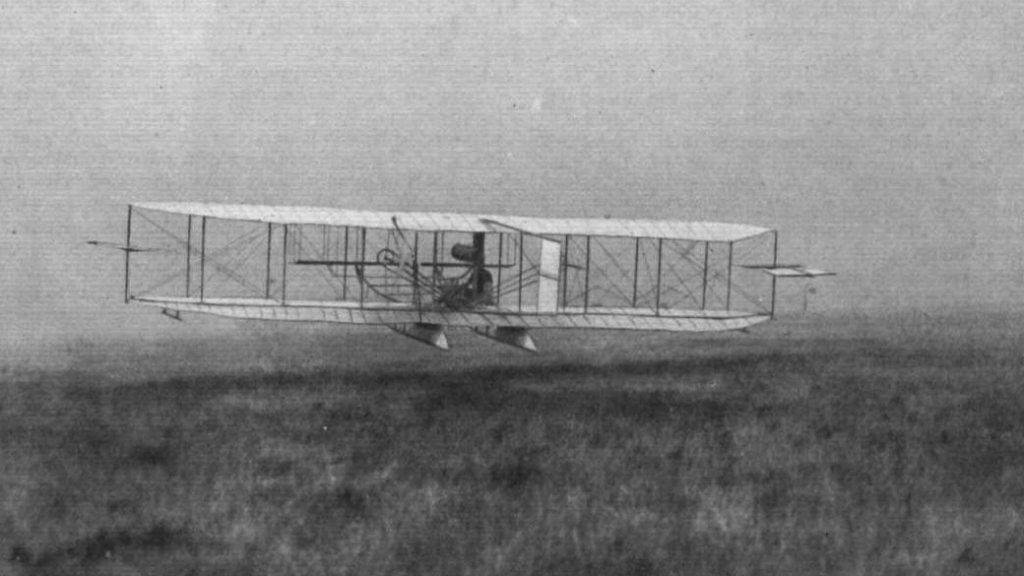
 On 30 October 1909, John Moore-Brabazon successfully completed the first one-mile closed-circuit flight in the United Kingdom, winning the Daily Mail prize.
John Theodore Cuthbert Moore-Brabazon, the 1st Baron Brabazon of Tara, was an English aristocrat and aviation pioneer. He was the first Englishman to fly a heavier-than-air aircraft and the first person in the United Kingdom to receive an official pilot’s licence, issued by the Royal Aero Club.
In November 1908, Moore-Brabazon made his first solo flight in France, in a Voisin biplane. In May 1909, he became the first Englishman to make an officially recognised aeroplane flight in England.
At the dawn of aviation, the British newspaper Daily Mail supported pioneer aviators by awarding them numerous prizes for achieving specific goals and advancing aircraft development.
The first prize, sponsored by the owner of the Daily Mail, Alfred Harmsworth, the 1st Viscount Northcliffe, was announced as early as 1906 and offered £10,000 (approximately equivalent to £1,300,000 today) for the first flight from London to Manchester. It was won only in 1910, by Louis Paulhan.
In the following years, the Daily Mail announced several more competitions, including a quarter-mile out-and-return flight, a cross-Channel flight, the fastest lap at Blackpool Aviation Week and the first one-mile closed-circuit flight by a British-built aircraft. It was the latter challenge that caught the attention of the eccentric aviation pioneer.
In 1909, Moore-Brabazon ordered an experimental biplane to be built at the Short Brothers factory. His aim was to win the aforementioned Daily Mail prize for a closed-circuit flight.
The aircraft built by Eustace and Oswald Short was the second aeroplane they had developed. Similar in design to the Wright Model A, the Short No. 2 was initially powered by an Ateliers Vivinus aviation engine taken from one of Moore-Brabazon’s Voisin biplanes.
On 27 September 1909, the aircraft successfully completed its first flight, covering almost a full mile in the air. The second flight took place on 4 October ending in a hard landing that caused minor damage to the aircraft.
During the repairs, the engine was replaced with a Green D.4 powerplant. At the time, it was the most powerful British-made aviation engine, producing 60 hp from a displacement of 8.99 litres. Installed in the Short No. 2, the Green engine drove two wooden, two-bladed propellers in a pusher configuration.
On 30 October 1909, Moore-Brabazon took off in the Short No. 2 from the Royal Aero Club’s flying field at Shellbeach, on the Isle of Sheppey in the Thames Estuary. He flew to a marker post positioned half a mile from the airfield, turned back and successfully landed next to the launching rail. The flight lasted 2 minutes and 36 seconds. Shortly afterwards, the £1,000 Daily Mail prize (approximately equivalent to £132,000 today) was officially awarded to the English aviation pioneer.
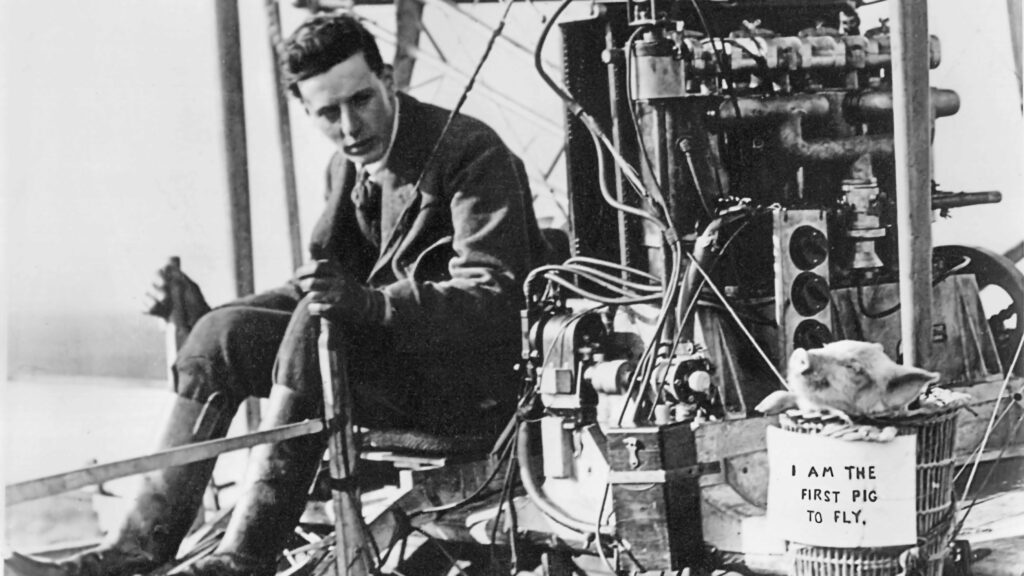
John Moore-Brabazon’s short but eventful flying career was marked by several other “firsts”, earning the young pilot a well-deserved place in aviation history. One of his most extravagant stunts was to prove that pigs can fly.
“When pigs fly” is a common English expression used to describe something impossible or an event that is highly unlikely ever to occur. The phrase has been used in various forms since the 17th century and has also been adopted by several other European languages.
Nevertheless, on 4 November 1909, the seemingly impossible became a reality. On that day, John Moore-Brabazon made a short cross-country flight in his Short Brothers biplane, carrying a very special ‘passenger’ on board – a piglet named Icarus II, which had been obtained from a nearby pub.
In mid-1910, following the tragic death of his close friend Charles Rolls in an aviation accident, Moore-Brabazon gave up flying.
Nevertheless, this was only a temporary break, as he returned to aviation when the Great War broke out. Serving first with the Royal Flying Corps and then with the Royal Air Force, John Moore-Brabazon further enhanced his place in aviation history through his work in aerial photography and reconnaissance. Later, during the Second World War, Moore-Brabazon served as British Minister of Transport and Minister of Aircraft Production.
John Theodore Cuthbert Moore-Brabazon, the 1st Baron Brabazon of Tara, died on 17 May 1964, aged 80.
More about John Moore-Brabazon, Icarus II and the Short No. 2 in 27 September 1909 – maiden flight of Short No.2 and 4 November 1909 – Pigs can fly.
Cover photo: Short No.2 during the record flight, Flight magazine, 19 Oct 1909. IWM photo used under the Non-Commercial licence.