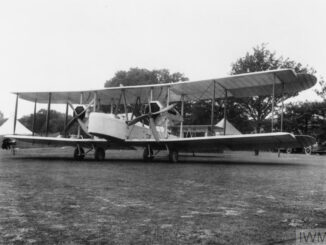
On 19 November 1915, Squadron Commander Richard Bell Davies of No. 3 Squadron RNAS (Royal Naval Air Service) performed a daring rescue mission behind enemy lines, saving the life of Flight Sub-Lieutenant Gilbert Formby Smylie. The action is widely considered the first Combat Search and Rescue (CSAR) operation in aviation history.
Richard Bell Davies was born on 19 May 1886 in Kensington, London. He joined the Royal Navy in 1901 and subsequently developed an interest in aviation, taking private flying lessons from 1910. Three years later, he joined the RNAS.
During the First World War, Davies initially took part in air raids against German naval bases at Ostend and Zeebrugge. In January 1915, despite being seriously wounded by anti-aircraft fire, he completed one of his missions and returned to base. For this act of bravery, he was awarded the Distinguished Service Order (DSO).
Later that year, Davies was deployed to the Gallipoli Campaign, where he commanded No. 3 Squadron RNAS, operating from Imbros (today’s Gökçeada, Türkiye). The unit conducted reconnaissance and bombing missions against enemy communications and supply lines.
On 19 November 1915, the squadron was assigned to attack a railway junction in Bulgarian territory, identified in British accounts as Ferrijik Junction. The target was most probably located near Feres, in present-day Greece. During the raid, Smylie’s Farman aircraft was hit by anti-aircraft fire, forcing him to make an emergency landing behind enemy lines.
After bringing his damaged aircraft down in a drained marsh, Smylie discovered that one of his bombs had failed to release. He set the aircraft on fire, hoping to destroy it completely, but the unexploded bomb presented an additional danger. Meanwhile, Davies, flying a Nieuport 10 fighter, spotted his colleague’s aircraft and decided to land nearby and rescue him.
Realising the danger posed by the unexploded bomb, Smylie managed to detonate it by firing several rounds from his pistol. This prevented a potentially disastrous explosion during Davies’s landing. The latter then squeezed his fellow pilot into the forward section of the Nieuport’s fuselage, originally designed to accommodate a second crew member.
Despite coming under rifle fire, Davies successfully took off and returned to Imbros with Smylie aboard. This extraordinary rescue was subsequently recognised with two major decorations: in January 1916, Davies received the Victoria Cross, while Smylie was awarded the Distinguished Service Cross.
Davies continued his naval aviation career, eventually reaching the rank of rear admiral and holding several senior positions within the Royal Navy. He retired in 1941 and died on 26 February 1966. Smylie also remained in military aviation, serving in the RAF in various flying and technical appointments. He died on 5 July 1965.
Although Davies’s rescue was an improvised operation rather than a planned military procedure, it anticipated one of the essential capabilities of modern armed forces. Combat Search and Rescue missions developed considerably during the Second World War and the First Indochina War, but it was during the Vietnam War that modern CSAR procedures took shape. According to US Army sources, SAR teams rescued more than 3,800 people during that conflict, at the cost of 71 rescuers and 45 aircraft.
Today, CSAR capabilities form an important part of the military structures of many countries. The 1915 rescue by Richard Bell Davies remains an early example of the determination to recover aircrew from hostile territory, a principle that continues to underpin modern combat rescue operations.
Cover photo: Front view of a Nieuport biplane, Paris 1915 (source: Mairie de Toulouse, Archives municipales, 49Fi1873/11, Public Domain).