On 18 November 2026, at 2:16 a.m. PST (11:16 a.m. CET), Voyager 1 achieved another milestone on its journey into the unknown, reaching a distance of one light-day from Earth. This is the distance that a particle of light can travel in 24 hours, equivalent to approximately 26 billion kilometres (or 16 billion miles).
Voyager 1 and its twin, Voyager 2, were both launched in 1977 as part of the Voyager programme, which was aimed at exploring Jupiter and Saturn – the two gas giant planets – and, if possible, also Uranus and Neptune, the distant ice giants.
The first of the two probes to be launched was, however, Voyager 2, which left Earth on 20 August 1977. Its trajectory was planned to take it close to Jupiter, Saturn, Uranus and Neptune. Voyager 1 followed sixteen days later, on 5 September. The probe followed a shorter and faster route, heading towards the Saturnian system, where its mission was originally expected to end.
Already in December 1977, Voyager 1 overtook its twin and continued its journey towards the Jovian system. It flew past Amalthea, Jupiter, Io, Europa, Ganymede and Callisto. In April 1979, the Jovian phase of the mission was completed, and the probe headed towards Saturn.
In November 1980, Voyager 1 performed a close flyby of Titan, passing just 6,490 km from its centre of mass. It then continued to explore of the Saturnian system, passing Tethys, Saturn, Mimas, Enceladus, Rhea and Hyperion. On 14 November 1980, the initially planned scope of the Voyager 1 mission was completed. The probe continued its spaceflight beyond Saturn, embarking on a journey towards the outer reaches of the Solar System.
When both probes successfully completed their initial missions, both spacecraft were still operational and transmitting data to Earth. Consequently, NASA decided to continue the Voyager programme for as long as possible, sending the probes on their journeys beyond the Solar System.
In 1998, Voyager 1 became the most distant human-made object from Earth. The spacecraft had travelled further than the two deep-space probes, Pioneer 10 and Pioneer 11, launched in 1972 and 1973, respectively. Six years later, Voyager 1 crossed the termination shock – the boundary in the heliosphere where the solar wind slows down to subsonic speeds.
One of the major achievements of the extended Voyager mission came in May 2021. As announced by NASA, for the first time in history, the spacecraft provided continuous measurements of the density of material in interstellar space, as well as detected interstellar sounds.
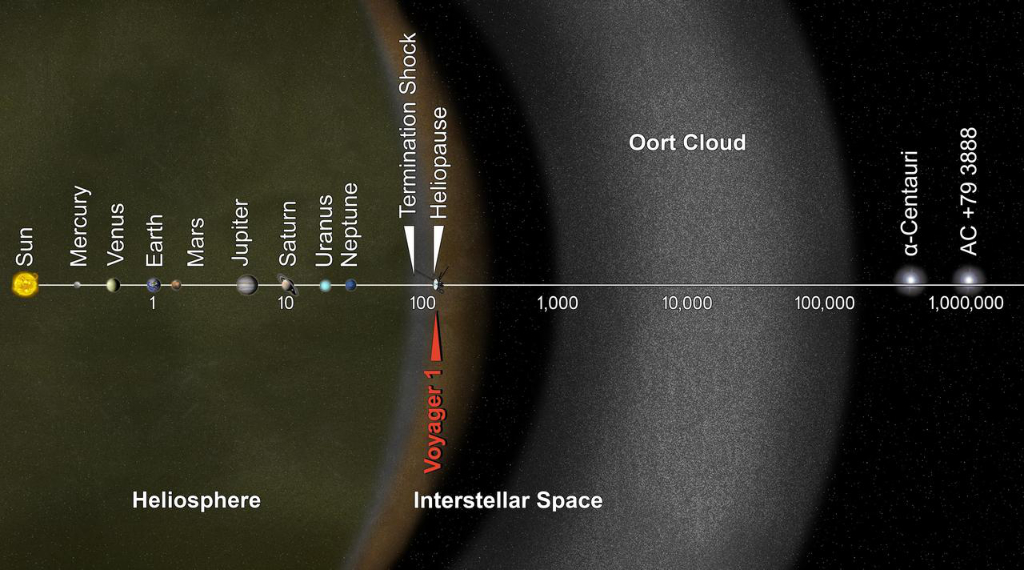
Another significant milestone was recorded on 25 August 2012, when Voyager 1 crossed the heliopause at a distance of 121.7 Astronomical Units (18.1 billion km) from the Sun, becoming the first human-made object to enter interstellar space.
Then, at the end of May 2025, Voyager 1 reached another distance milestone, travelling 25 billion kilometres (15,534,279,806 miles / 167.114 AU) from the Sun. A similar achievement, but this time measured in relation to Earth, was recorded in July of that year.
In April 2026, NASA engineers began working on an energy-saving programme, nicknamed the “Big Bang”. As both spacecraft were running low on power, the decision was made to switch off the Low-energy Charged Particles experiment (LECP) aboard Voyager 1 and then carry out a series of power-saving measures, switching off selected instruments or replacing them with lower-power alternatives.
The ”Big Bang” programme was first implemented aboard Voyager 2 in August 2026. Six weeks later, the same effort was successfully carried out on Voyager 1. Three of its instruments were switched off and their functions were subsequently replaced with low-power alternatives. This should help keep the spacecraft warm enough to survive in interstellar space and continue gathering scientific data for as long as possible.
Both Voyager probes are powered by plutonium-238 radioisotope thermoelectric generators, which convert the heat produced by the radioactive decay of plutonium into electricity. This continuous process means that the available plutonium fuel is gradually being depleted, with the spacecraft losing approximately 4 watts of electrical power per year. However, regardless of how long their power supplies continue to operate, both probes are expected to move out of range of the Deep Space Network communication system in 2036.
On 18 November 2026, Voyager 1 made space exploration history once again, reaching a distance of one light-day from Earth – the distance that light, and indeed any form of electromagnetic radiation, can travel in 24 hours. This equates exactly to 25,902,068,356 kilometres (or 16,094,799,096 miles).
It took the human-made object forty-nine years, two months and thirteen days to travel one light-day away from Earth. If Voyager 1 were a crewed spacecraft, its crew would now see Earth as it was 24 hours earlier, meaning that by the time today’s events on our planet reached them, they would already be yesterday’s news.
Voyager 2, which is following a different trajectory through the Solar System and beyond, is expected to reach the distance of one light-day from Earth in another nine years, presumably in November 2035.
Currently, Voyager 1 continues its journey into the unknown. If its spaceflight proceeds without any unexpected disturbances, in approximately three hundred years from now, Voyager 1 should reach the so-called Oort Cloud – a theorised cloud of icy planetesimals surrounding the Sun, extending from approximately 2,000 to 200,000 AU, although distance estimates vary depending on the source. It should take about 30,000 years for the spacecraft to cross the cloud. Then, approximately 10,000 years later, Voyager 1 is expected to pass within 1.6 light-years of Gliese 445, in the constellation Camelopardalis.
Assuming that the Voyager probes are neither retrieved nor collide with any other object, the spacecraft could – as NASA once stated – wander through the Milky Way eternally. Voyager 1 will remain the most distant human-made object in space for decades, or even centuries to come – at least until the implementation of more effective propulsion systems or the development of a completely new way of travelling through space.
Interestingly, Voyager 1 is also the fastest human-made spacecraft travelling beyond the Solar System, reaching a speed of 61,198.15 kph (38,026.77 mph) relative to the Sun. Its twin, Voyager 2, follows at 55,346.92 kph (34,390.98 mph), while the New Horizons spacecraft travels at 49,245 kph (30,600 mph).
Although New Horizons was the fastest spacecraft ever launched, being the first probe to follow a direct solar escape trajectory and leaving Earth at 58,536 kph (36,373 mph), this was only its initial velocity. The spacecraft is gradually slowing down, while Voyager 1 and Voyager 2 gained additional speed through gravitational assists from the gas giant planets.
Finally, it should also be mentioned that both Voyager probes carry the so-called Golden Record on board – a gold-plated audio-visual disc containing a selection of sounds and images portraying life on Earth. The Golden Record is intended for any intelligent extraterrestrial life forms that might encounter the spacecraft and serves as a kind of invitation to establish contact with the human race.
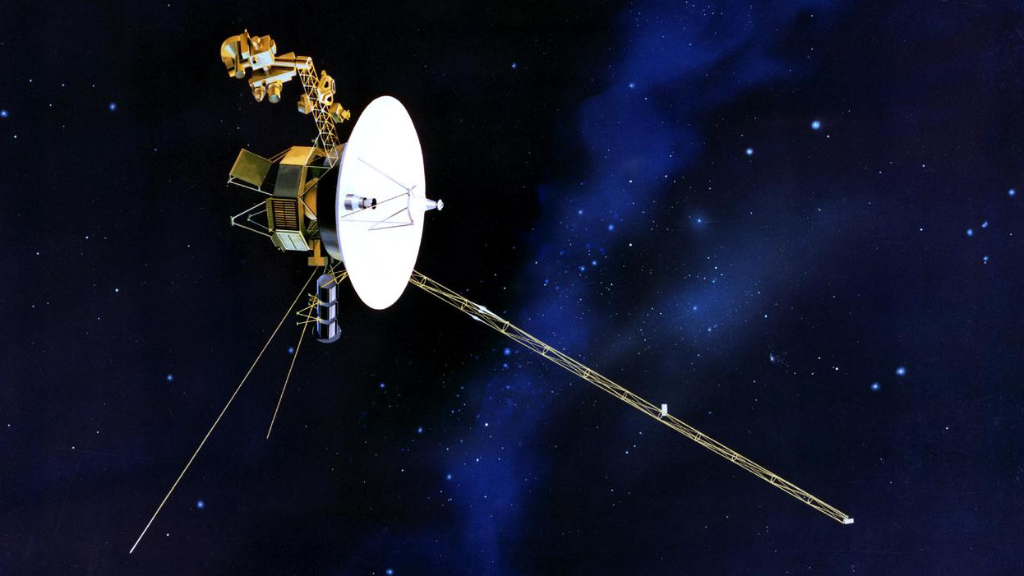
Cover photo: Voyager 1 spacecraft entering interstellar space, artist concept (NASA, PIA17462).
All photos © National Aeronautics and Space Administration. Information from NASA press releases and Voyager programme website indicating current position of the both space probes were used.