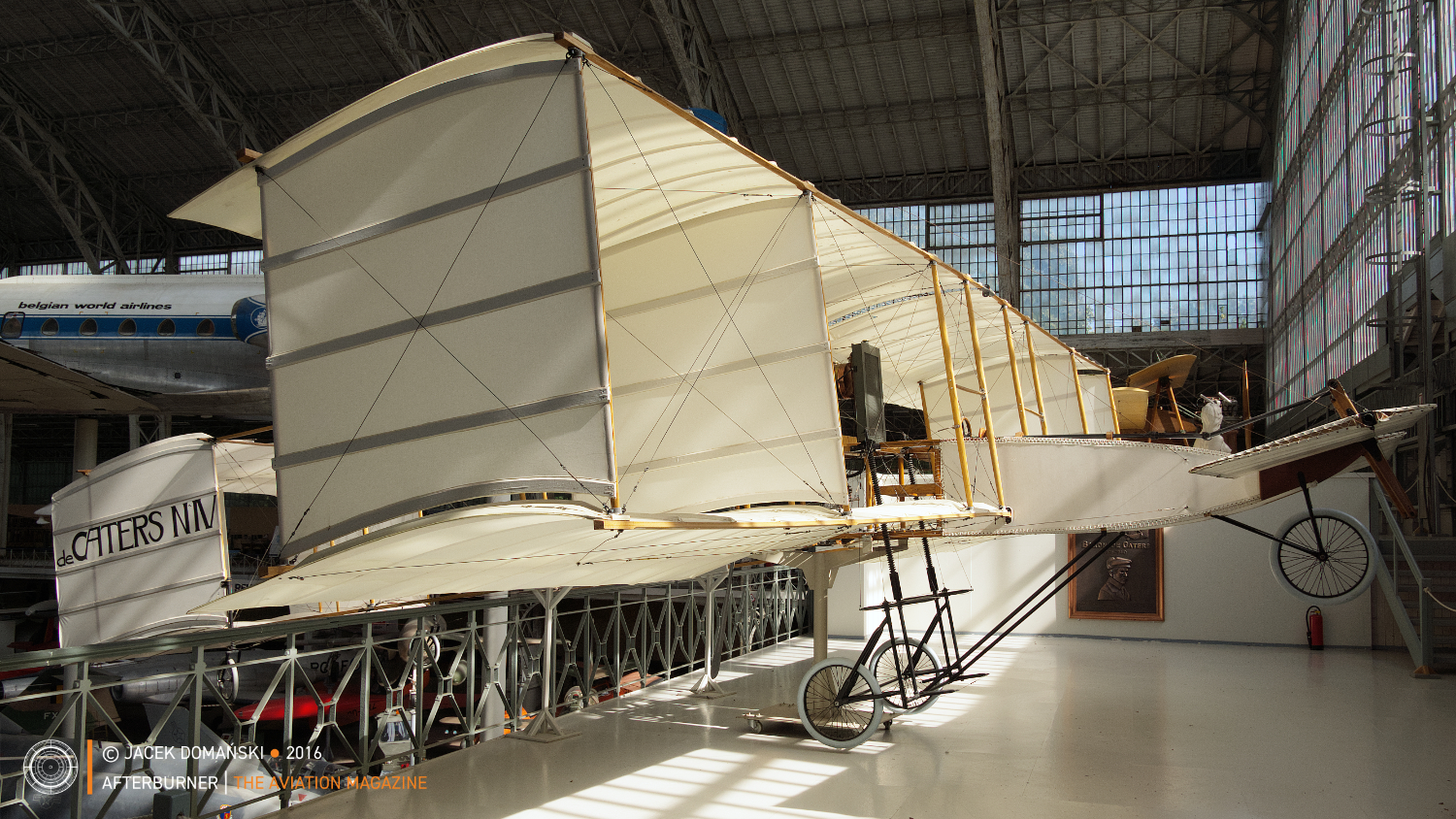
 Voisin de Caters IV (full-scale replica), exhibited at the Royal Museum of the Armed Forces and Military History, Brussels, September 2016.
Baron Pierre de Caters, born in 1875 in Berchem, was a Belgian adventurer and aviation pioneer, as well as a car and motorboat racer.
His racing career began at the turn of the 19th and 20th centuries. De Caters not only won several competitions, such as the Grand Prix of Ostend and the Ardennes Circuit, but also set the world land speed record three times.
In 1908, after witnessing Henri Farman‘s flying display in Ghent, de Caters decided to learn how to fly. He went to Issy-les-Moulineaux, in France, which at the time served as an informal training hub for early European aviation. There, on 25 September 1908, Pierre de Caters made his first flight in a Voisin No. 1 biplane, becoming probably the first Belgian to fly a heavier-than-air aircraft.
Interestingly, there is no consensus in Belgian publications on who was the first Belgian to fly an aeroplane. Some authors suggest that this distinction should go to Émile Allard, an engineer and early aviator who also began his aviation career in late 1908. However, the date of his first flight has not been officially confirmed, and de Caters is therefore generally considered to be the first Belgian pilot.
After completing his pilot training, Pierre de Caters bought the Voisin biplane and equipped it with a Belgian-made Vivinus engine generating between 50 and 57 hp. In October or November 1908, depending on the source, de Caters made the first officially recorded flight of a heavier-than-air aircraft in Belgium by a Belgian pilot.
In 1909, the Belgian aviation pioneer founded the country’s first flying school and subsequently became vice-president of l’Aero-Club d’Anvers. He also gave flying demonstrations throughout the country. Later that year, de Caters opened his first aviation workshop.
Between 23 October and 2 November 1909, Pierre de Caters participated in the first aviation meeting in Belgium, Vliegweek van Antwerpen / Semaine d’Aviation d’Anvers (Antwerp Aviation Week). It was the first time that several pilots and their aircraft had gathered in Belgium to demonstrate their flying skills to a large audience.
Unfortunately, the meeting was marked by poor weather conditions. On the very first day, de Caters seriously damaged one of his Voisin aeroplanes. It was most probably the Voisin de Caters No. IV. Towards the end of the meeting, the Belgian aviator gave a flying display using one of his reserve aircraft. Unfortunately, this second performance also ended in a crash, when de Caters lost control of his aeroplane in a gust of wind.
The Voisin de Caters No. IV was repaired by the Bollekens brothers. The aeroplane was subsequently used by de Caters during his tour of Central Europe and the Middle East.
It is also worth noting that the repair of the de Caters IV marked the beginning of the aviation careers of Eugène, Isidore and Joseph Bollekens. In 1909, they founded their own aviation workshop, named JERO after their father, François-Jérôme Bollekens. The following year, the Bollekens brothers acquired Pierre de Caters’ aircraft manufacturing business.
In 1973, a full-scale replica of the Voisin de Caters No. IV was built in France for use in the television film Les faucheurs de marguerites (The Daisy Cutters). In 2008, to mark the centenary of the pioneering flight, the aeroplane was rebuilt by Jean Salis to reproduce the original de Caters aircraft as closely as possible. The replica subsequently became part of the collection of the Royal Museum of the Armed Forces and Military History.