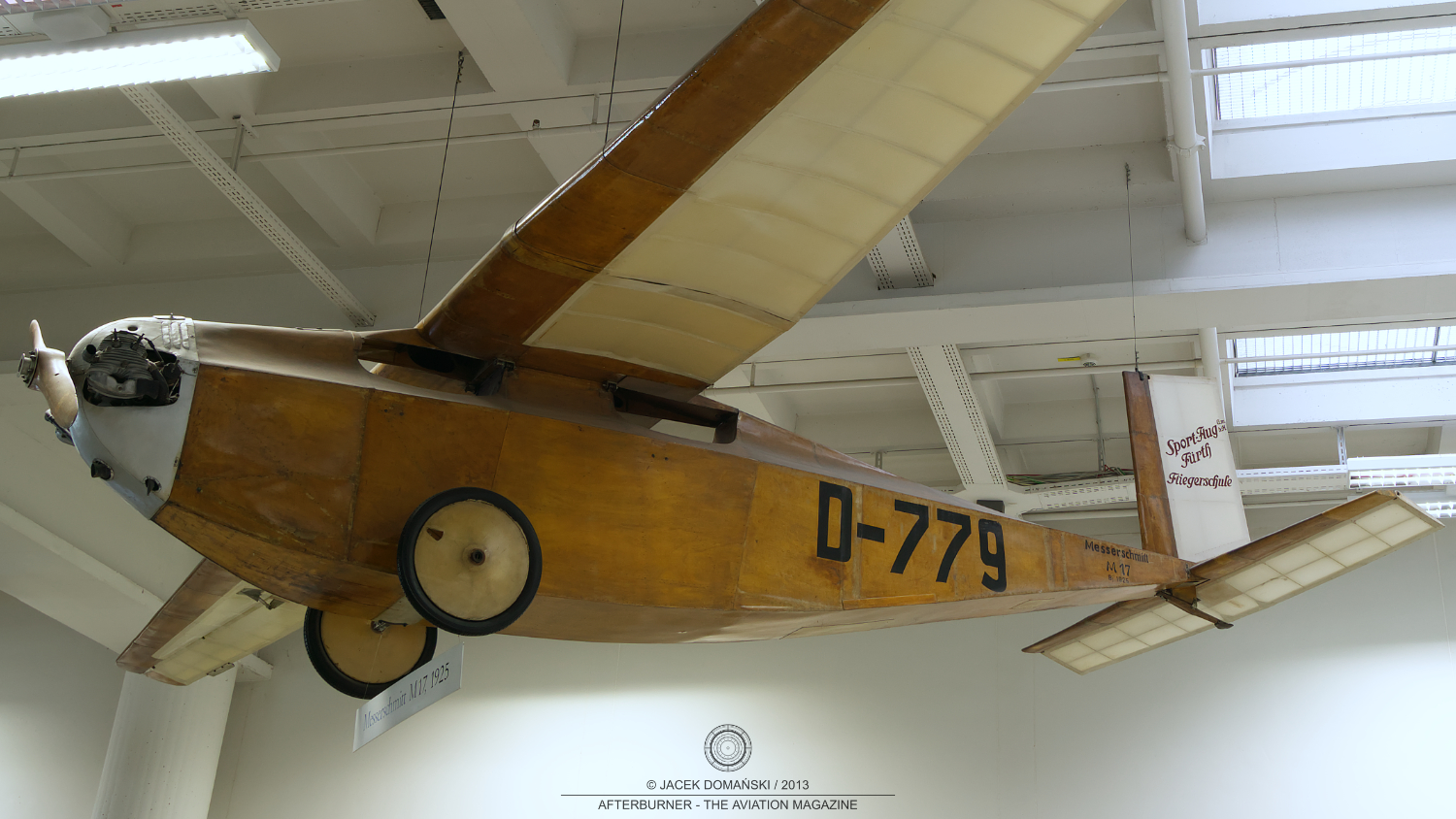
 Messerschmitt M17 (c/n 25, D-779), exhibited at the Deutsches Museum in Munich, October 2013.
In 1923, Willy Messerschmitt graduated from Technische Hochschule München (currently known as Technische Universität München – the Technical University of Munich) and founded his first aviation company. Located in Bamberg, Messerschmitt Flugzeugbau GmbH (Messerschmitt Aircraft Construction Ltd.) began its activity by building sailplanes and motor gliders.
Already in the first year of his company’s operation, Messerschmitt developed a successful glider, designated the S14. The aircraft was designed and built in a very short time in order to take part in the fourth edition of Rhön-Segelflugwettbewerb (the Rhön gliding competition).
The S14 performed very well in the competition. Piloted by Hans Hackmack, the glider won the Albert Böhm Prize for reaching the highest altitude and came second in the flight distance category. This success motivated Messerschmitt to develop a powered variant of the glider, known as the M15, to participate in the following year’s edition of the contest.
The 1924 edition of Rhön-Segelflugwettbewerb was to be the first to include motorised aircraft. At that time, following the constraints imposed by the Treaty of Versailles, the German aviation industry was still suffering from a ban on the development of powered aeroplanes. Building light, powered gliders was the only permitted option and represented the first exception to the restrictions.
However, the M15 turned out to have several drawbacks, preventing the aircraft from succeeding in the competition. Messerschmitt quickly improved the design, redeveloping it into an upgraded variant named the S16.
Although the company’s test flights had not been completed, two examples of the new powered glider took part in the competition. This time, it proved to be a major disappointment. Shortly after take-off, the single-seat version of the S16 suffered from powerplant and propeller failure, while the two-seat glider also experienced engine issues and was forced to make an emergency landing. In conclusion, the only trophy Messerschmitt won at that competition was the honorary Cup of Aeroclubs.
Undaunted by the failure of his motor glider, Willy Messerschmitt began work on an advanced variant of his design, known as the M17. The aircraft successfully performed its first flight in January 1925, becoming the first light aircraft developed by Messerschmitt.
It was a two-seat aeroplane, made of wood, weighed only 198 kg and was powered by a 29 hp Bristol Cherub II engine Interestingly, the cockpit provided no forward visibility for the pilot.
Nevertheless, the development of the aeroplane would not have been possible without the secret support of the German state. Messerschmitt was short of funds and had been unable to find investors. It was only thanks to a financial subsidy of 4,000 Reichsmarks (approximately 18,000 USD in current value), received from his long-time friend Theodor Croneiß that allowed Messerschmitt to purchase an engine and complete development of the M17. However, this was not merely a gesture of friendship, as Croneiß was the head of Verkehrsflug GmbH für Mittelfranken, Oberfranken und Oberpfalz (Commercial Flights Ltd. for Middle Franconia, Upper Franconia and Upper Palatinate), a covert company of the German armed forces, the Reichswehr.
In May of that year, the first example of the M17, nicknamed “Ello”, took part in the Oberfrankenflug flying contest. Piloted by Heinrich Seywald, the aircraft took the first place in the altitude and speed competitions, as well as came the second in the cross-country flight. However, ten days later, the M17 crashed and was damaged beyond repair.
The second example of the aircraft took part in Internationalen Flugwettbewerb (the International Flight Competition), organised in Schleißheim in September 1925. Similarly to the earlier event, the M17 won in both the speed and altitude categories.
Between 20 and 29 September 1926, Eberhard von Conta and the writer Werner von Langsdorff flew the M17 “D-887” from Bamberg to Rome. It was the first time a light aircraft had crossed the Central Alps. The pioneering flight lasted 14 hours and 20 minutes, excluding the refuelling stopovers the crew had to make every three hours. The maximum altitude reached was approximately 4,500 metres.
Depending on the source, six to eight examples of the aircraft were built. Only one M17 has survived to the present day and is currently part of the Deutsches Museum collection.
Between 2000 and 2004, an airworthy replica of the M17 was built by the Augsburg-based company Bitz Flugzeugbau GmbH. Interestingly, the aircraft was equipped with the original Bristol Cherub III engine that had been acquired by the Messerschmitt company in 1926.