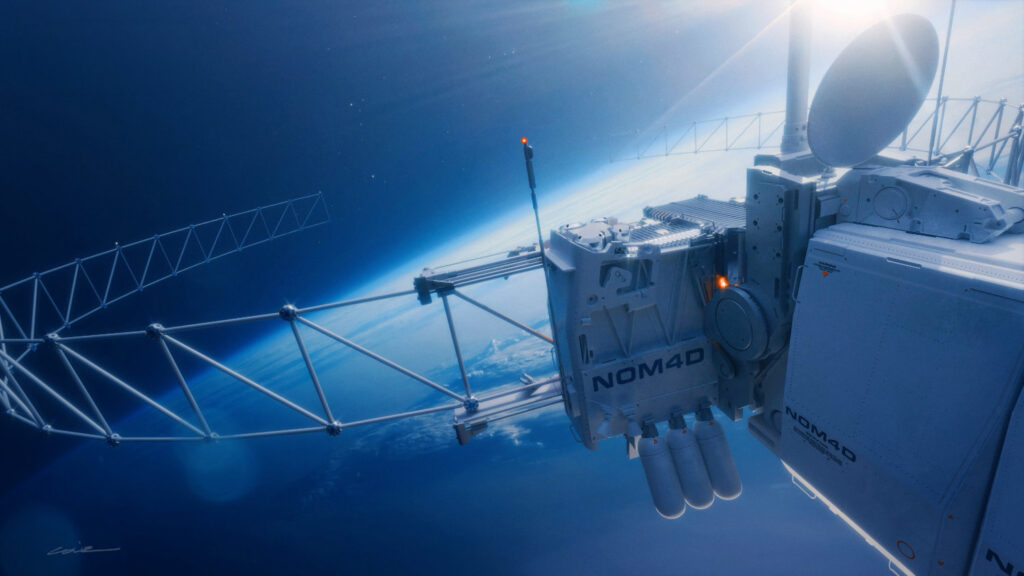
 On 5 November 2026, the Defense Advanced Research Projects Agency (DARPA) announced the successful demonstration of automated in-space assembly under its Novel Orbital and Moon Manufacturing, Materials and Mass-efficient Design (NOM4D) programme. A robotic system developed by the California Institute of Technology (Caltech) assembled a truss section in orbit, achieving what DARPA described as a world first.
The development of large-scale space infrastructure is constrained by the need to transport it from Earth. Structures must fit within the payload fairing of a launch vehicle and withstand the mechanical loads of ascent. Traditionally, these limitations have been addressed through deployable designs or the orbital assembly of individually launched modules, as exemplified by the International Space Station (ISS).
In 2022, DARPA introduced NOM4D to explore an alternative approach based on orbital manufacturing and assembly using raw materials supplied from Earth or, potentially, sourced from the Moon. The goal was to establish the technological foundations for structures optimised for their operational environment rather than launch conditions. While the first two phases investigated the potential use of lunar regolith through Earth-based simulants, the final phase focuses exclusively on terrestrial materials.
Initially involving eight research teams from industry and academia, NOM4D focused on two complementary areas. The first encompassed materials, manufacturing processes and design technologies for orbital fabrication, while the second explored structural architectures that exploit the advantages of in-space manufacturing to achieve high mass efficiency and precision while withstanding manoeuvres, thermal cycles and other operational challenges.
Originally, all experiments were to be conducted on Earth. However, promising results from the second phase, particularly advances in automated assembly and high-precision composite manufacturing, prompted DARPA to revise the scope of the third and final phase. In February 2025, the agency announced plans for two small-scale orbital demonstrations.
The first, designated Autonomous In-Space Tensioned Reflector Assembly (ASTRA), was developed by a Caltech team led by Professor Sergio Pellegrino. On 30 March 2026, it reached low Earth orbit aboard the Momentus Vigoride-7 spacecraft, launched by a Falcon 9 rocket from Vandenberg Space Force Base in California as part of the SpaceX Transporter-16 rideshare mission. Momentus supported payload integration and provided power, communications, imaging and other operational services. According to DARPA, just fifteen months elapsed between the initial concept of an orbital demonstration and the launch of a working prototype.
ASTRA was designed to validate a robotic assembly technique for space-based reflector antennas. Its intended configuration comprised a 1.4-metre-diameter reflective surface supported by a perimeter truss consisting of eleven modular sections, known as bays.
At the heart of the system was a gantry robot capable of moving along three linear axes without requiring complex robotics or advanced algorithms. During the nominal operating cycle, the manipulator would retrieve composite tubes and custom-designed aluminium joints from motorised dispensers, connect them on an assembly plate and attach the reflective material. Each completed bay would then be pushed out of the assembly unit, making room for the next.
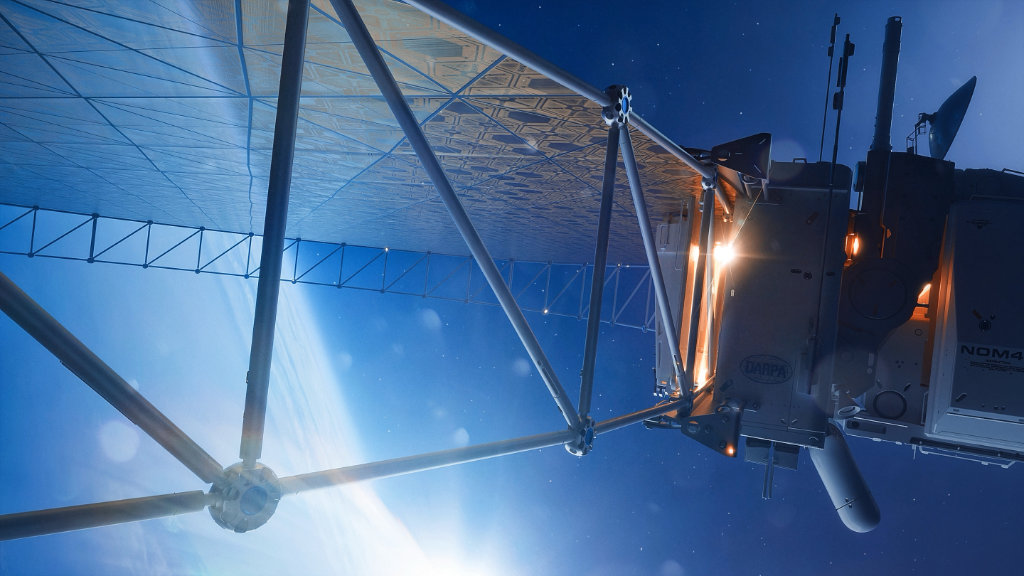
Another notable feature was the reflective material, jointly developed by research teams at Caltech and the University of Pennsylvania, the latter led by Professor Igor Bargatin. Made of perforated Kapton film, the material formed two cable nets prestressed against each other by springs. Compared with the knitted metallic mesh traditionally used in deployable reflectors, the film required less prestress, enabling considerably lighter supporting structures.
ASTRA carried two pre-assembled bays which were deployed in orbit before the manipulator successfully built a third from individual components. The ground team transmitted commands and verified the results using images downloaded from space. Numerous unforeseen problems necessitated repeated operations, with solutions tested on a flight spare at Caltech before being implemented aboard ASTRA. Troubleshooting was further complicated by just seven or eight communication windows per day, each lasting approximately fifteen minutes. Although completing all eleven bays before the scheduled conclusion of the mission in December 2026 appeared unlikely, the experiment demonstrated the feasibility of the concept and identified the need for design simplification and refinement.
“NOM4D’s objective is to enable efficient, scalable construction of very large structures in space,” said Andrew Detor, the NOM4D programme manager at DARPA. “By ‘very large,’ I mean hundreds of meters or kilometers in scale. Nothing approaching that scale can be achieved today.” he added.
The long-term ambition encompasses lightweight infrastructure hundreds of metres or even kilometres in scale, including large optical systems, megawatt-class solar arrays, orbital depots, spacecraft refuelling stations, habitats and radio antennas for astronomical research. DARPA also envisages antennas at least 100 metres in diameter to enhance space situational awareness in the cislunar region and beyond.
One more orbital experiment is planned before NOM4D concludes. Designated Mission Illinois, it is being developed by a research team at the University of Illinois Urbana-Champaign (UIUC), with Voyager Technologies as its launch service provider. According to the latest information published by UIUC, the payload is scheduled for launch on 29th November 2026, with testing to be conducted in the station’s commercial Bishop Airlock module. Unlike ASTRA, the project will focus on manufacturing, marking the first in-space test of a specially engineered, space-compatible resin system for the energy-efficient production of high-strength composite components.
The UIUC process uses carbon fibre sleeves pre-impregnated with a resin that remains stable for months before curing. Transported in a flattened configuration to minimise cargo volume, the material is formed into a hollow cylindrical structural element known as a longeron. The technique, called incremental reactive extrusion (IRE), progressively heats and compresses successive sections, employing frontal polymerisation – a self-propagating chemical reaction that eliminates the need to heat the entire component simultaneously. The experiment aims to produce a seamless composite longeron with a wall thickness of 2.5 mm.
The third research team involved in the final phase of NOM4D, based at the University of Florida, is advancing laser-based sheet metal bending in collaboration with NASA’s Marshall Space Flight Center in Huntsville, Alabama. Although not part of the orbital demonstrations, its work could complement NASA’s laser welding and cutting technologies, expanding the range of metalworking processes available for future space-based manufacturing.
“The NOM4D Caltech demonstration is not an endpoint; it’s a beginning,” said Detor. “Now that we’ve demonstrated a process that can scale to large structures, what do we go make? What wild ideas get assembled thousands of miles above us and what new capabilities do those structures enable?” added the NOM4D programme manager.
As the programme approaches its conclusion, DARPA hopes to stimulate ambitious concepts and encourage substantial investment in space manufacturing and assembly. Greater technological maturity and wider adoption could enable entirely new categories of systems conceived specifically for construction and operation in space rather than adapted to launch constraints. Looking further ahead, combining automated assembly, composite manufacturing and laser-based metalworking could open up even broader engineering possibilities for future orbital infrastructure.

Cover photo: Concept art for how a NOM4D-inspired device might autonomously construct a truss structure in space. (photo © DARPA | Colie Wertz)
DARPA, Caltech, UIUC and Momentus Inc. press releases and materials were used in preparing this article.