 The story of this unusual aircraft begins in Italy in the mid-1940s, when engineer Luigi Pellarini collaborated with the Milan-based company Carrozzeria Colli. Together, they developed a series of “flying car” prototypes (PL-1 to PL-5), marketed as Aerauto. Despite their innovative design, the projects attracted little interest in post-war Europe, and attempts to enter the US market were hindered by costly and complex certification procedures.
Disappointed, Pellarini moved to Australia in the early 1950s, hoping local conditions would favour such concepts. When this proved unsuccessful, he shifted focus to light and agricultural aircraft. Between 1953 and 1961, he designed several prototypes, though none of them entered production. His unconventional designs often stood out for their highly unorthodox appearance.
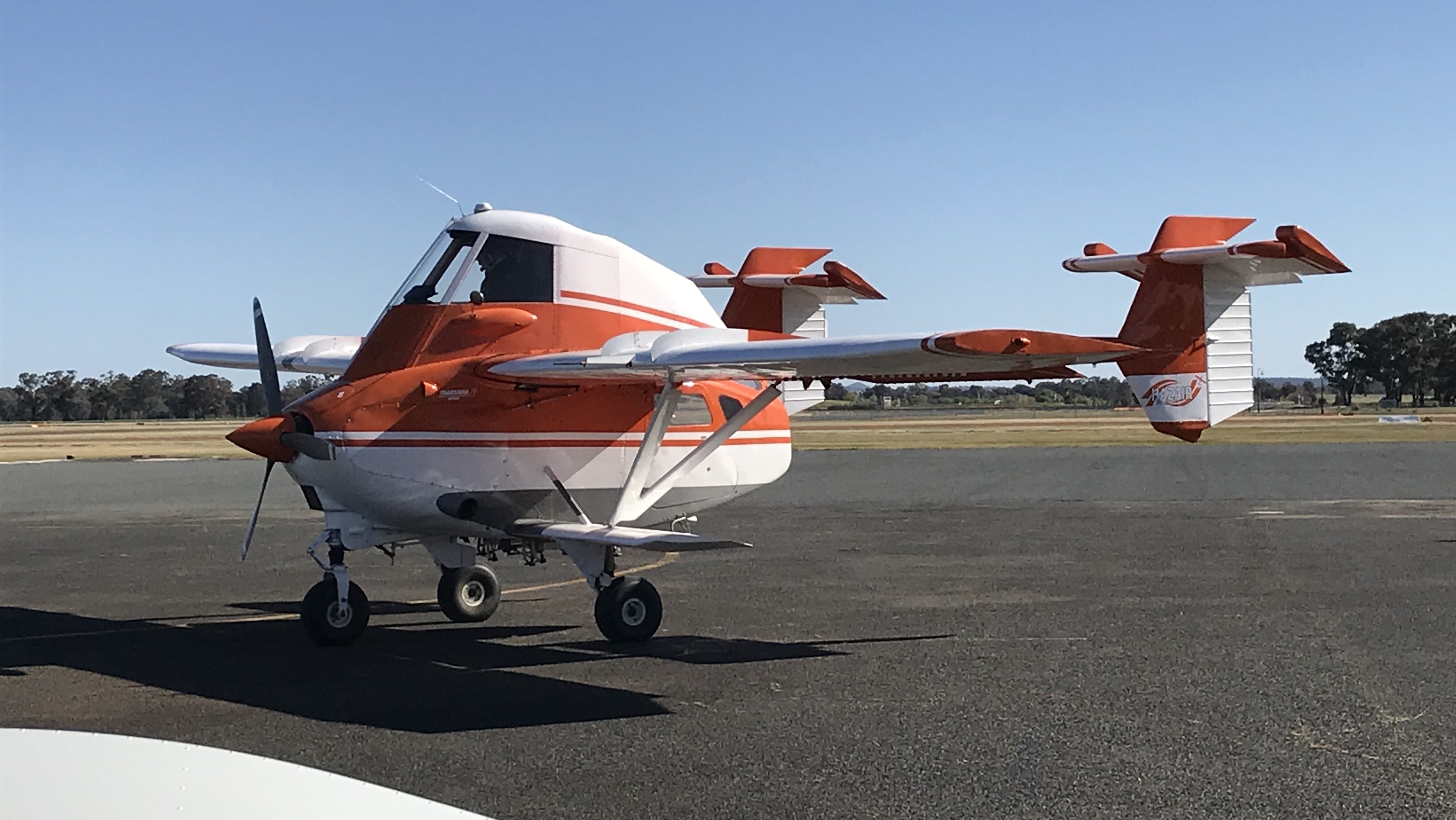
One such project was the PL-12, originally developed in 1956 for a New Zealand company and later revived in 1965 by Transavia Corporation. Despite its unusual configuration, the aircraft – named Airtruk – was a practical agricultural aeroplane. It featured a sesquiplane layout with twin tail booms, a high-mounted cockpit for improved visibility, and the ability to carry around one tonne of chemicals. It could also be adapted for passenger, cargo, or medical transport.
The PL-12 Airtruk became Pellarini’s only commercial success. Approximately 120 aircraft were built before production ceased in 1993. Although often regarded as one of the most unusual aircraft ever produced, its design was well suited to its specialised role, reflecting Pellarini’s unconventional engineering approach.
The Airtruk also gained a place in popular culture, appearing as the “Flying Jalopy” in the film Mad Max Beyond Thunderdome. It is also often considered one of the ugliest aircraft ever made.
Cover photo: Hazair’s VH-TRT visiting Temora October 2018 by Fmt1962 via Wikipedia Commons (CC BY-SA 4.0)