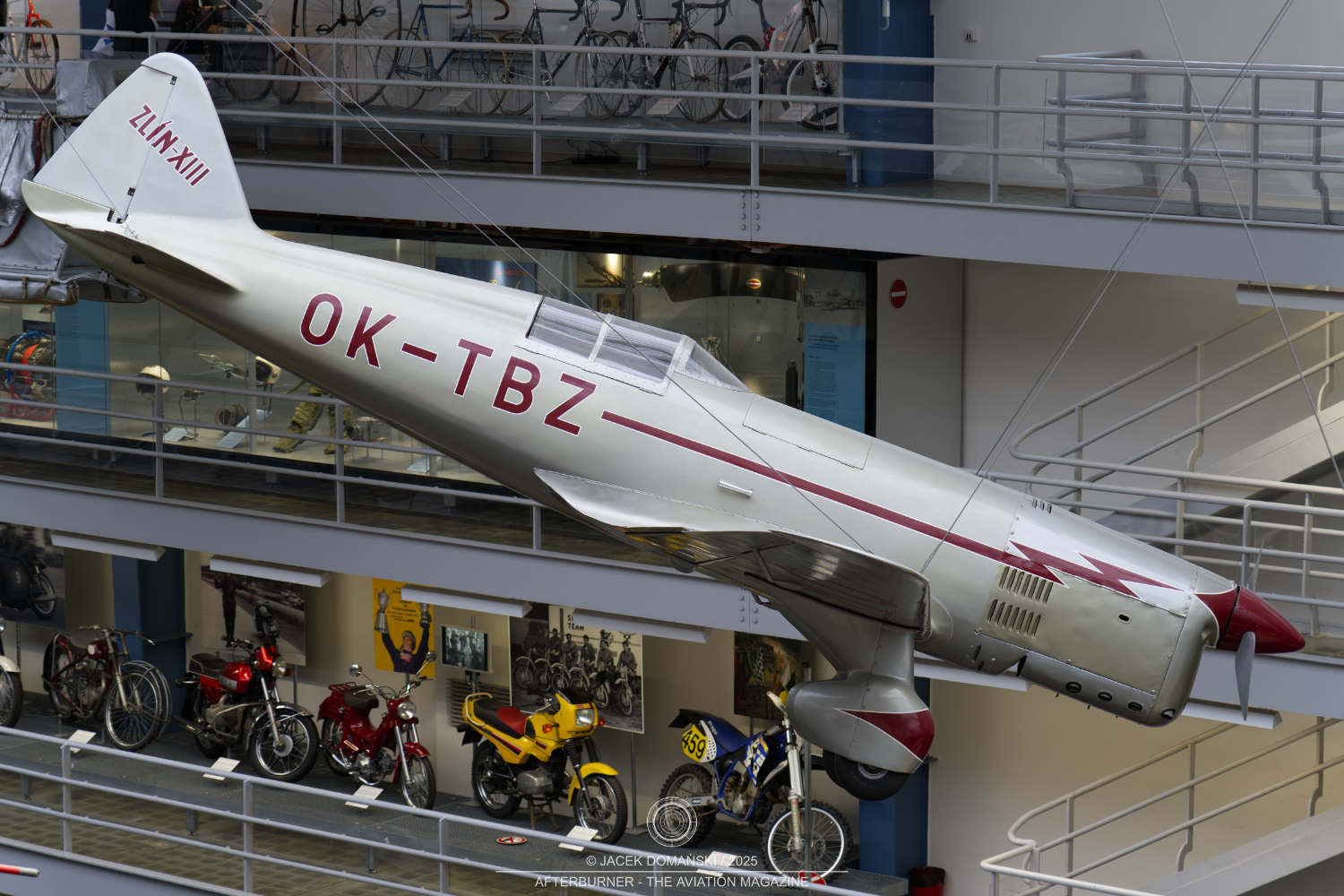
Zlín Z-XIII (prototype, OK-TBZ), a Czechoslovak sports aircraft, exhibited in the National Technical Museum, Prague, April 2025.
In the mid-1930s, several aviation companies developed so-called “fast courier aircraft” – small touring and sports aeroplanes characterised by advanced construction and high maximum speed. Most of these aircraft were built as cantilever monoplanes, equipped with enclosed cockpits and, in some cases, retractable undercarriage. Used as technology demonstrators, they heralded the arrival of a new era in aviation development and influenced the design of most combat aircraft of the upcoming world war.
The Zlín-XIII was a good example of this trend. The aircraft was developed by Zlínská letecká společnost, a.s. (Zlín Aviation Joint-Stock Company), the Czechoslovak aviation manufacturer based in Otrokovice. Notably, at that time Zlín – which would soon become one of the most recognised Czech aviation brands – had among its major shareholders the no less famous Baťa shoe company.
In 1936, the company introduced to the market a light sport and training aircraft designated the Zlín-XII. The aeroplane was created by Jaroslav Lonek, an aircraft engineer who worked as chief designer for Zlín between 1935 and 1938. The design of the Zlín-XII was based on his earlier development, the Lonek L-8 Ginette, and it soon became a domestic and international success.
The fast racing and courier aircraft known as the Zlín-XIII was Lonek’s next development. The aeroplane was built as an all-wood, cantilever low-wing monoplane with an enclosed cockpit and a fixed but faired tailwheel undercarriage. The Zlín-XIII was equipped with a relatively low-powered engine, a four-cylinder inverted Walter Minor 4 generating up to 130 hp.
Nevertheless, its streamlined silhouette and a gross weight of only 630 kilograms allowed the Zlín-XIII to reach a maximum speed of 350 kph. This was close to the maximum speeds of biplane fighter aircraft then in service, such as the Fiat CR.32 (360 kph), the Hawker Fury (Mk I – 320 kph, Mk II – 359 kph), the Heinkel He 51 (330 kph) and the Blériot-SPAD S.510 (370 kph).
The Zlín-XIII prototype made its maiden flight in the spring of 1937, with Ladislav Šváb, the company’s chief pilot, at the controls. Rumour has it that the aircraft was ready to fly much earlier, but no one wanted to test it due to concerns about its anticipated flight characteristics.
Whether this was true or not, the fact remains that the Zlín-XIII was difficult to fly. The first evaluation flights revealed some structural flaws, but these were corrected shortly afterwards. Nevertheless, the aeroplane was demanding to pilot and required well-prepared airfields due to its extremely high landing speed of 140 kph – for comparison, the landing speed of the Messerschmitt Bf 108 was 85 kph, while that of the PZL P.11c, one of the best fighter aircraft in service at the time, was 120 kph.
In August 1937, the Zlín-XIII was registered as OK-TBZ (regarded by some as an abbreviation of “Tomáš Baťa Zlín”) and was due to take part in an aviation race in France. However, severe weather conditions caused the aircraft, piloted by Maj. Ján Ambruš, to arrive at the Vittel airfield with a delay. Consequently, the Zlín-XIII was not approved for the competition.
Interestingly, although initially planned as a two-seater, the aeroplane was built and operated in a single-seat configuration. This allowed the company to advertise the Zlín-XIII as a fast courier aircraft, with a small, enclosed cargo compartment located in front of the pilot’s cabin.
However, tensions that would lead to the outbreak of the Second World War halted any further development of the aircraft. When the German occupation of Czechoslovakia began, the Zlín-XIII was initially planned for evacuation to Yugoslavia but ultimately spent the war hidden in the company hangar.
After the war, development of the Zlín-XIII did not continue, and the aeroplane was donated to the National Technical Museum in Prague for exhibition purposes.
In conclusion, it is worth mentioning an attempt to build an airworthy replica of the Zlín-XIII. The project began in 2007 and was run by the association Historická letka republiky Československé (Historical Squadron of the Czechoslovak Republic).
The Zlín-XIII was intended to become the second flying replica of a Czechoslovak aircraft built by the association, following the Avia BH-5. Regrettably, work on the aircraft came to a halt around 2013, although – based on press releases from the time – the replica was close to completion. According to the Czech company register, Historická letka republiky Československé definitively ceased its activities in June 2025.