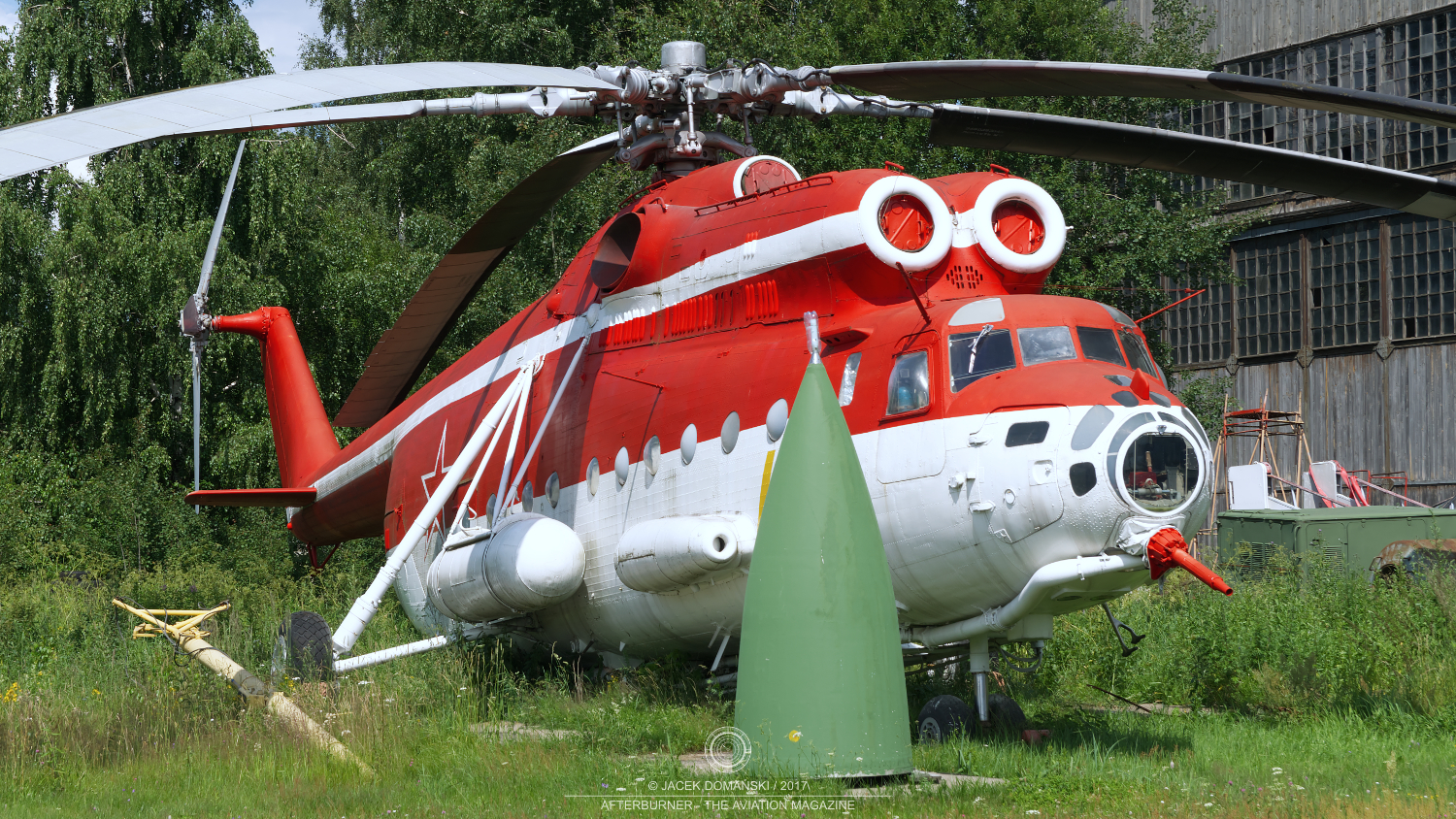
 Mil Mi-6PZh2 / Ми-6ПЖ2 (c/n 9683901V, formerly “41” of the Soviet Air Force / Военно-воздушные силы СССР), exhibited at the Central Air Force Museum (Центральный музей Военно-воздушных сил РФ) in Monino, July 2017.
In the early 1950s, OKB-329 (commonly known as the Mil design bureau), began studies on a new heavy-lift helicopter. Initially known as изделие «50» (Product 50), the rotorcraft was also given the internal company designation VM-6 – the Mil helicopter with a payload capacity of six tonnes.
Officially, development of the new rotorcraft was approved on 11 June 1954. The prototype was designated the V-6, and its main characteristics, such as a maximum payload of at least 8,000 kg and a range of between 700 and 1,200 km, depending on the carried load, were set by the Soviet authorities.
In addition, the size of the cargo compartment was designed to accomodate a broad range of Soviet weapons and military equipment, including the ASU-57 self-propelled gun, the BTR-152 armoured personnel carrier, artillery and infantry vehicles, as well as operational and tactical missiles.
In 1957, the new Soviet heavy-lift helicopter successfully performed its maiden flight. On 5 June, the V-6 lifted off the ground for the first time, and on 18 June completed its first flight in a circuit.
Production of the Mi-6 (NATO reporting name “Hook”), as the rotorcraft was subsequently designated, began in 1959. The first examples were built for the Soviet armed forces, while a dedicated civil variant was developed only in 1962.
The Mi-6 became a popular Soviet heavy-lift rotorcraft, with more than 900 examples built by 1980. The military variants of the helicopter were used, mainly for transport purposes, by around ten air forces worldwide. The civil versions included general transport rotorcraft, utility and firefighting variants, as well as the specialised flying crane variant, equipped with two additional fixed wings.
At the time it was introduced, the Mi-6 was the largest and fastest rotorcraft in serial production. In addition, the rotorcraft set several world aviation records in speed and payload categories.
In 1967, the Mil design bureau developed a specialised firefighting variant of the rotorcraft, designated the Mi-6PZh / Ми-6ПЖ (derived from пожарный, meaning “firefighting”). The prototype was converted from a transport variant and equipped with an internal fuselage tank for 12 tonnes of water, featuring a central discharge opening and an additional tank for foaming agent. The helicopter was also equipped with pumps and a boom for scooping water from an open water source while hovering, as well as rescue kit and other firefighting hardware. In addition, the Mi-6PZh could carry six 1.5-tonne, flexible tanks filled with fire-extinguishing liquid on its external sling.
In May and June 1967, the prototype of the firefighting variant was exhibited at the 27th Paris Air Show. Then, in August of that year, the Mi-6PZh was flown by the well-known Soviet test pilot Yuri Garnaev / Юрий Гарнаев and underwent live-fire tests for Sécurité Civile, the French Civil Security Agency. However, while fighting a fire in southern France, the rotorcraft crashed in the hills near Ensuès-la-Redonne, in the vicinity of Marseille. The entire crew of nine was killed.
In 1971, the second firefighting variant of the rotorcraft was developed, known as the Mi-6PZh2 / Ми-6ПЖ2. Unlike its predecessor, this helicopter featured a new nose-mounted turret equipped with a combined water nozzle. The new variant was approved by the Soviet authorities, and several transport and military Mi-6s were converted to the firefighting configuration.
The rotorcraft featured in our Photo of the Week series is an example of the aforementioned Mi-6PZh2 conversion. The helicopter was manufactured in 1969 and initially operated by the Soviet Air Force. In 1971, it was converted into the firefighting variant and then assigned to the 113th Independent Helicopter Regiment of the Search and Rescue Service / 113-й отдельный вертолётный полк поисково-спасательной службы, with the “41” tactical number.
At the end of 1991, the helicopter was retired from active service and transferred to the Central Air Force Museum, where our current Photo of the Week was taken in 2017.