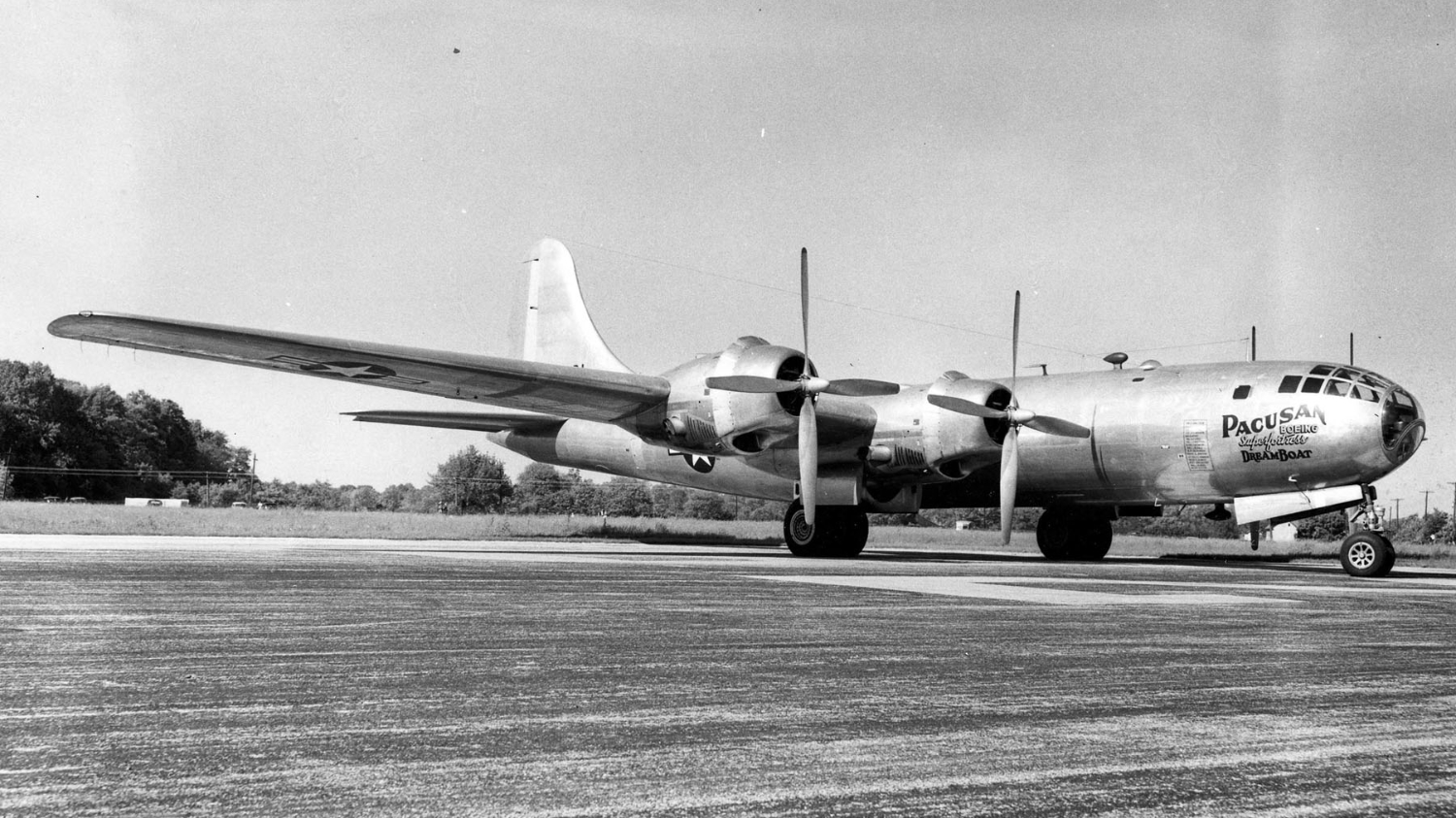
 On 20 November 1945, the Boeing B-29 Superfortress “Pacusan Dreamboat” successfully landed in Washington, D.C., completing its non-stop, unrefuelled flight from Guam and setting a new FAI record for flight distance of 12,739.59 kilometres (7,916.041 miles).
The “Pacusan Dreamboat” was a Bell-built example of the Boeing B-29B Superfortress (44-84061). The aircraft was originally manufactured as a low-level, lightweight variant of the bomber, with all defensive armament removed except for the two tail machine guns and a radar-directed 20 mm cannon. In addition, as Japanese fighter activity had been reduced to a minimum by late 1944, most of the aircraft’s armour plates were also removed.
At the end of 1945, the United States Army Air Forces (USAAF) began testing its long-range strike capabilities. A series of record flights was planned to demonstrate that USAAF bombers could reach extremely distant targets, a capability that became particularly important on the eve of the Cold War. In addition, the flights were intended to test Arctic navigation and win public and Congressional support for the Air Force, which would soon become an independent branch of the US armed forces.
The aircraft chosen for the record flight was the aforementioned B-29B Superfortress. Nicknamed “Pacusan Dreamboat”, with the first word being a combination of the names of its intended flight routes – Pacific, United States, Atlantic and North – the bomber was additionally prepared for long-range flights.
The aeroplane underwent significant modifications to further reduce its weight, including the removal of the tail machine guns and all armour plates. Moreover, the B-29B’s tail section was reshaped for aerodynamic reasons, and additional fuel tanks were installed. The “Pacusan Dreamboat” could now carry 10,000 gallons (37,854 litres) of fuel, while its empty weight was reduced from the standard 69,000 pounds (31,298 kilograms) to 66,000 pounds (29,937 kilograms).
The “Pacusan Dreamboat” was operated by a crew of ten – later increased to twelve – airmen, commanded by Colonel Clarence Shortridge “Bill” Irvine. He was not selected by coincidence, as he was an experienced test pilot who had already made his mark in aviation history while testing the Boeing B-17 Flying Fortress. In August 1939, flying the 14th prototype of the aircraft, designated Y1B-17A, Irvine set two FAI world records in the “Speed over 1,000 km with 5,000 kg payload” and “Altitude with 500 kg payload” categories.
On 19 November 1945, the B-29B took off from Guam, a US military base in the Mariana Islands, for its first record-breaking flight. The following day, the aircraft successfully landed in Washington, D.C., having covered a distance of 12,739.59 kilometres (7,916.041 miles).
The record, set by the crew comprising C.S. Irvine, W.J. Bennett, G.F. Broughton, Dock West, W.S. O’Hara, F.S. O’Leary, K.L. Royer, F.J. Shannon, J.A. Shinnault and G.R. Stanley, was officially recognised by the Fédération Aéronautique Internationale (FAI) in the “distance in a straight line” category.
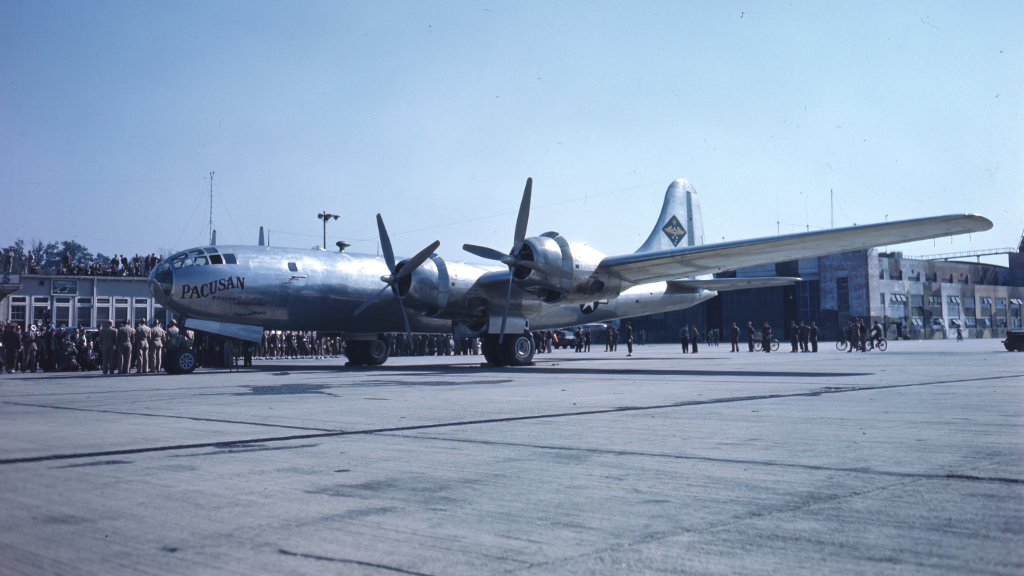
It should be mentioned here that the total distance covered during the Guam–Washington, D.C. flight was 13,193 kilometres (8,198 miles), and the journey took 35 hours and 5 minutes. However, only part of this distance was recognised in the aforementioned FAI category.
In the following years, the “Pacusan Dreamboat” continued to set new flight records, leaving a lasting mark on the pages of aviation history.
On 11 December 1945, the B-29B flew from Burbank, California, to Floyd Bennett Field in New York, covering the distance of 2,464 miles in 5 hours, 27 minutes and 8 seconds. During the flight, the “Pacusan Dreamboat” achieved an average speed of 724.82 kph (450.38 mph) and established a new transcontinental speed record.
Between 4 and 6 October 1946, C.S. Irvine and his crew made another non-stop, unrefuelled flight. This time, the B-29B flew from Honolulu to Cairo, covering a distance of 15,288 kilometres (9,500 miles) in 39 hours and 36 minutes. The flight was conducted over the Arctic region to test communications and navigation procedures under extreme conditions.
Although this mission was initially planned as another record-breaking achievement, the Honolulu–Cairo flight remained just another notable accomplishment of C.S. Irvine and his crew. Only a few days earlier, a Lockheed P2V-1 Neptune patrol aircraft of the US Navy, nicknamed “Truculent Turtle”, had made aviation history with a non-stop, unrefuelled flight from Perth, Australia, to NAS Columbus, Ohio, covering 18,082 km (11,235.6 miles) in 55 hours and 17 minutes. In the age-old rivalry between the Navy and the Air Force, this time the naval aviators had the upper hand.
In 1947, the “Pacusan Dreamboat” set another FAI record, this time in the “Distance over a closed circuit without landing” category. Commanded by Lieutenant Colonel Olbert Fearing “Dick” Lassiter, the B-29B covered 14,249.66 km (8,854.8 miles) on a flight between MacDill Field, Tucson and Andrews Field. As in the previous case, the total distance covered was 9,002 miles, but only part of it was recognised for the FAI record.
In the following years, the “Pacusan Dreamboat” was one of six B-29s converted into YB-29J experimental aircraft, equipped with R-3350-79 engines. Later, the aeroplane was used for reconnaissance purposes and redesignated RB-29J.
The B-29 “Pacusan Dreamboat” was retired from USAF service in 1954. Regrettably, the aircraft was not preserved for future generations and was scrapped around 1965.
Cover photo: Boeing B-29B-60-BA (S/N 44-84061) “Pacusan Dreamboat” (US Air Force photo via National Museum of the United States Air Force, 050511-F-1234P-055, Public Domain).