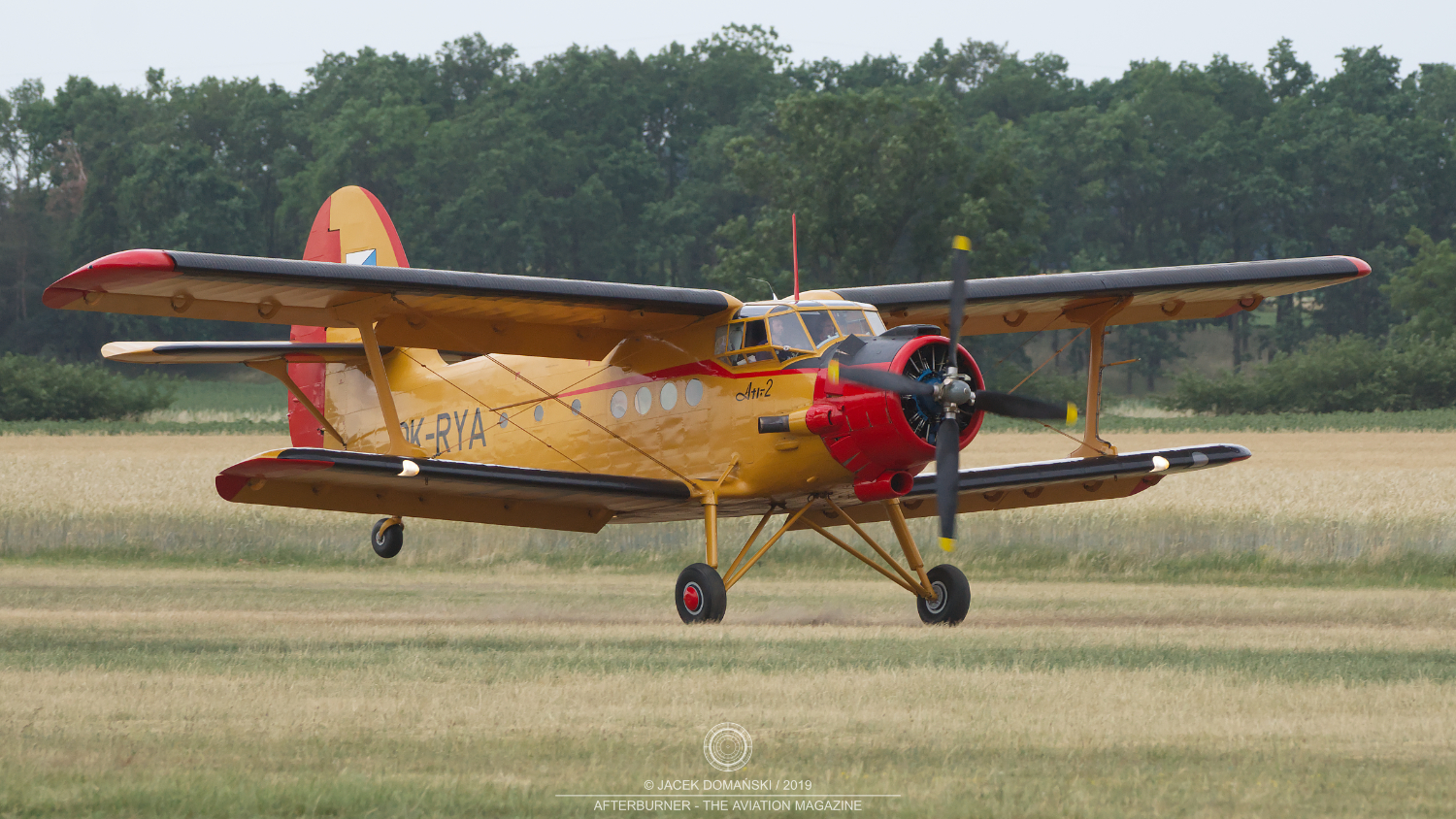
Antonov An-2R (c/n 1G190-04/1980, OK-RYA), landing at Roudnice nad Labem airfield during the 2019 edition of the Memorial Air Show, Roudnice, June 2019.
At the end of August 2026, it has already been 79 years since the first flight of the legendary Soviet aircraft designed by Oleg Antonov, the Antonov An-2.
This multipurpose aeroplane was designed in the late 1940s, partially as a replacement for another iconic biplane – the World War II-era utility aircraft designated U-2 (later known as the Polikarpov Po-2), but widely known by its nickname кукурузник (“crop/maize duster”, from the Russian кукуруза – maize).
The new aircraft was created by the Antonov Design Bureau, led by chief designer Oleg Konstantinovich Antonov. The SHA-1 (СХА-1), as the new project was initially designated, could carry up to 1,300 kg of payload and was significantly larger than its predecessor. It had a gross weight of about 5,300 kg (compared with 1,000 kg for the Po-2) and an upper wingspan of 18.2 m (11.4 m for the Po-2). The prototype was powered by a 1,000 hp Shvetsov Ash-62, a nine-cylinder radial engine developed in the Soviet Union from the Wright R-1820 Cyclone, which had been licence-manufactured in the USSR since 1933.
The new biplane took off on its maiden flight on 31 August 1947 and, two years later, on 9 September 1949, the first serial-production An-2 rolled out of the aviation plant in Kiev (in present-day Ukraine).
The Antonov An-2 quickly gained popularity in the Soviet Union and other Eastern Bloc states, where it was adopted in large numbers by local aviation service operators and aeroclubs, as well as armed forces. Used as a short-range airliner, for various agricultural tasks, for carrying parachutists at aeroclubs and with the armed forces, and for connecting remote settlements and scientific bases with civilisation, An-2s were the backbone of the utility aircraft sector for years.
Despite its size and somewhat different role, the new biplane inherited its predecessor’s nickname, кукурузник, but was also known by various other nicknames, many of them were related to its designer’s surname, Antonov. This is how Антошка, Аннушка (Annie), and Антон (Anton) appeared in the Soviet Union; Andula (Annie) in then-Czechoslovakia; and Antek (a diminutive of Antoni – Anton/Anthony) in Poland. Equally popular were the Russian nicknames referring to the “aerodynamic silhouette” of the An-2 (сарай – shed) or to its legendary durability and ability to fly almost anywhere (таракан – cockroach).
The Antonov An-2 was manufactured at several locations: by Aviation Plant No. 473 in Kiev (1949–1963) and the Dolgoprudny Machine-Building Plant (1966–1971) in the Soviet Union; by WSK PZL-Mielec in Poland under licence (1959–2002); by Aviation Plant No. 320 in Nanchang (1956–1968, as the Feng Shou-2 and Nanchang Y-5); and by Shijiazhuang Aircraft Manufacturing Corporation (since 1970, as the Shijiazhuang Y-5) in China. Moreover, the latter is still producing a modernised variant of the Antonov’s biplane, with estimates suggesting that between 10 and 20 aeroplanes are manufactured each year under the current designation Yunshuji Y-5B.
The exact number of original and licensed An-2s, their Chinese copies and other derivatives produced is, unfortunately, not known, mostly because of the incalculable scale of Chinese production. However, even the most conservative estimates put the number at 18,000 aeroplanes manufactured since 1949, making the Antonov An-2 one of the most-produced aircraft ever and the most-produced biplane in aviation history.
The Antonov An-2 is widely regarded as the largest single-engine biplane ever built. However, this title actually belongs to one of its derivatives, the Antonov An-3, developed in the mid-1970s. Thanks to the shape of its turboprop powerplant, the An-3 is one and a half metres longer than the An-2. Nevertheless, the largest single-engine biplane to enter serial production was built in only about 25 examples and today remains virtually unknown, unlike the An-2.
Although in most European countries the An-2 is currently considered a vintage aircraft, with some examples still being used by aeroclubs, parachute clubs and other private operators, the biplane remains a core pillar of logistics in remote Russian areas such as the Far North, the Far East and Siberia.
According to the Ministry of Industry and Trade of the Russian Federation (Minpromtorg), the aircraft is the only mean of transport and a lifeline to civilisation for inhabitants of 28,000 settlements in fifteen regions of Russia. To this day, the majority of those aircraft are An-2s, more than 79 years after their maiden flight. Although several attempts to develop a modern successor to the кукурузник have been made in Russia during the last decade, none of the aircraft designed has reached the mass-production stage.
The Antonov An-2R featured in our Photo of the Week series was manufactured in 1980 by the PZL Mielec aviation plant in Poland. Initially registered as OK-KII, the aeroplane was operated in the former Czechoslovakia, and subsequently in the Czech Republic, for agricultural aviation. In the mid-2010s, the biplane was renovated, received the former livery of Slov-Air and was registered as OK-RYA.