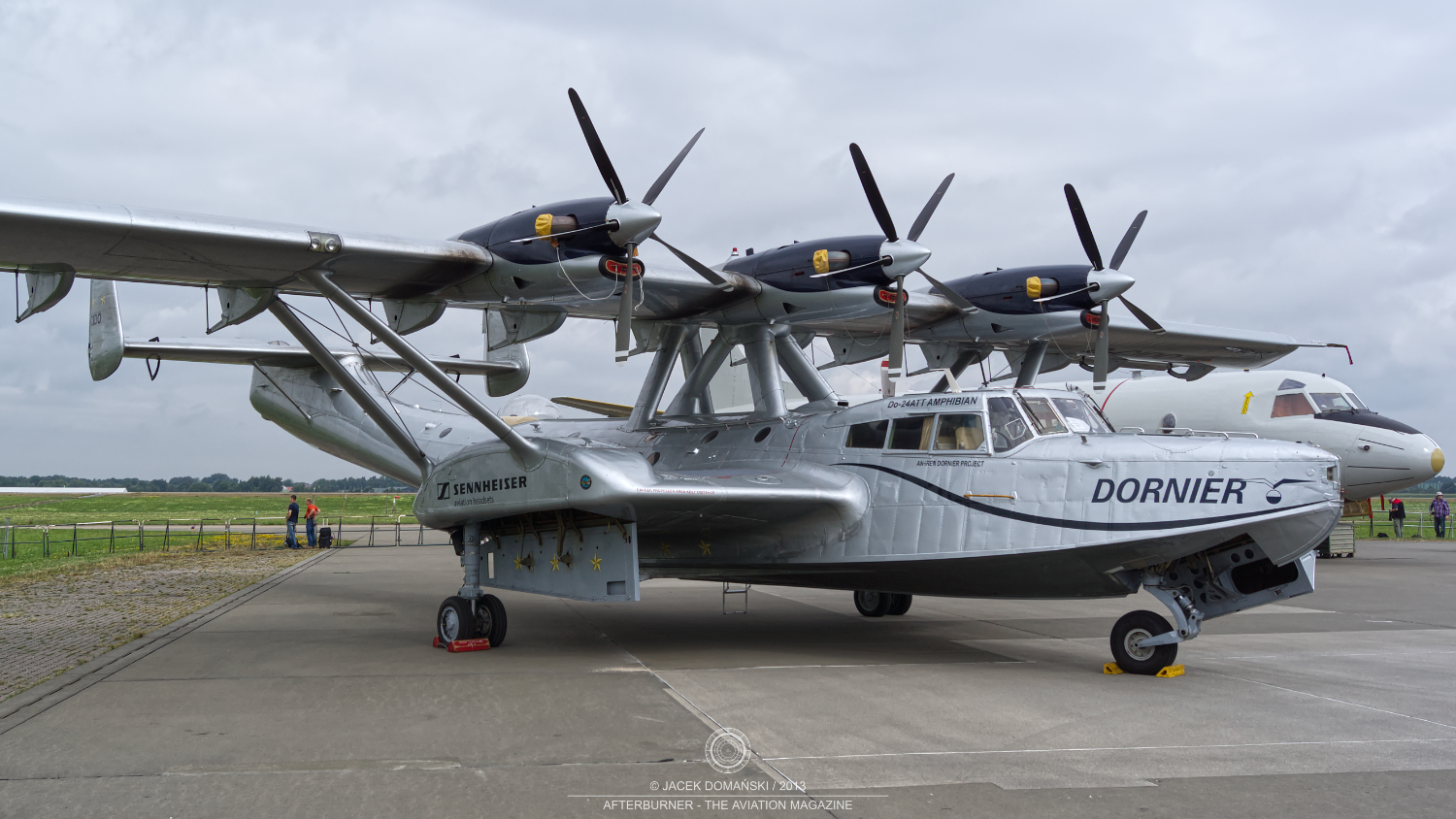
 Dornier Do 24 ATT (c/n 5345, D-CIDO, formerly RP-C2403 and D-CADT), exhibited at the static display during the spotter day organised on the eve of the 100th Anniversary of German Naval Aviation (Marineflieger), Nordholz, August 2013.
The aircraft that later became the world-famous Do 24 ATT was initially built in 1944 as the Do 24 T-3 (c/n 3404) for the Spanish Air Force. The aeroplane remained in active service until the late 1960s – registered as HR.5-12 and then HR.5-4 – being used for search-and-rescue duties and operating, inter alia, from Pollensa Air Base.
In 1969 (or 1971, according to some publications), the aircraft was acquired by the Dornier company. At the time, the German aviation manufacturer was considering the possibility of giving a “second life” to the remaining examples of the Do 24. The project, officially named the Do 24/72, was intended to turn the flying boats manufactured in the 1940s into modern aviation platforms that could be used for SAR duties, maritime surveillance and firefighting. The modernised aircraft were to be equipped with three turboprop engines, either Pratt & Whitney Canada PT6A or Avco-Lycoming T53, as well as the hull length and wingspan were to be extended..
The modernisation was to be carried out in cooperation with Construcciones Aeronáuticas S.A. (CASA) from Spain and Aérospatiale from France. Initially, the Spanish Air Force showed interest in purchasing up to thirty examples of the aeroplane. However, the modernisation project was abandoned shortly afterwards, and the Do 24/72 never entered serial production.
Nevertheless, the ex-Spanish Do 24T underwent an extensive modernisation, within a project initially named the Do 24A, but then redesignated as the Do 24 TT and, since 1978, the Do 24 ATT. The programme, carried out by Dornier but financed by Bundesministerium für Forschung und Technologie (the Federal German Ministry of Research and Technology), officially began in 1979.
The aircraft, now formally known as Amphibien-Technologieträger (the Amphibian Technology Testbed – ATT), was ready in mid-1980. Dornier extensively modernised the aircraft by fitting it with Advanced Technology Wing with high-lift capabilities, derived from the Dornier Do 228, and converting it into an amphibian by installing a retractable undercarriage. In addition, the Do 24 ATT was re-fitted with three Pratt & Whitney Canada PT6A-45B turboprop engines. However, the aircraft retained the original hull shape and side sponsons.
In 1983, the Do 24 ATT was registered as D-CATD and entered the flight-test phase. The first flight of the modernised aeroplane took place on 25 April 1983 at Oberpfaffenhofen. However, as an experimental aircraft, the Do 24 ATT was restricted to 150 hours of flight time. This limit was reached within a year. Shortly afterwards, Dornier was acquired by Daimler-Benz and further testing of the turboprop-powered Do 24 was abandoned. The aeroplane was then donated to Deutsches Museum / Flugwerft Schleißheim in Munich.
However, this was not the end of the Do 24 ATT story. In the early 2000s, the aeroplane was purchased by Iren Dornier, the grandson of the famous Claude Dornier. The flying boat was shipped to the Philippines, where it was overhauled and restored to flying condition. Registered as RP-C2403 and nicknamed “Latina”, the Do 24 ATT was then used by Iren Dornier for a round-the-world tour as part of a humanitarian project organised in cooperation with UNICEF.
After circumnavigating the world, the Do 24 ATT was based in Germany and used for promotional flights. The aircraft frequently visited Western European air shows, performing from both land and water. With the beginning of the next decade, the only airworthy Do 24 in the world underwent another overhaul and then received the German registration D-CIDO.
On 18 July 2015, the Do 24 ATT, piloted by Iren Dornier, participated in the Air Challenge 2015 show, which took place on Lake Wolfgangsee in Austria. During the flying display, the aircraft was to perform a touch-and-go manoeuvre on the water. Regrettably, after the successful landing on the lake surface, a piece of floating debris struck the Do 24’s hull. Although no one was injured, the accident resulted in a hole in the fuselage and the destruction of the electrical systems by the leaking water.
Later, after careful consideration of the aircraft’s condition, the decision was made to abandon plans to repair it. The last airworthy example of the Do 24 was then transferred to the Dornier Museum Friedrichshafen, where it has been on display ever since.