 Hugo Junkers, a renowned German aviation engineer and aircraft pioneer, was born on 3 February 1859 in Rheydt, today a borough of the city of Mönchengladbach. His father owned a cotton weaving mill, ensuring the family’s financial independence and enabling Hugo and his siblings to receive a good education and a strong start in life.
In 1888, Junkers moved to Dessau, where he started working for Deutschen Continental Gasgesellschaft, a company involved in electricity production and the development of gas and electric engines. There, together with Wilhelm von Oechelhäuser Jr., he built his first two-stroke gas engines and developed a calorimeter.
In October 1892, Junkers rented a workshop from the same company and founded his first independent enterprise, named Hugo Junkers, Civil-Ingenieur. The following year, he exhibited his calorimeter at the World’s Fair in Chicago, where it was awarded a gold medal. Soon after, he invented and patented his own gas stove.
On 2 July 1895, Junkers founded Junkers & Co., with Robert Ludwig as financial investor. The company specialised in developing and manufacturing calorimeters, gas stoves, fan heaters, as well as domestic heating and water-heating systems.
Inspired by German aviation pioneer Hans Reissner, Junkers turned his attention to aerodynamics and aircraft construction in 1908. In 1910, he successfully patented his first major aviation innovation: a thick-profile, cantilever, unbraced wing.
Within a short time, Junkers gained recognition as an aviation visionary, for his advanced concepts of all-metal aircraft and flying wings. However, these developments were interrupted by the outbreak of the Great War, when German authorities compelled him to focus on military aircraft only and to merge his aviation company with Fokker Flugzeugwerke mbH, forming Junkers-Fokker-Werke AG.
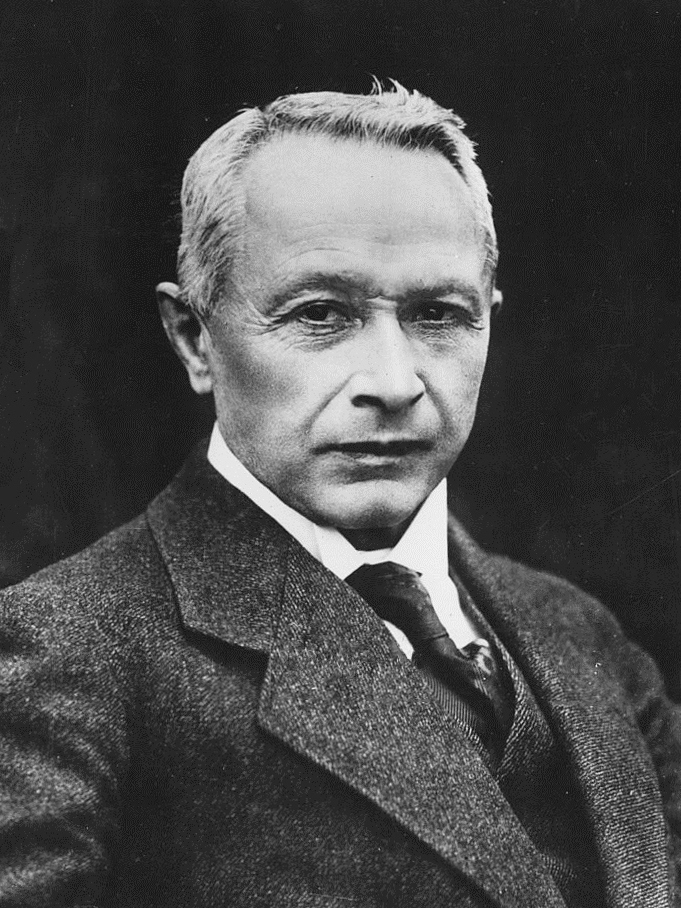
On 12 December 1915, the first aircraft designed by Junkers made its maiden flight. Officially designated the Junkers J 1, it was the world’s first all-metal aeroplane and became commonly known as Blechesel (“sheet-metal donkey”).
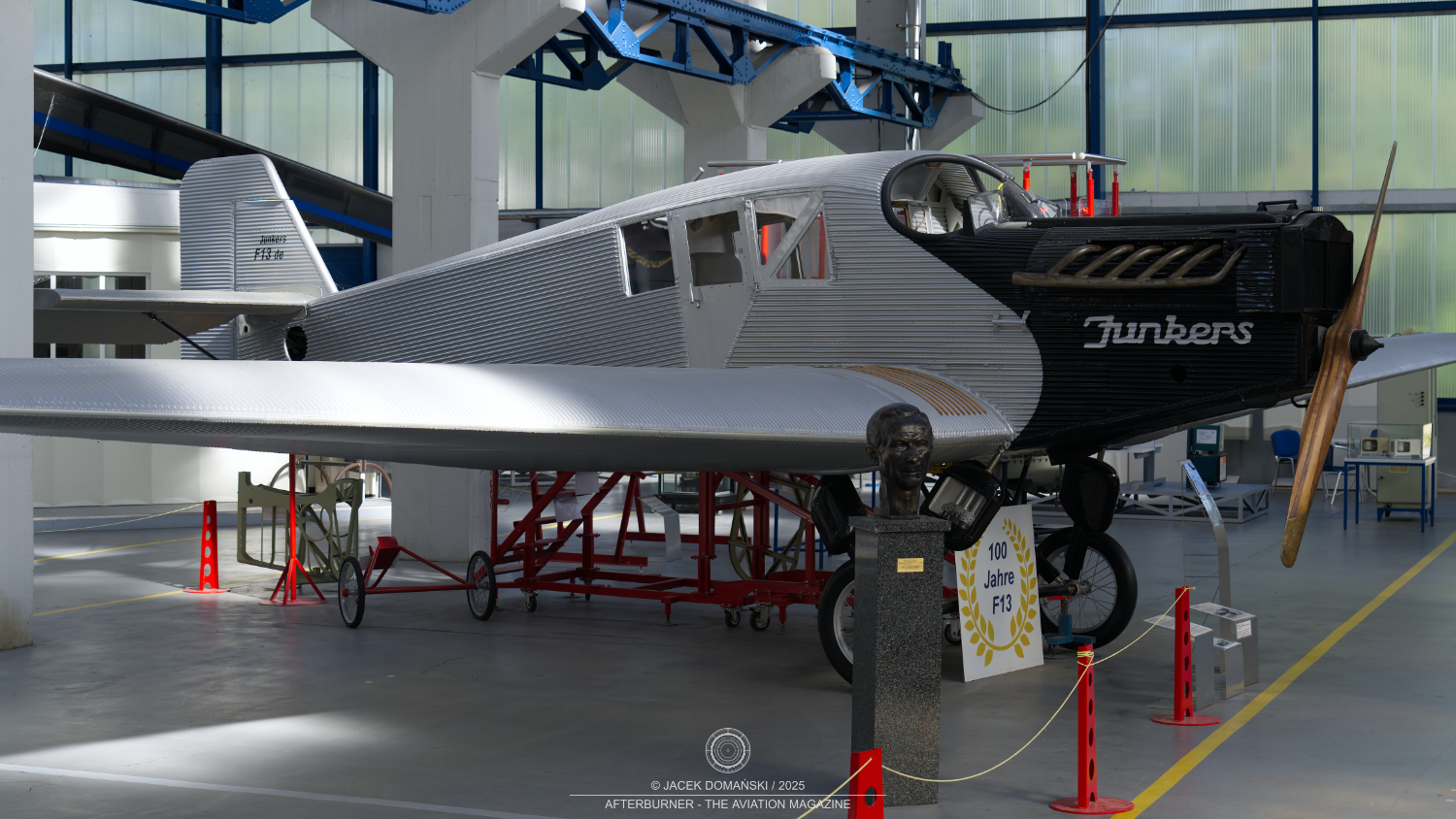
After the war, Junkers separated from Fokker and founded Junkers Flugzeugwerk AG. He went on to design the world’s first all-metal passenger aircraft, the Junkers F 13, which first flew on 25 June 1919. The F 13 was followed by the world’s first all-metal sports aircraft, the Junkers EF 13 (later known as the A 50), which made its maiden flight on 13 February 1929.
On 7 March 1932, the most famous Junkers aircraft, the three-engine Ju 52/3m, made its maiden flight. Developed from the earlier single-engine Ju 52/1m, which first flew on 13 October 1930, the Ju 52/3m soon became an icon of German civil and military aviation in the late 1930s.
The Nazi seizure of power marked the near end of Junkers’ business activities. Only three days after Adolf Hitler took control on the country, Junkers was ordered to transfer all remaining patent rights and both of his companies to the German state. After refusing, he was accused of espionage and placed under house arrest, while his companies were subjected to criminal investigations and state-organised repression.
In December 1933, Junkers was forced to assign his patents and fifty-one per cent of the company´s shares to the state and was dismissed as chairman of the supervisory board. Nevertheless, the pressure continued as Hermann Göring and Erhard Milch sought control of the remaining shares. Junkers remained under house arrest, forbidden to leave his home or receive visitors, and his health steadily deteriorated.
Hugo Junkers died on 3 February 1935, on the day of his seventy-sixth birthday. His wife was subsequently compelled to sell the remaining shares for a fraction of their market value. After the war, Junkers’ son tried to regain control of the company through the German courts but without any success.
More information about Hugo Junkers, his aviation developments and legacy can be found in the following articles:
- 3 February – birth (1859) and death (1935) of Hugo Junkers
- Visionary engineer and aviation pioneer – the world of Hugo Junkers by Technikmuseum „Hugo Junkers“ Dessau
- Junkers J 1
- Junkers F 13
- Junkers A50ci ´Junior´
- Junkers Ju 52/3mte (CASA 325L)
- Junkers Ju 52/3m (CASA 325L)
Cover photo: Junkers F 13 (replica), Technikmuseum „Hugo Junkers“ Dessau