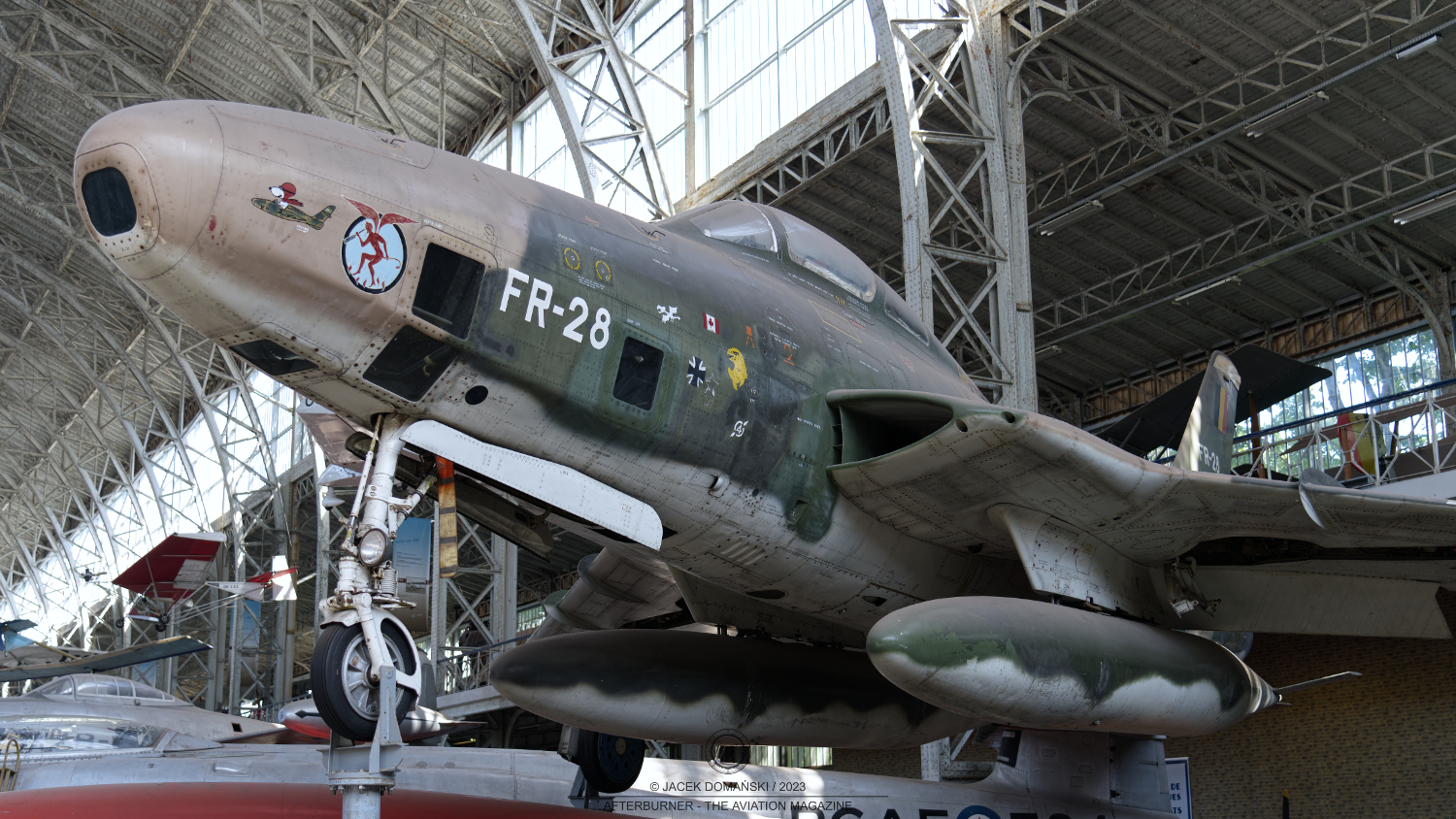
 Republic RF-84F Thunderflash (c/n unknown, formerly 51-1945 of the US Air National Guard and FR-28 of the Belgian Air Force), exhibited at the Royal Museum of the Armed Forces and Military History, Brussels, September 2023.
In 1948, the Republic company began developing a swept-wing version of its first-generation jet fighter, the F-84 Thunderjet. Far more than just another variant of the straight-wing F-84, the new design, known as the F-84F Thunderstreak, was intended as an answer to the North American F-86 Sabre – an aircraft that offered significantly better performance than the Thunderjet and gradually became the standard fighter of many NATO air forces.
The maiden flight of the F-84F took place in June 1950, and the aircraft was approved for serial production in the same year. However, the fighter became operational only four years later, in May 1954.
During the Thunderstreak development programme, two prototypes were built. The first YF-84F featured the standard nose air intake; however, the second example was equipped with wing-root air intakes. This solution proved less effective, as the aircraft experienced an unacceptable loss of thrust for a fighter jet. Consequently, the F-84F retained the nose air intake, although in a redesigned form.
Nevertheless, the second prototype attracted interest as a potential reconnaissance aircraft due to the possibility of installing cameras in the nose section. In February 1952, the first prototype of the reconnaissance variant was completed and officially designated the YRF-84F.
The aircraft could be equipped with up to fifteen cameras. Their operation was supported by a central computer that automatically adjusted them to changing light, speed and altitude conditions. In addition to this feature, the aeroplane was fitted with a pilot’s periscope offering a better view of the target and a voice recorder for live commentary. Although intended solely for reconnaissance missions, the jet was initially armed with four Browning machine guns.
As it was based on the F-84F fighter-bomber, the reconnaissance variant was affected by the same issues as the original design. The new aircraft proved to be more complex to manufacture than expected and, as a result, the first production examples of the Thunderstreak were not completed until 1952. Furthermore, the initial aircraft suffered from several performance problems that had to be resolved, delaying the introduction of the new fighter by another two years.
In March 1954, the new reconnaissance aircraft – now known as the Republic RF-84F Thunderflash – finally entered operational service with the United States Air Force.
Although considered a successful design, the RF-84F had a relatively short service career with the USAF. The aircraft was withdrawn from front-line service as early as 1957 and transferred to Air National Guard units. There, the Thunderflash remained in active service until 1972.
Certainly, the problems affecting the basic fighter variant were not without significance. The F-84F retained many of the flying characteristics of its predecessor, the Thunderjet. These included poor take-off performance and a tendency towards accelerated stall pitch-up. Moreover, the Thunderstreak was also virtually impossible to recover from a spin.
As early as 1955, the USAF’s F-84F fleet was grounded due to engine problems. In 1962, the aircraft was grounded again because of corroding control rods. Finally, in 1971, stress corrosion led to the Thunderstreak’s retirement from service.
Nevertheless, the RF-84F became a popular reconnaissance aircraft among other NATO countries. The Thunderflash was operated by Belgium, Denmark, France, West Germany, Greece, Italy, the Netherlands and Norway. It generally remained in active service until the mid-1970s, except in Greece, where the RF-84F stayed operational until the early 1980s. In addition, approximately twenty-five Thunderflash aircraft served with the Republic of China Air Force (Taiwan).
Belgium acquired twenty-four Thunderflash aircraft through the Mutual Defence Assistance Program. The aircraft were delivered between 1955 and 1958 and operated by No. 42 Squadron. In 1963, six additional RF-84Fs were purchased from the US Air National Guard and, two years later, a further four aircraft were acquired from Germany.
The Belgian RF-84Fs remained in active service until 1971, when they were replaced by Mirage fighters. The FR-28 aircraft featured in our Photo of the Week series is one of the preserved examples. The aeroplane is displayed at the Royal Museum of the Armed Forces and Military History in Brussels and represents one of the former ANG aircraft purchased in 1963.
The aircraft is displayed in the final camouflage scheme of the RF-84F, featuring a Vietnam-style green and brown pattern. Initially, the Belgian Thunderflash fleet was operated without camouflage, finished in natural metal with a silver appearance and marked with H8 serial codes. Later, the aircraft received a single-colour camouflage scheme and the codes were changed to FR serial numbers. The final camouflage pattern was adopted in 1968.