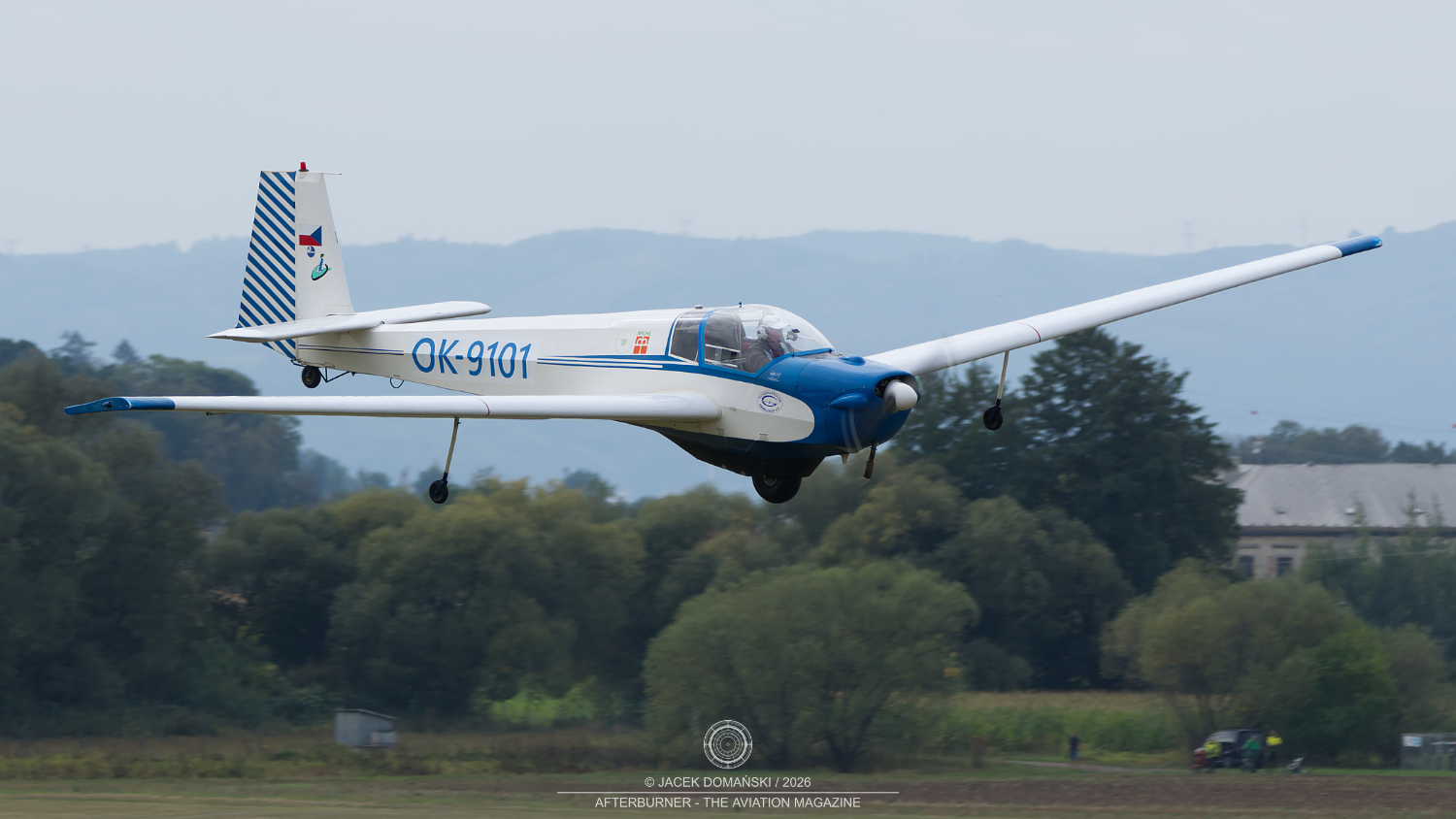
 Scheibe SF 25C Falke (c/n 4457, OK-9101), flying display during the air show held at the 80th anniversary of Aeroklub Šumperk, Šumperk, September 2026.
The SF 25 Falke (Falcon) was a further step in the development of self-powered gliders designed by the German aviation engineer and aircraft designer Egon Scheibe. The sailplane was based on two of his previous motorised designs, the Mü 13 “Merlin” and the SF 24 Motorspatz (Motor Sparrow), and took off on its maiden flight in May 1963.
While designing the SF 25, Scheibe used several components from his earlier developments, not only the two aforementioned powered sailplanes but also classic gliders such as the Bergfalke II (Mountain Hawk) and the Specht (Woodpecker). His aim was to create an affordable and easy-to-fly, self-launching powered glider for aeroclubs to reduce training costs.
The new glider featured a steel-tube framework fuselage covered with fabric, shoulder-mounted plywood wings and a two-seat enclosed cockpit in a side-by-side configuration. Initially designated the SF 25A Motor Falke, the first version of the aircraft was powered by a 26 hp Hirth F10A2a four-cylinder, two-stroke engine.
Serial production of the new Scheibe design was launched as early as 1963. However, the shoulder-mounted wings resulted in poor manoeuvrability in flight, the glider was heavy on the controls and, in addition, another person was required to hold the wing during take-off. Moreover, the noise of the two-stroke engine was annoying even by the standards of the day. The SF 25A was built in only 56 examples and, within a short time, earned the nickname Motorkuh – a powered cow.
A significant change came with the next variant of the glider, introduced in 1967. Designated the SF 25B Falke, the redeveloped aircraft featured new, low-mounted wings, easier access to the cockpit, a variable-pitch propeller and a modernised undercarriage with small support wheels under the wings. In addition, the SF 25B was powered by VW-based Stamo aircraft engines. A total of 373 examples of the B-series Falke motor glider were built, helping the SF 25 eventually achieve the popularity that Scheibe had envisaged for it in Europe.
In the mid-1970s, the Falke glider underwent another modernisation. Known as the SF 25C, this version of the aircraft was equipped with a modified fuselage, a new canopy, redesigned control sticks and mass-balanced ailerons. In addition, the landing gear was available in three configurations: central-wheel, two-wheel and tricycle variants. Originally, the C series was powered by a 60 hp Limbach SL-1700-EA engine. However, later variants were also equipped with the 80 hp Limbach L 2000 EA and, subsequently, with either a Rotax 912A or 912S engine, producing 80 hp and 100 hp, respectively.
Next versions of the Falke motor glider included the SF 25D, powered by a 67 hp Limbach L 1700A engine, the SF 25E Super Falke with extended wings and a new vertical tail, as well as the SF 25K, with folding wings and a larger canopy.
Interestingly, in 1997, the French company Loravia developed an independent modification of the glider, named the SFL 25R. Powered by an 87 hp Limbach L-2400 engine, this Falke was certified to tow gliders.
There was also the SF 28 Tandem-Falke, developed by Scheibe and based on the Bergfalke IV glider. This aircraft was equipped with a two-seat cockpit in a tandem configuration.
Depending on the source, between 1,200–1,500 examples of the SF 25 Falke were built until 2006. The C series became the most popular one, with 685 examples built in total. In addition to Scheibe Flugzeugbau GmbH, the SF 25 gliders were manufactured under licence by Sportavia-Pützer, Aeronautica Umbra and Slingsby.