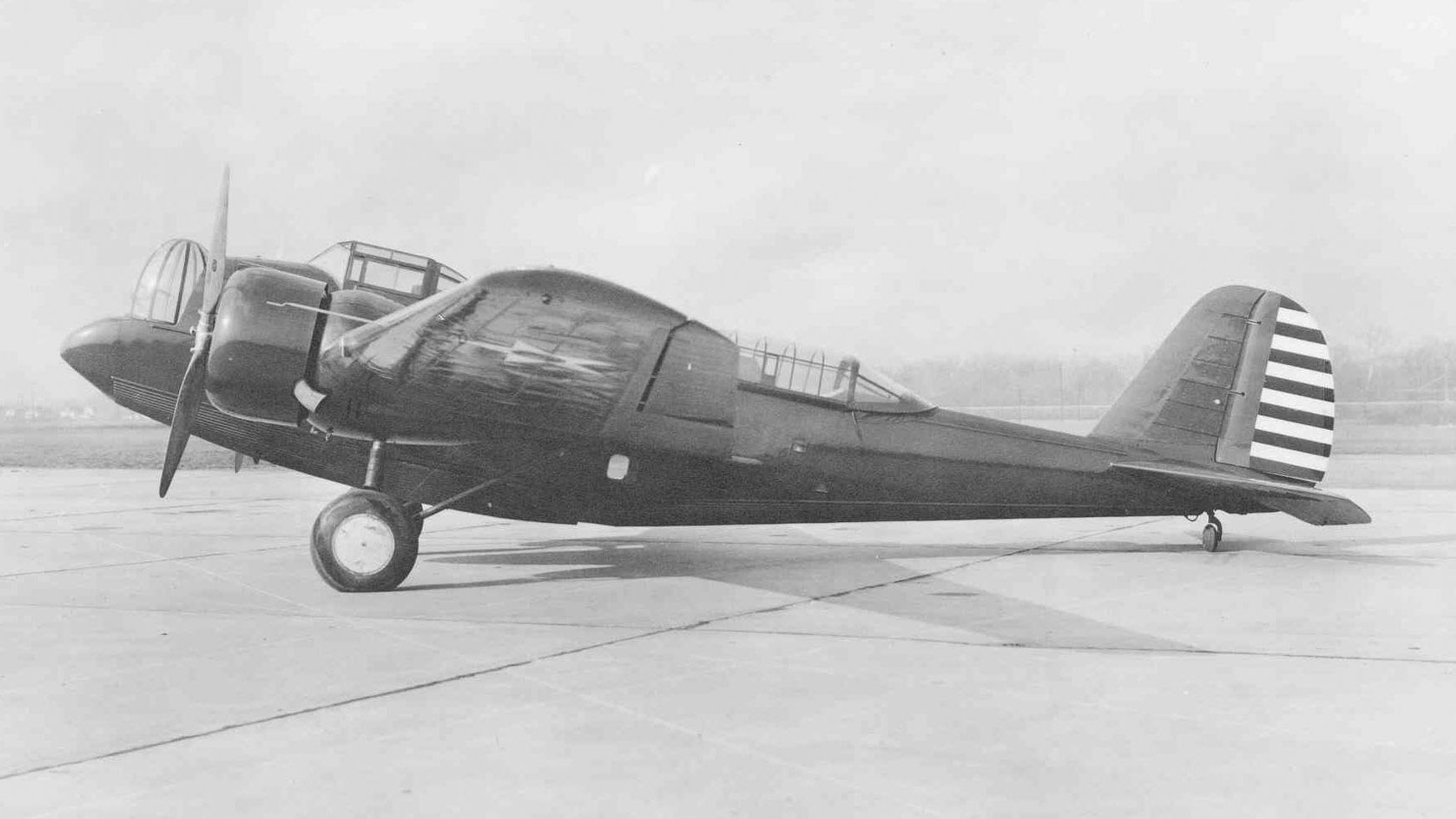
 On 27 November 1933, the United States Army Air Corps (USAAC) acquired the first example of its new aircraft, the Martin YB-10 (later known as the B-10). The aeroplane changed the way future bomber aircraft were designed and used, ultimately leading to the creation of the medium-bomber class.
The B-10 story began in the early 1930s, with the development of the Martin Model 123. It was a bomber aircraft built by the Glenn L. Martin Company as a private venture, featuring groundbreaking construction and design features for its era.
The Model 123 was a mid-wing, all-metal monoplane powered by two 600 hp Wright SR-1820-E Cyclone engines. Its fuselage was designed with a deep belly incorporating an internal bomb bay, and the aircraft was equipped with retractable main landing gear. The bomber was operated by a crew of four, with three open cockpits on top of the fuselage – for the pilot, the nose gunner, who also served as a bombardier, and the rear gunner. The co-pilot, who assisted with flight operations and engine management, was seated inside the fuselage.
On 16 February 1932, the Model 123 successfully performed its first flight. The aircraft was then transferred to Wright Field for USAAC trials. During testing, the bomber achieved a maximum speed of 317 kph (197 mph) and an altitude of 1,828 metres (6,000 ft).
In mid-1932, the aircraft was returned to the manufacturer, together with a list of suggested modifications. These included fitting the aircraft with more powerful R-1820-19 Cyclone engines, each generating 675 hp, increasing the wingspan and equipping the bomber with a nose gun turret.
In October of that year, the upgraded bomber was tested again by the US Army. This time, the aircraft achieved a top speed of 333 kph (207 mph). Shortly afterwards, the Glenn L. Martin Company was awarded the Collier Trophy for the Model 123 design.
At the beginning of the following year, the USAAC purchased the test aircraft, which was renamed the XB-10. In addition, an order for forty-eight production bombers was placed, designated by the company as the Model 139.
The Martin Model 123 was not only a revolutionary design but also set a new direction in bomber aircraft development. It rendered all existing bombers – usually large but slow, fabric-covered biplanes dating back to the First World War – immediately obsolete, while also outclassing most of the fighter aircraft in service at the time.
A prime example was the Polish PZL P.7a fighter, which entered service at roughly the same time. Considered by many to be the best fighter aeroplane of its day, this all-metal monoplane fighter was powered by a 485 hp Jupiter radial engine and had a top speed of 317 kph (197 mph).
The core of the Royal Air Force’s fighter force consisted of Bristol Bulldog and Hawker Fury biplanes. The former had a maximum speed of 286 kph (178 mph), while the latter was the first RAF fighter to exceed 320 kph (200 mph) in level flight. Meanwhile, USAAF fighter squadrons were equipped with Curtiss P-6 Hawk biplanes, which had a maximum speed of 266 kph (165 mph).
Although unintentionally, the Martin bomber became the first embodiment of the future air warfare vision popularised by Giulio Douhet, an Italian general and air power theorist. In 1921, Douhet published his principal work, Il dominio dell’aria (The Command of the Air), in which he argued that future air warfare would be dominated entirely by fast and powerful bomber aircraft.
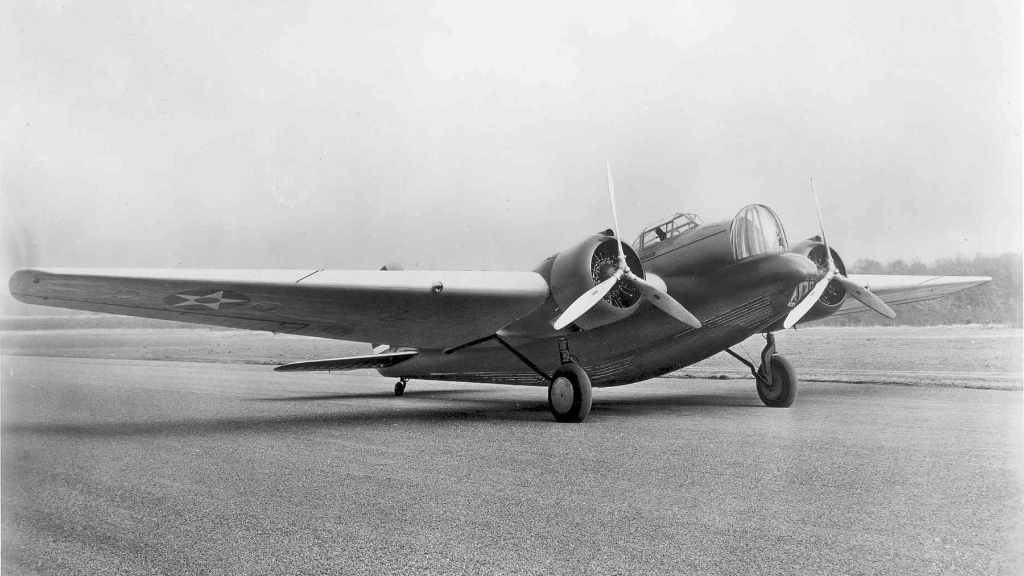
On 27 November 1933, the USAAC received its first Model 139 aircraft. The bomber, serial number 33-140, was part of the first production batch, intended for testing and designated the YB-10. These aircraft differed from the prototype in having enclosed canopies for the pilot and rear gunner, as well as an additional radio operator in the crew.
In total, 348 Martin B-10 bombers were built. The most numerous version was the B-10B, with 105 aircraft produced. They were powered by two 775 hp R-1820-33 engines and achieved a top speed of 343 kph (213 mph). The B-10B were able to carry up to 1,025 kg (2,260 lb) of bombs, had a maximum range of 2,000 km (1,240 miles) and was armed with three 7.62 mm Browning machine guns for self-defence.
In 1936, the B-10 was approved for export and purchased by China, the Netherlands (for the Royal Netherlands East Indies Army Air Force), Siam (renamed Thailand in 1938) and Turkey. Martin bombers saw operational service during the Second Sino-Japanese War, the Malayan campaign of the Second World War and the Franco-Thai War.
The Martin B-10 marked a major milestone in the history of aviation, breaking away from the large but slow biplane bomber designs of the previous era. At the time of its introduction, it was one of the fastest combat aircraft in the world, with performance surpassing that of contemporary fighter aeroplanes, which were often referred to as “pursuit” aircraft.
The B-10 helped to establish the medium-bomber class, which became widely represented during the Second World War and the early years of the Cold War. This category included such iconic aircraft as the North American B-25 Mitchell, Mitsubishi G4M “Betty”, Heinkel He 111, English Electric Canberra and Ilyushin Il-28.
Moreover, the exceptional performance of the Martin bomber, combined with the aforementioned Douhet´s theories, contributed to the emergence of the Schnellbomber concept (German for “fast bomber”) – an extremely fast bomber aircraft with minimal defensive armament and a cruising speed high enough to evade enemy fighters. Although the concept originated in Germany, with the Dornier Do 17 becoming its first representative, it quickly attracted interest in other countries and paved the way for the development of the Mitsubishi G3M in Japan and the PZL.37 Łoś (Moose) in Poland.
However, advances in fighter aircraft soon undermined the Schnellbomber concept. By the mid-1930s, a new generation of fighters had emerged, represented by all-metal, low-wing monoplanes. Powered by modern aviation engines generating 1,000 hp or more, these aircraft could fly faster than any bomber. As a result, bombers increasingly required fighter escort to carry out their missions.
The rapid pace of aviation development also meant that the B-10 soon became obsolete. By the end of the decade, all Martin bombers had been withdrawn from combat service and reassigned to secondary duties, such as target towing.
Although the Glenn L. Martin Company developed a modernised version of the aircraft, known as the Model 146, it failed to achieve the same success as the B-10. The aeroplane competed in the 1935 USAAF contest for a new long-range bomber but lost to the Douglas B-18 Bolo.
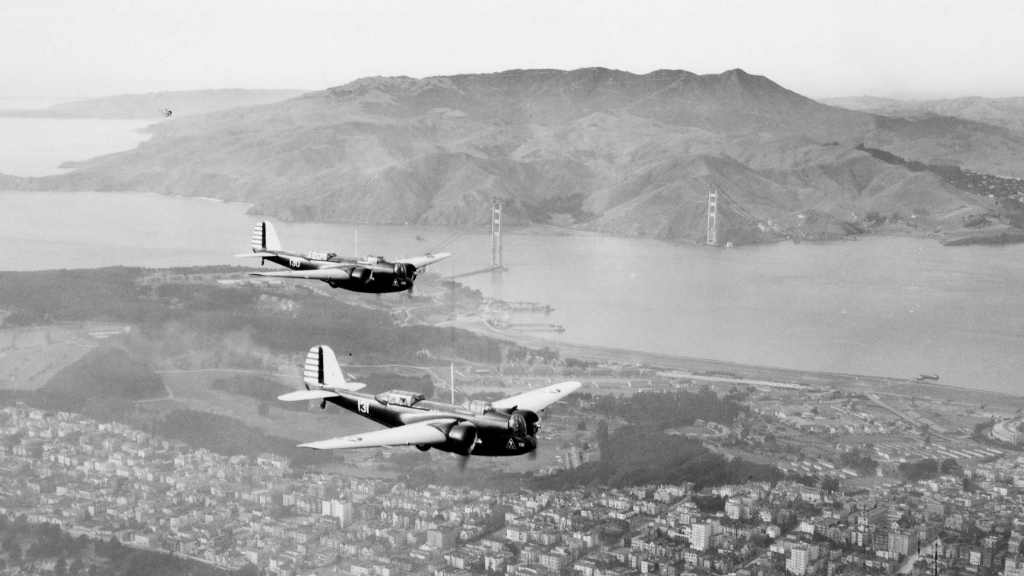
Cover photo: Martin YB-10 (US Air Force photo, 060511-F-1234S-008, Public Domain)