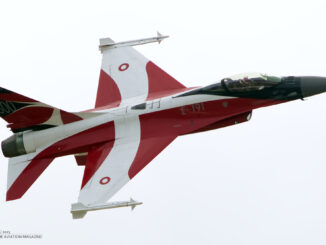
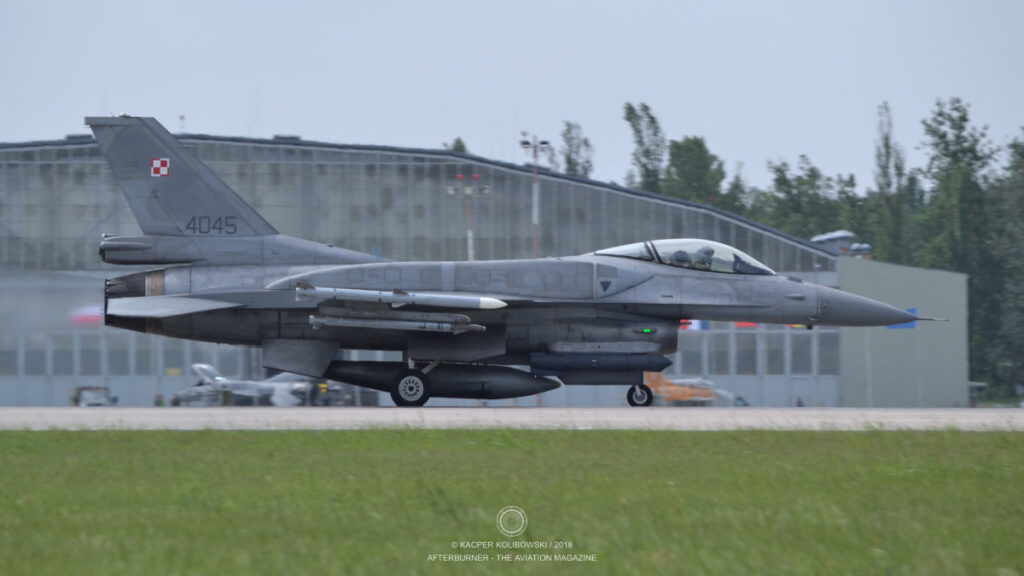
 In 2026, Siły Powietrzne (the Polish Air Force) celebrate twenty years of operating F-16 fighter jets. By choosing these aircraft, Poland has not only strengthened its own air force, but also bolstered NATO’s air power, enhancing its ability to deter threats and defend allied territory, particularly on the eastern flank.
Poland decided to acquire forty-eight F-16 Block 52+ aircraft in 2003. The purchase was made as part of the “Peace Sky” programme, which brought Poland’s fighter forces into line with NATO’s training, tactical and operational standards. Soon afterwards, the first Polish F-16 pilots and ground crew personnel underwent initial training in the US with the 162nd Fighter Wing of the United States National Guard. Meanwhile, the Polish Air Force bases in Krzesiny and Łask were modernised to accommodate the new aircraft and to support future allied operations.
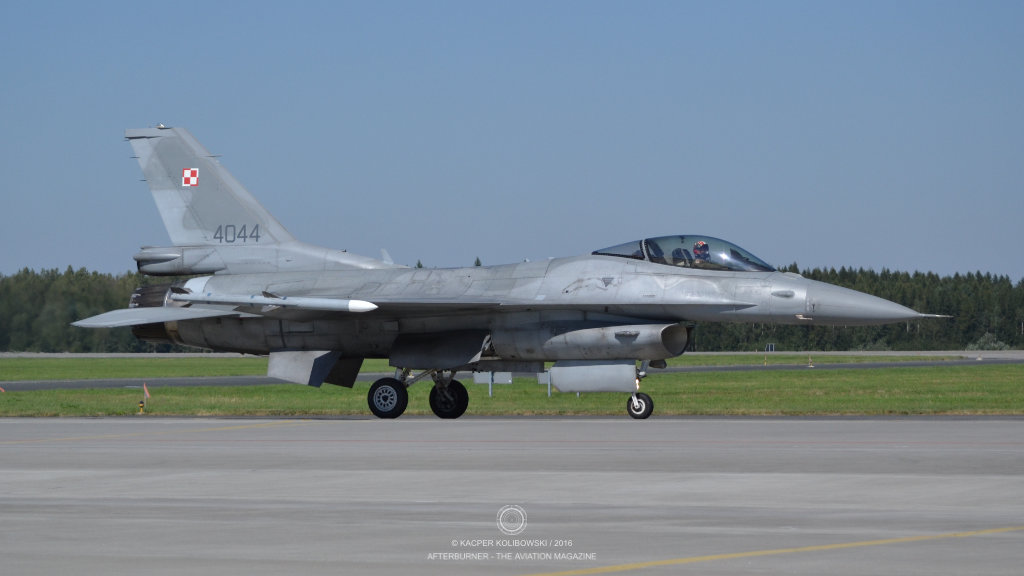
The first two F-16C Block 52+ aeroplanes, with tail numbers 4043 and 4044, arrived at 31. Baza Lotnictwa Taktycznego (the 31st Tactical Air Base) in Poznań-Krzesiny on 8 November 2006, flown by US pilots. The following day, the aircraft received a ceremonial welcome. The last of the ordered F-16s were delivered to Poland in 2008.
By 2010, the new Polish fighter jets had taken on Quick Reaction Alert (QRA) duties, protecting Polish airspace. Domestic maintenance capabilities for the F-16 fleet were enhanced through the expansion of Wojskowe Zakłady Lotnicze nr 2 (the Military Aviation Works No. 2) in Bydgoszcz, while Polskie Zakłady Lotnicze Mielec (PZL Mielec — the Polish Aviation Works in Mielec) supported the broader industrial base of the F-16 programme by manufacturing key structural components of the fuselage for Block 70/72 aircraft.
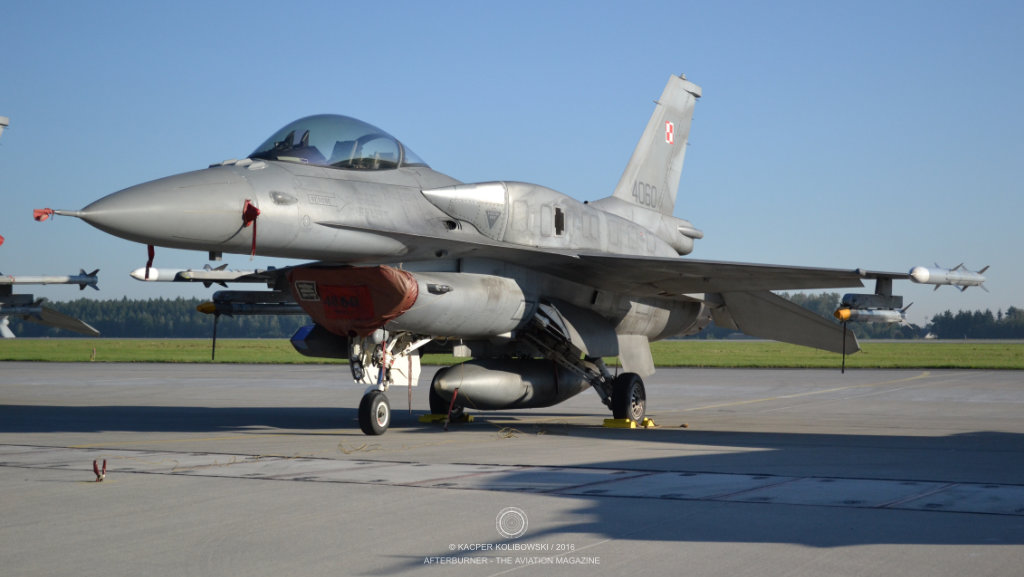
The Polish F-16s have also been employed in NATO operations under the supervision of the Allied Air Command (AIRCOM), which is responsible for the defence of NATO airspace through its Combined Air Operations Centres (CAOCs). Air Policing contributes to a comprehensive air defence strategy, as demonstrated by the enhanced Vigilance Activity (eVA) and the Eastern Sentry initiative, launched in September 2025 in response to the escalation in NATO airspace violations by Russian unmanned aerial vehicles and aeroplanes. These measures serve to strengthen deterrence and defence capabilities along the eastern flank of NATO.
The F-16s from allied countries have repeatedly participated in recent Eastern Sentry activities, including Command-And-Control and Counter-Anti-Access/Area-Denial (C-A2/AD) training missions stretching across NATO’s eastern flank. They have also taken part in Find, Fix, Track and Target (F2T2) training led by the AIRCOM, aimed at improving multi-domain coordination. In October 2025, Romania announced that its Escadrila 48 Vânătoare (the 48th Fighter Squadron) would begin NATO-led air policing missions in its national airspace, describing the certification as a step demonstrating interoperability and adding modern defensive capability to NATO’s air defence system.
In 2025, Ministerstwo Obrony Narodowej (the Polish Ministry of Defence) signed a Letter of Offer and Acceptance with the US government for the modernisation of the Polish F-16 Block 52+ fleet to the F-16V (also known as the Viper) standard. The modernisation work is due to begin in 2028, with an expected completion date of 2038.
“Poland’s decision two decades ago to field the F-16 reshaped its airpower and strengthened NATO’s collective defense,” said Mike Shoemaker, vice president and general manager of the Integrated Fighter Group at Lockheed Martin. “With the F-16 Viper upgrade, Poland is fielding new advanced capabilities grounded in real-world operations, integrated across NATO and scaled to deliver credible deterrence in increasingly complex and contested environments.”
Press materials of the Allied Air Command Public Affairs Office were used.